 Add to Chrome
 Add to Firefox
 Add to Edge
An Invariant Compiler for Neural ODEs in AI-Accelerated Scientific Simulation
Mar 25, 2026
Neural ODEs are increasingly used as continuous-time models for scientific and sensor data, but unconstrained neural ODEs can drift and violate domain invariants (e.g., conservation laws), yielding physically implausible solutions. In turn, this can compound error in long-horizon prediction and surrogate simulation. Existing solutions typically aim to enforce invariance by soft penalties or other forms of regularization, which can reduce overall error but do not guarantee that trajectories will not leave the constraint manifold. We introduce the invariant compiler, a framework that enforces invariants by construction: it treats invariants as first-class types and uses an LLM-driven compilation workflow to translate a generic neural ODE specification into a structure-preserving architecture whose trajectories remain on the admissible manifold in continuous time (and up to numerical integration error in practice). This compiler view cleanly separates what must be preserved (scientific structure) from what is learned from data (dynamics within that structure). It provides a systematic design pattern for invariant-respecting neural surrogates across scientific domains.

How (Not) to Hybridize Neural and Mechanistic Models for Epidemiological Forecasting
Feb 06, 2026Epidemiological forecasting from surveillance data is a hard problem and hybridizing mechanistic compartmental models with neural models is a natural direction. The mechanistic structure helps keep trajectories epidemiologically plausible, while neural components can capture non-stationary, data-adaptive effects. In practice, however, many seemingly straightforward couplings fail under partial observability and continually shifting transmission dynamics driven by behavior, waning immunity, seasonality, and interventions. We catalog these failure modes and show that robust performance requires making non-stationarity explicit: we extract multi-scale structure from the observed infection series and use it as an interpretable control signal for a controlled neural ODE coupled to an epidemiological model. Concretely, we decompose infections into trend, seasonal, and residual components and use these signals to drive continuous-time latent dynamics while jointly forecasting and inferring time-varying transmission, recovery, and immunity-loss rates. Across seasonal and non-seasonal settings, including early outbreaks and multi-wave regimes, our approach reduces long-horizon RMSE by 15-35%, improves peak timing error by 1-3 weeks, and lowers peak magnitude bias by up to 30% relative to strong time-series, neural ODE, and hybrid baselines, without relying on auxiliary covariates.
Learning a Formality-Aware Japanese Sentence Representation
Jan 17, 2023


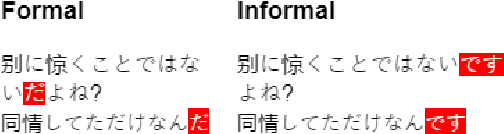
While the way intermediate representations are generated in encoder-decoder sequence-to-sequence models typically allow them to preserve the semantics of the input sentence, input features such as formality might be left out. On the other hand, downstream tasks such as translation would benefit from working with a sentence representation that preserves formality in addition to semantics, so as to generate sentences with the appropriate level of social formality -- the difference between speaking to a friend versus speaking with a supervisor. We propose a sequence-to-sequence method for learning a formality-aware representation for Japanese sentences, where sentence generation is conditioned on both the original representation of the input sentence, and a side constraint which guides the sentence representation towards preserving formality information. Additionally, we propose augmenting the sentence representation with a learned representation of formality which facilitates the extraction of formality in downstream tasks. We address the lack of formality-annotated parallel data by adapting previous works on procedural formality classification of Japanese sentences. Experimental results suggest that our techniques not only helps the decoder recover the formality of the input sentence, but also slightly improves the preservation of input sentence semantics.