 Add to Chrome
 Add to Firefox
 Add to Edge
Stochastic CHAOS: Why Deterministic Inference Kills, and Distributional Variability Is the Heartbeat of Artifical Cognition
Jan 12, 2026
Deterministic inference is a comforting ideal in classical software: the same program on the same input should always produce the same output. As large language models move into real-world deployment, this ideal has been imported wholesale into inference stacks. Recent work from the Thinking Machines Lab has presented a detailed analysis of nondeterminism in LLM inference, showing how batch-invariant kernels and deterministic attention can enforce bitwise-identical outputs, positioning deterministic inference as a prerequisite for reproducibility and enterprise reliability. In this paper, we take the opposite stance. We argue that, for LLMs, deterministic inference kills. It kills the ability to model uncertainty, suppresses emergent abilities, collapses reasoning into a single brittle path, and weakens safety alignment by hiding tail risks. LLMs implement conditional distributions over outputs, not fixed functions. Collapsing these distributions to a single canonical completion may appear reassuring, but it systematically conceals properties central to artificial cognition. We instead advocate Stochastic CHAOS, treating distributional variability as a signal to be measured and controlled. Empirically, we show that deterministic inference is systematically misleading. Single-sample deterministic evaluation underestimates both capability and fragility, masking failure probability under paraphrases and noise. Phase-like transitions associated with emergent abilities disappear under greedy decoding. Multi-path reasoning degrades when forced onto deterministic backbones, reducing accuracy and diagnostic insight. Finally, deterministic evaluation underestimates safety risk by hiding rare but dangerous behaviors that appear only under multi-sample evaluation.

GRIT -- Geometry-Aware PEFT with K-FACPreconditioning, Fisher-Guided Reprojection, andDynamic Rank Adaptation
Jan 01, 2026Parameter-efficient fine-tuning (PEFT) is the default way to adapt LLMs, but widely used LoRA and QLoRA are largely geometry-agnostic: they optimize in fixed, randomly oriented low-rank subspaces with first-order descent, mostly ignoring local loss curvature. This can inflate the effective update budget and amplify drift along weakly constrained directions. We introduce GRIT, a dynamic, curvature-aware LoRA procedure that preserves the LoRA parameterization but: (1) preconditions gradients in rank space using K-FAC as a natural-gradient proxy; (2) periodically reprojects the low-rank basis onto dominant Fisher eigendirections to suppress drift; and (3) adapts the effective rank from the spectrum so capacity concentrates where signal resides. Across instruction-following, comprehension, and reasoning benchmarks on LLaMA backbones, GRIT matches or surpasses LoRA and QLoRA while reducing trainable parameters by 46% on average (25--80% across tasks), without practical quality loss across prompt styles and data mixes. To model forgetting, we fit a curvature-modulated power law. Empirically, GRIT yields lower drift and a better updates-vs-retention frontier than strong PEFT-optimizer baselines (Orthogonal-LoRA, IA3, DoRA, Eff-FT, Shampoo).
LOST: A Mental Health Dataset of Low Self-esteem in Reddit Posts
Jun 08, 2023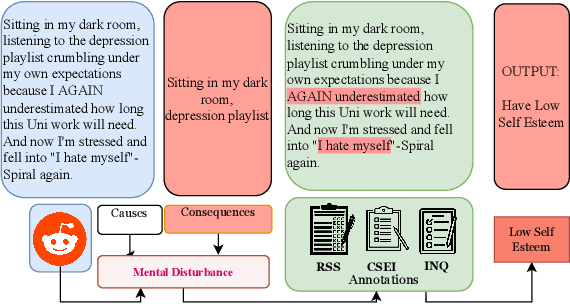
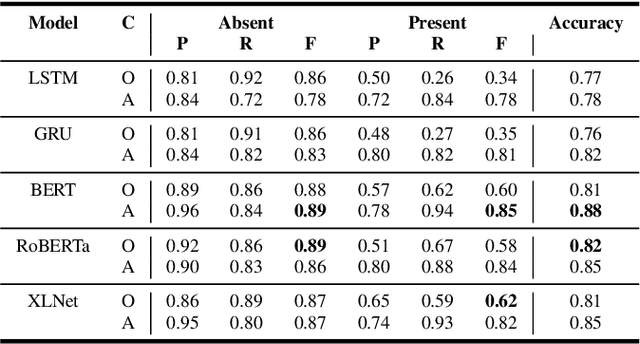
Low self-esteem and interpersonal needs (i.e., thwarted belongingness (TB) and perceived burdensomeness (PB)) have a major impact on depression and suicide attempts. Individuals seek social connectedness on social media to boost and alleviate their loneliness. Social media platforms allow people to express their thoughts, experiences, beliefs, and emotions. Prior studies on mental health from social media have focused on symptoms, causes, and disorders. Whereas an initial screening of social media content for interpersonal risk factors and low self-esteem may raise early alerts and assign therapists to at-risk users of mental disturbance. Standardized scales measure self-esteem and interpersonal needs from questions created using psychological theories. In the current research, we introduce a psychology-grounded and expertly annotated dataset, LoST: Low Self esTeem, to study and detect low self-esteem on Reddit. Through an annotation approach involving checks on coherence, correctness, consistency, and reliability, we ensure gold-standard for supervised learning. We present results from different deep language models tested using two data augmentation techniques. Our findings suggest developing a class of language models that infuses psychological and clinical knowledge.
Demo Alleviate: Demonstrating Artificial Intelligence Enabled Virtual Assistance for Telehealth: The Mental Health Case
Mar 31, 2023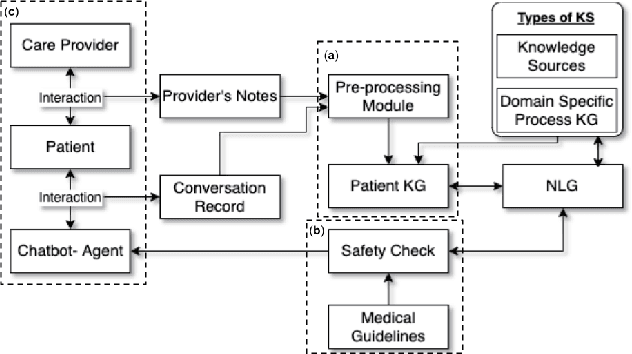

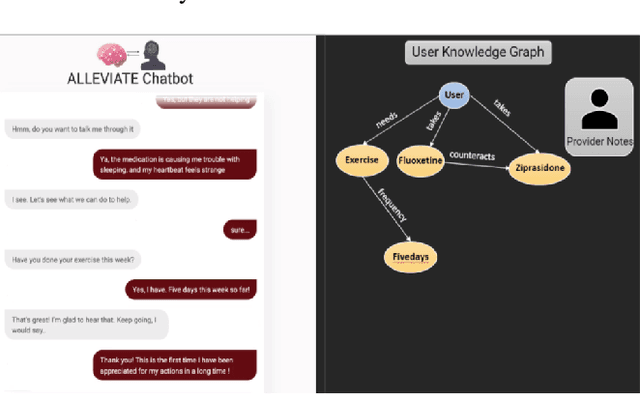
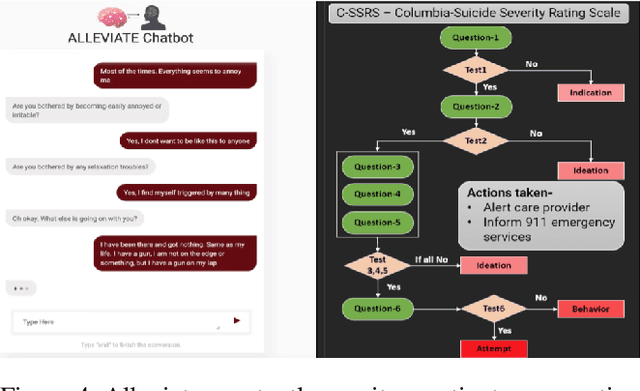
After the pandemic, artificial intelligence (AI) powered support for mental health care has become increasingly important. The breadth and complexity of significant challenges required to provide adequate care involve: (a) Personalized patient understanding, (b) Safety-constrained and medically validated chatbot patient interactions, and (c) Support for continued feedback-based refinements in design using chatbot-patient interactions. We propose Alleviate, a chatbot designed to assist patients suffering from mental health challenges with personalized care and assist clinicians with understanding their patients better. Alleviate draws from an array of publicly available clinically valid mental-health texts and databases, allowing Alleviate to make medically sound and informed decisions. In addition, Alleviate's modular design and explainable decision-making lends itself to robust and continued feedback-based refinements to its design. In this paper, we explain the different modules of Alleviate and submit a short video demonstrating Alleviate's capabilities to help patients and clinicians understand each other better to facilitate optimal care strategies.