 Add to Chrome
 Add to Firefox
 Add to Edge
Cross-Modal-Domain Generalization Through Semantically Aligned Discrete Representations
May 13, 2026
Multimodal learning seeks to integrate information across diverse sensory sources, yet current approaches struggle to balance cross-modal generalizability with modality-specific structure. Continuous (implicit) methods preserve fine-grained priors but render generalization challenging, while discrete (explicit) approaches enforce shared prototypes at the expense of modality specificity. We introduce CoDAAR (Cross-modal Discrete Alignment And Reconstruction), a novel framework that resolves this long-standing trade-off by establishing semantic consensus across modality-specific codebooks through index-level alignment. This design uniquely allows CoDAAR to preserve modality-unique structures while achieving generalizable cross-modal representations within a unified discrete space. CoDAAR combines two complementary mechanisms: Discrete Temporal Alignment (DTA), which enables fine-grained temporal quantization, and Cascading Semantic Alignment (CSA), which promotes progressive cross-modal semantic agreement. Together, they establish a competition-free unified representation space. Trained with self-supervised reconstruction objectives on paired multimodal sequences, CoDAAR demonstrates robust cross-modal and cross-domain generalization. Across Cross-Modal Generalization benchmarks, including event classification, localization, video segmentation, and cross-dataset transfer, CoDAAR achieves state-of-the-art performance, establishing a new paradigm for discrete and generalizable multimodal representation learning.

Sheaf Diffusion with Adaptive Local Structure for Spatio-Temporal Forecasting
Apr 13, 2026Spatio-temporal systems often exhibit highly heterogeneous and non-intuitive responses to localized disruptions, limiting the effectiveness of conventional message passing approaches in modeling higher-order interactions under local heterogeneity. This paper reformulates spatio-temporal forecasting as the problem of learning information flow over locally structured spaces, rather than propagating globally aligned node representations. We introduce a spatio-temporal sheaf diffusion graph neural network (ST-Sheaf GNN) that embeds graph topology into sheaf-theoretic vector spaces connected by learned linear restriction maps. Unlike prior work that relies on static or globally shared transformations, our model learns dynamic restriction maps that evolve over time and adapt to local spatio-temporal patterns to enable substantially more expressive interactions. By explicitly modeling latent local structure, the proposed framework efficiently mitigates the oversmoothing phenomenon in deep GNN architectures. We evaluate our framework on a diverse set of real-world spatio-temporal forecasting benchmarks spanning multiple domains. Experimental results demonstrate state-of-the-art performance, highlighting the effectiveness of sheaf-theoretic topological representations as a powerful foundation for spatio-temporal graph learning. The code is available at: https://anonymous.4open.science/r/ST-SheafGNN-6523/.
From Literature to Hypotheses: An AI Co-Scientist System for Biomarker-Guided Drug Combination Hypothesis Generation
Feb 28, 2026The rapid growth of biomedical literature and curated databases has made it increasingly difficult for researchers to systematically connect biomarker mechanisms to actionable drug combination hypotheses. We present AI Co-Scientist (CoDHy), an interactive, human-in-the-loop system for biomarker-guided drug combination hypothesis generation in cancer research. CoDHy integrates structured biomedical databases and unstructured literature evidence into a task-specific knowledge graph, which serves as the basis for graph-based reasoning and hypothesis construction. The system combines knowledge graph embeddings with agent-based reasoning to generate, validate, and rank candidate drug combinations, while explicitly grounding each hypothesis in retrievable evidence. Through a web-based interface, users can configure the scientific context, inspect intermediate results, and iteratively refine hypotheses, enabling transparent and researcher-steerable exploration rather than automated decision-making. We demonstrate CoDHy as a system for exploratory hypothesis generation and decision support in translational oncology, highlighting its design, interaction workflow, and practical use cases.
Orthogonalized Multimodal Contrastive Learning with Asymmetric Masking for Structured Representations
Feb 16, 2026Multimodal learning seeks to integrate information from heterogeneous sources, where signals may be shared across modalities, specific to individual modalities, or emerge only through their interaction. While self-supervised multimodal contrastive learning has achieved remarkable progress, most existing methods predominantly capture redundant cross-modal signals, often neglecting modality-specific (unique) and interaction-driven (synergistic) information. Recent extensions broaden this perspective, yet they either fail to explicitly model synergistic interactions or learn different information components in an entangled manner, leading to incomplete representations and potential information leakage. We introduce \textbf{COrAL}, a principled framework that explicitly and simultaneously preserves redundant, unique, and synergistic information within multimodal representations. COrAL employs a dual-path architecture with orthogonality constraints to disentangle shared and modality-specific features, ensuring a clean separation of information components. To promote synergy modeling, we introduce asymmetric masking with complementary view-specific patterns, compelling the model to infer cross-modal dependencies rather than rely solely on redundant cues. Extensive experiments on synthetic benchmarks and diverse MultiBench datasets demonstrate that COrAL consistently matches or outperforms state-of-the-art methods while exhibiting low performance variance across runs. These results indicate that explicitly modeling the full spectrum of multimodal information yields more stable, reliable, and comprehensive embeddings.
Learning from the Right Patches: A Two-Stage Wavelet-Driven Masked Autoencoder for Histopathology Representation Learning
Nov 19, 2025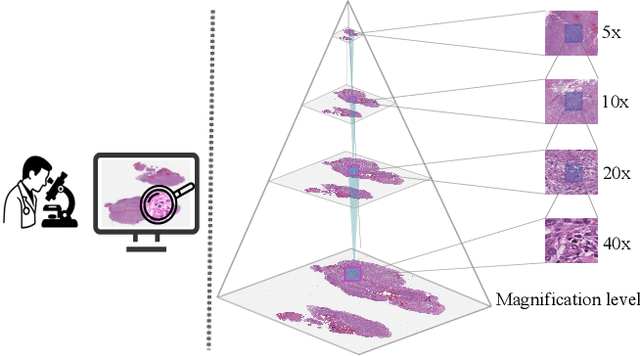
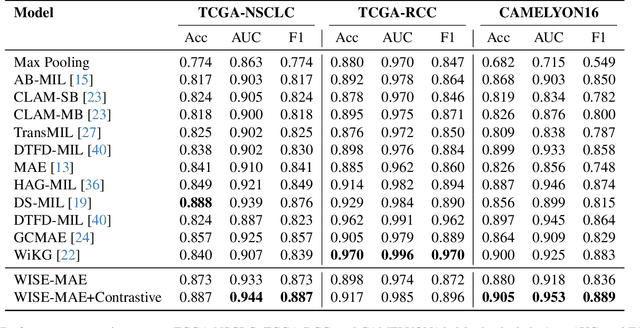
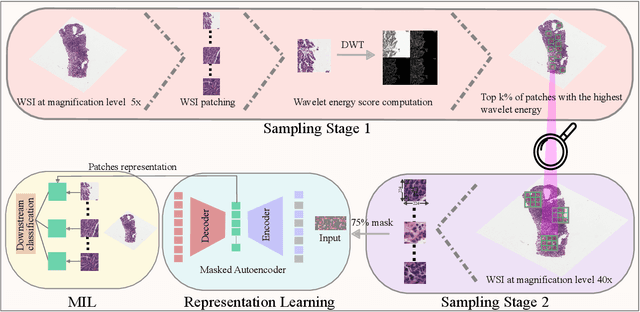
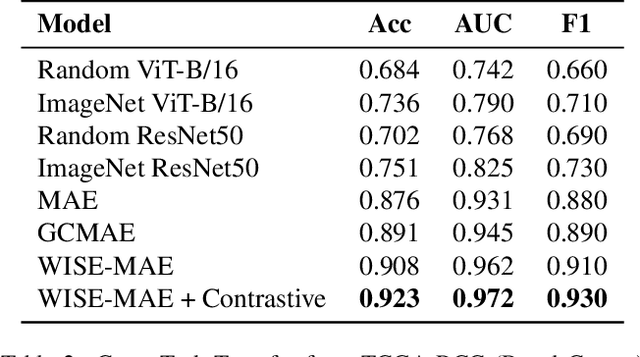
Whole-slide images are central to digital pathology, yet their extreme size and scarce annotations make self-supervised learning essential. Masked Autoencoders (MAEs) with Vision Transformer backbones have recently shown strong potential for histopathology representation learning. However, conventional random patch sampling during MAE pretraining often includes irrelevant or noisy regions, limiting the model's ability to capture meaningful tissue patterns. In this paper, we present a lightweight and domain-adapted framework that brings structure and biological relevance into MAE-based learning through a wavelet-informed patch selection strategy. WISE-MAE applies a two-step coarse-to-fine process: wavelet-based screening at low magnification to locate structurally rich regions, followed by high-resolution extraction for detailed modeling. This approach mirrors the diagnostic workflow of pathologists and improves the quality of learned representations. Evaluations across multiple cancer datasets, including lung, renal, and colorectal tissues, show that WISE-MAE achieves competitive representation quality and downstream classification performance while maintaining efficiency under weak supervision.
MTS2Graph: Interpretable Multivariate Time Series Classification with Temporal Evolving Graphs
Jun 06, 2023Conventional time series classification approaches based on bags of patterns or shapelets face significant challenges in dealing with a vast amount of feature candidates from high-dimensional multivariate data. In contrast, deep neural networks can learn low-dimensional features efficiently, and in particular, Convolutional Neural Networks (CNN) have shown promising results in classifying Multivariate Time Series (MTS) data. A key factor in the success of deep neural networks is this astonishing expressive power. However, this power comes at the cost of complex, black-boxed models, conflicting with the goals of building reliable and human-understandable models. An essential criterion in understanding such predictive deep models involves quantifying the contribution of time-varying input variables to the classification. Hence, in this work, we introduce a new framework for interpreting multivariate time series data by extracting and clustering the input representative patterns that highly activate CNN neurons. This way, we identify each signal's role and dependencies, considering all possible combinations of signals in the MTS input. Then, we construct a graph that captures the temporal relationship between the extracted patterns for each layer. An effective graph merging strategy finds the connection of each node to the previous layer's nodes. Finally, a graph embedding algorithm generates new representations of the created interpretable time-series features. To evaluate the performance of our proposed framework, we run extensive experiments on eight datasets of the UCR/UEA archive, along with HAR and PAM datasets. The experiments indicate the benefit of our time-aware graph-based representation in MTS classification while enriching them with more interpretability.