 Add to Chrome
 Add to Firefox
 Add to Edge
From Literature to Hypotheses: An AI Co-Scientist System for Biomarker-Guided Drug Combination Hypothesis Generation
Feb 28, 2026
The rapid growth of biomedical literature and curated databases has made it increasingly difficult for researchers to systematically connect biomarker mechanisms to actionable drug combination hypotheses. We present AI Co-Scientist (CoDHy), an interactive, human-in-the-loop system for biomarker-guided drug combination hypothesis generation in cancer research. CoDHy integrates structured biomedical databases and unstructured literature evidence into a task-specific knowledge graph, which serves as the basis for graph-based reasoning and hypothesis construction. The system combines knowledge graph embeddings with agent-based reasoning to generate, validate, and rank candidate drug combinations, while explicitly grounding each hypothesis in retrievable evidence. Through a web-based interface, users can configure the scientific context, inspect intermediate results, and iteratively refine hypotheses, enabling transparent and researcher-steerable exploration rather than automated decision-making. We demonstrate CoDHy as a system for exploratory hypothesis generation and decision support in translational oncology, highlighting its design, interaction workflow, and practical use cases.

Learning from the Right Patches: A Two-Stage Wavelet-Driven Masked Autoencoder for Histopathology Representation Learning
Nov 19, 2025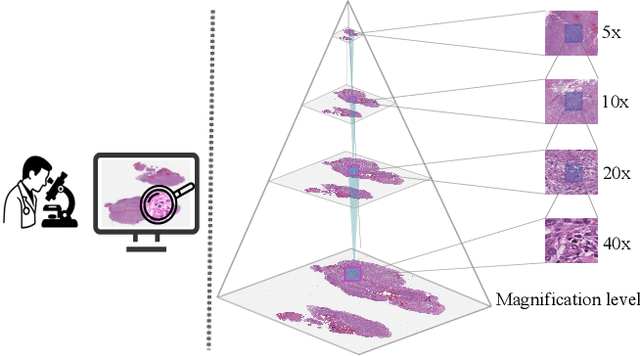
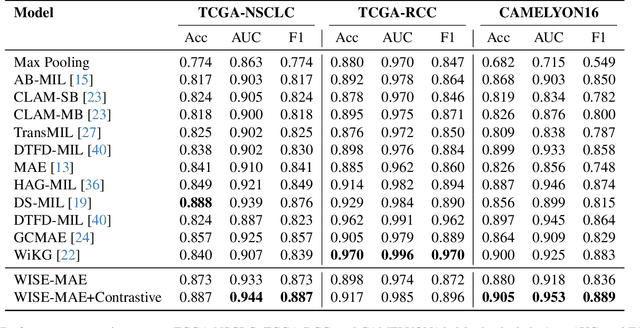
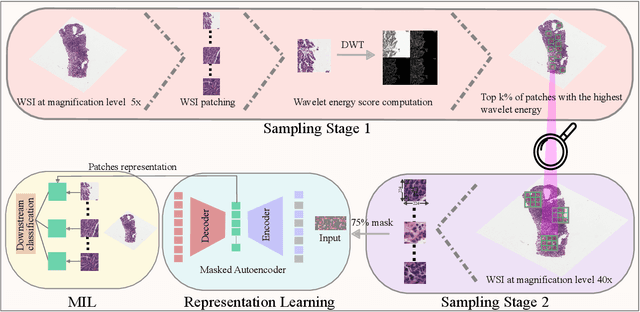
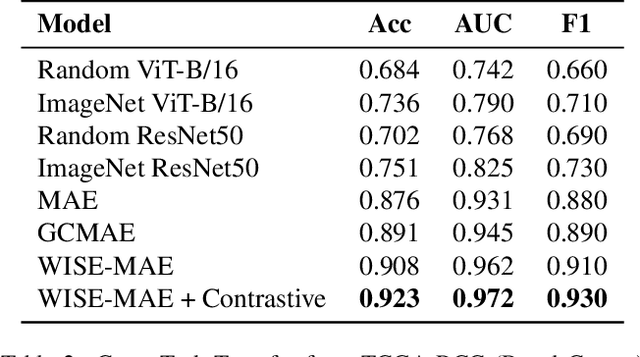
Whole-slide images are central to digital pathology, yet their extreme size and scarce annotations make self-supervised learning essential. Masked Autoencoders (MAEs) with Vision Transformer backbones have recently shown strong potential for histopathology representation learning. However, conventional random patch sampling during MAE pretraining often includes irrelevant or noisy regions, limiting the model's ability to capture meaningful tissue patterns. In this paper, we present a lightweight and domain-adapted framework that brings structure and biological relevance into MAE-based learning through a wavelet-informed patch selection strategy. WISE-MAE applies a two-step coarse-to-fine process: wavelet-based screening at low magnification to locate structurally rich regions, followed by high-resolution extraction for detailed modeling. This approach mirrors the diagnostic workflow of pathologists and improves the quality of learned representations. Evaluations across multiple cancer datasets, including lung, renal, and colorectal tissues, show that WISE-MAE achieves competitive representation quality and downstream classification performance while maintaining efficiency under weak supervision.