 Add to Chrome
 Add to Firefox
 Add to Edge
Learning Permutation from Structure Without Supervision
May 25, 2026
Many learning problems require uncovering a hidden ordering that reveals structure in unordered data, such as monotonicity in sorting or spatial continuity in jigsaw reconstruction. In these settings, permutations can be learned as latent operators by optimizing objectives defined directly on the reordered output, often without access to ground-truth orderings. Differentiable relaxations such as Gumbel-Sinkhorn make this approach practical by approximating permutation matrices with doubly stochastic matrices. However, learning from structure without supervision induces a non-uniform uncertainty: some assignments become confident early, while others remain ambiguous. Existing methods control this process using a single global temperature, forcing all assignments to sharpen or diffuse simultaneously and leading to instability at scale. We introduce an entropy-adaptive formulation of Gumbel-Sinkhorn that locally modulates temperature based on assignment uncertainty. This allows confident assignments to discretize early while preserving exploration where uncertainty remains. Across sorting and jigsaw reconstruction tasks and in routing-style settings, adaptive entropy control improves training stability and final permutation quality relative to fixed-temperature baselines, particularly as problem size and assignment ambiguity increase.

Conditional Deep Canonical Time Warping
Dec 24, 2024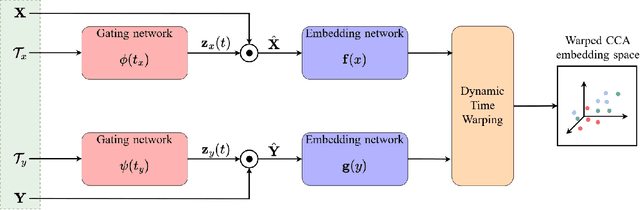
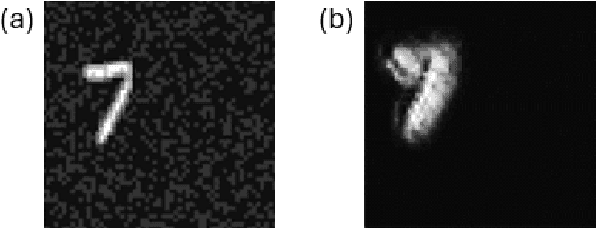
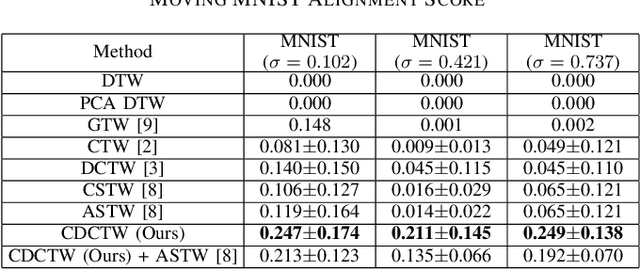
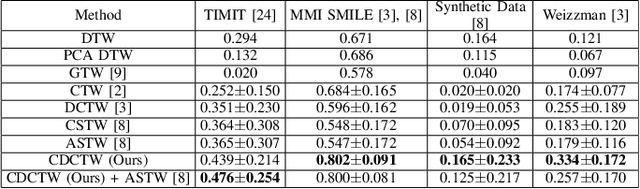
Temporal alignment of sequences is a fundamental challenge in many applications, such as computer vision and bioinformatics, where local time shifting needs to be accounted for. Misalignment can lead to poor model generalization, especially in high-dimensional sequences. Existing methods often struggle with optimization when dealing with high-dimensional sparse data, falling into poor alignments. Feature selection is frequently used to enhance model performance for sparse data. However, a fixed set of selected features would not generally work for dynamically changing sequences and would need to be modified based on the state of the sequence. Therefore, modifying the selected feature based on contextual input would result in better alignment. Our suggested method, Conditional Deep Canonical Temporal Time Warping (CDCTW), is designed for temporal alignment in sparse temporal data to address these challenges. CDCTW enhances alignment accuracy for high dimensional time-dependent views be performing dynamic time warping on data embedded in maximally correlated subspace which handles sparsity with novel feature selection method. We validate the effectiveness of CDCTW through extensive experiments on various datasets, demonstrating superior performance over previous techniques.
Self Supervised Correlation-based Permutations for Multi-View Clustering
Feb 26, 2024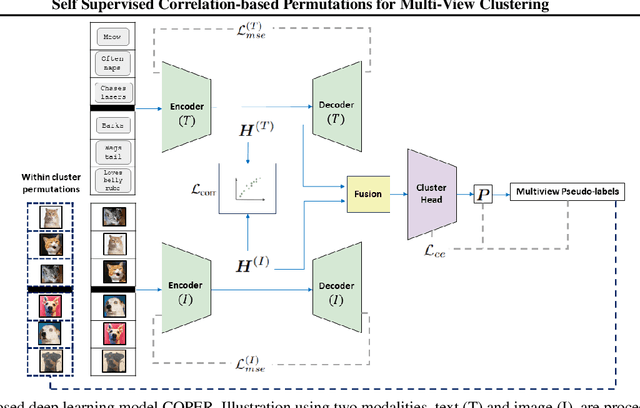


Fusing information from different modalities can enhance data analysis tasks, including clustering. However, existing multi-view clustering (MVC) solutions are limited to specific domains or rely on a suboptimal and computationally demanding two-stage procedure of representation and clustering. We propose an end-to-end deep learning-based MVC framework for general data (image, tabular, etc.). Our approach involves learning meaningful fused data representations with a novel permutation-based canonical correlation objective. Concurrently, we learn cluster assignments by identifying consistent pseudo-labels across multiple views. We demonstrate the effectiveness of our model using ten MVC benchmark datasets. Theoretically, we show that our model approximates the supervised linear discrimination analysis (LDA) representation. Additionally, we provide an error bound induced by false-pseudo label annotations.