 Add to Chrome
 Add to Firefox
 Add to Edge
Palmyra x6 Technical Report: An Agentic, Tool-Use Model Post-Trained via Anchored Supervised Fine-Tuning
Aug 18, 2026
Palmyra x6 is a large language model optimized for use with enterprise-oriented agentic tasks. The model was built by post-training a Mixture-of-Experts base model with Anchored Supervised Fine-Tuning on a compact corpus of verified, synthetic tool-use trajectories, optimized with a Muon + Adam hybrid. The recipe is deliberately conservative and deliberately controlled: 626 trajectories, a single epoch, a low learning rate, and a KL anchor to the frozen base. The model shows substantial gains over the previous default model for Writer Agent, and compares favorably with several recent models on public benchmarks, scoring the highest on BFCL Core at $0.785$ and posts the highest six-benchmark mean of the cohort. Furthermore, the model has shown itself to be competitive or leading relative to comparators in our bias and safety evaluations.

The Harness Effect: How Orchestration Design Sets the Token Economics of Enterprise Agentic AI
Jul 08, 2026Agentic AI development today runs on token maxing: buying capability with tokens -- longer reasoning traces, more turns, wider tool payloads, bigger replayed contexts -- so tokens per task grow faster than task value. Falling per-token prices mask the pattern; total spend rises anyway. We argue the decisive lever against token maxing is the harness: the orchestration layer that assembles context, exposes tools, sequences turns, delegates work, and carries enterprise observability and governance. We isolate it with a controlled swap: 22 locked evaluation tasks, six foundation models (Claude Sonnet 4.6, Gemini 3.1, Gemini Flash 3.5, Qwen 3.6, GLM 5.1, Palmyra X6), changing only the orchestration layer -- a frozen conventional production loop versus the Writer Agent Harness. Holding models constant, the harness cuts blended cost per task 41% ($0.21->$0.12), median wall-clock 44% (48s->27s), and tokens per task 38% (14.2k->8.8k), with task-completion quality at parity (0.78->0.81, directional at this sample size). Efficiency is model-invariant -- every model gets cheaper (33-61%) -- while quality gains are capability-dependent: a model's gain correlates almost perfectly with its baseline strength (r=0.99, n=6), a phenomenon we term harness leverage. Quality per dollar rises 82%; task-completions per million tokens rise from 54.9 to 92.0. On this workload the orchestration layer moved cost per task more than the full spread of the model menu did. We formalize token economics at the orchestration layer (including effective input price under prompt caching), detail the six mechanism families behind the effect -- cache-shape discipline to failure-spend governance -- compare six widely used agent systems on the same axes, and argue the harness is the one component whose efficiency multiplies across every model an organization runs -- present and future.
Accurate Failure Prediction in Agents Does Not Imply Effective Failure Prevention
Feb 03, 2026Proactive interventions by LLM critic models are often assumed to improve reliability, yet their effects at deployment time are poorly understood. We show that a binary LLM critic with strong offline accuracy (AUROC 0.94) can nevertheless cause severe performance degradation, inducing a 26 percentage point (pp) collapse on one model while affecting another by near zero pp. This variability demonstrates that LLM critic accuracy alone is insufficient to determine whether intervention is safe. We identify a disruption-recovery tradeoff: interventions may recover failing trajectories but also disrupt trajectories that would have succeeded. Based on this insight, we propose a pre-deployment test that uses a small pilot of 50 tasks to estimate whether intervention is likely to help or harm, without requiring full deployment. Across benchmarks, the test correctly anticipates outcomes: intervention degrades performance on high-success tasks (0 to -26 pp), while yielding a modest improvement on the high-failure ALFWorld benchmark (+2.8 pp, p=0.014). The primary value of our framework is therefore identifying when not to intervene, preventing severe regressions before deployment.
Benchmarking Neural Network Training Algorithms
Jun 12, 2023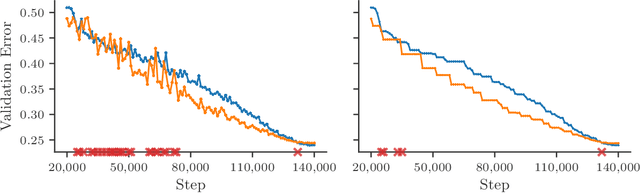
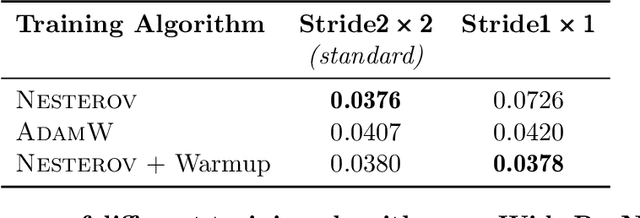
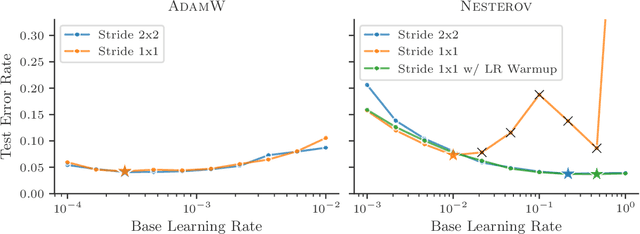
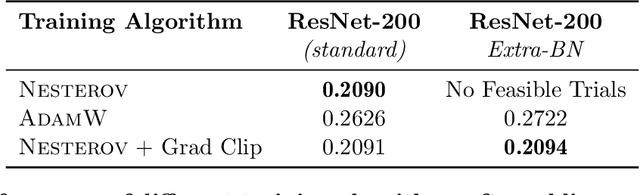
Training algorithms, broadly construed, are an essential part of every deep learning pipeline. Training algorithm improvements that speed up training across a wide variety of workloads (e.g., better update rules, tuning protocols, learning rate schedules, or data selection schemes) could save time, save computational resources, and lead to better, more accurate, models. Unfortunately, as a community, we are currently unable to reliably identify training algorithm improvements, or even determine the state-of-the-art training algorithm. In this work, using concrete experiments, we argue that real progress in speeding up training requires new benchmarks that resolve three basic challenges faced by empirical comparisons of training algorithms: (1) how to decide when training is complete and precisely measure training time, (2) how to handle the sensitivity of measurements to exact workload details, and (3) how to fairly compare algorithms that require hyperparameter tuning. In order to address these challenges, we introduce a new, competitive, time-to-result benchmark using multiple workloads running on fixed hardware, the AlgoPerf: Training Algorithms benchmark. Our benchmark includes a set of workload variants that make it possible to detect benchmark submissions that are more robust to workload changes than current widely-used methods. Finally, we evaluate baseline submissions constructed using various optimizers that represent current practice, as well as other optimizers that have recently received attention in the literature. These baseline results collectively demonstrate the feasibility of our benchmark, show that non-trivial gaps between methods exist, and set a provisional state-of-the-art for future benchmark submissions to try and surpass.