 Add to Chrome
 Add to Firefox
 Add to Edge
Domain-Specific Knowledge Graphs in RAG-Enhanced Healthcare LLMs
Jan 21, 2026
Large Language Models (LLMs) generate fluent answers but can struggle with trustworthy, domain-specific reasoning. We evaluate whether domain knowledge graphs (KGs) improve Retrieval-Augmented Generation (RAG) for healthcare by constructing three PubMed-derived graphs: $\mathbb{G}_1$ (T2DM), $\mathbb{G}_2$ (Alzheimer's disease), and $\mathbb{G}_3$ (AD+T2DM). We design two probes: Probe 1 targets merged AD T2DM knowledge, while Probe 2 targets the intersection of $\mathbb{G}_1$ and $\mathbb{G}_2$. Seven instruction-tuned LLMs are tested across retrieval sources {No-RAG, $\mathbb{G}_1$, $\mathbb{G}_2$, $\mathbb{G}_1$ + $\mathbb{G}_2$, $\mathbb{G}_3$, $\mathbb{G}_1$+$\mathbb{G}_2$ + $\mathbb{G}_3$} and three decoding temperatures. Results show that scope alignment between probe and KG is decisive: precise, scope-matched retrieval (notably $\mathbb{G}_2$) yields the most consistent gains, whereas indiscriminate graph unions often introduce distractors that reduce accuracy. Larger models frequently match or exceed KG-RAG with a No-RAG baseline on Probe 1, indicating strong parametric priors, whereas smaller/mid-sized models benefit more from well-scoped retrieval. Temperature plays a secondary role; higher values rarely help. We conclude that precision-first, scope-matched KG-RAG is preferable to breadth-first unions, and we outline practical guidelines for graph selection, model sizing, and retrieval/reranking. Code and Data available here - https://github.com/sydneyanuyah/RAGComparison

PROFUSEme: PROstate Cancer Biochemical Recurrence Prediction via FUSEd Multi-modal Embeddings
Sep 17, 2025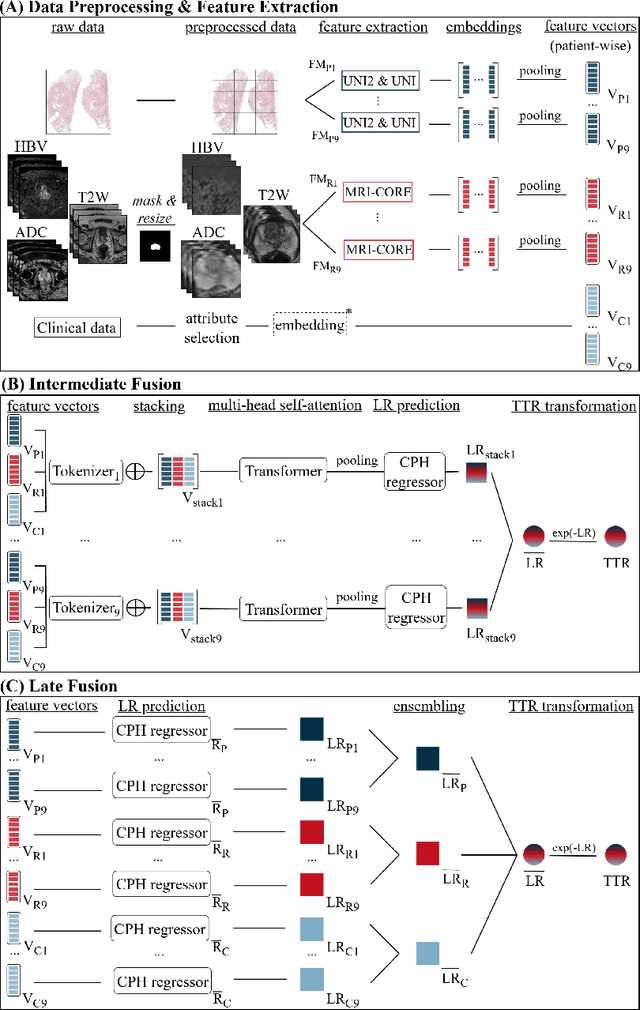
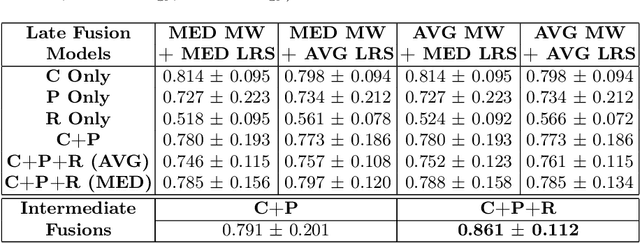
Almost 30% of prostate cancer (PCa) patients undergoing radical prostatectomy (RP) experience biochemical recurrence (BCR), characterized by increased prostate specific antigen (PSA) and associated with increased mortality. Accurate early prediction of BCR, at the time of RP, would contribute to prompt adaptive clinical decision-making and improved patient outcomes. In this work, we propose prostate cancer BCR prediction via fused multi-modal embeddings (PROFUSEme), which learns cross-modal interactions of clinical, radiology, and pathology data, following an intermediate fusion configuration in combination with Cox Proportional Hazard regressors. Quantitative evaluation of our proposed approach reveals superior performance, when compared with late fusion configurations, yielding a mean C-index of 0.861 ($\sigma=0.112$) on the internal 5-fold nested cross-validation framework, and a C-index of 0.7103 on the hold out data of CHIMERA 2025 challenge validation leaderboard.