 Add to Chrome
 Add to Firefox
 Add to Edge
Long-Horizon Traffic Forecasting via Incident-Aware Conformal Spatio-Temporal Transformers
Mar 17, 2026
Reliable multi-horizon traffic forecasting is challenging because network conditions are stochastic, incident disruptions are intermittent, and effective spatial dependencies vary across time-of-day patterns. This study is conducted on the Ohio Department of Transportation (ODOT) traffic count data and corresponding ODOT crash records. This work utilizes a Spatio-Temporal Transformer (STT) model with Adaptive Conformal Prediction (ACP) to produce multi-horizon forecasts with calibrated uncertainty. We propose a piecewise Coefficient of Variation (CV) strategy that models hour-to-hour traveltime variability using a log-normal distribution, enabling the construction of a per-hour dynamic adjacency matrix. We further perturb edge weights using incident-related severity signals derived from the ODOT crash dataset that comprises incident clearance time, weather conditions, speed violations, work zones, and roadway functional class, to capture localized disruptions and peak/off-peak transitions. This dynamic graph construction replaces a fixed-CV assumption and better represents changing traffic conditions within the forecast window. For validation, we generate extended trips via multi-hour loop runs on the Columbus, Ohio, network in SUMO simulations and apply a Monte Carlo simulation to obtain travel-time distributions for a Vehicle Under Test (VUT). Experiments demonstrate improved long-horizon accuracy and well-calibrated prediction intervals compared to other baseline methods.

Componentization: Decomposing Monolithic LLM Responses into Manipulable Semantic Units
Sep 10, 2025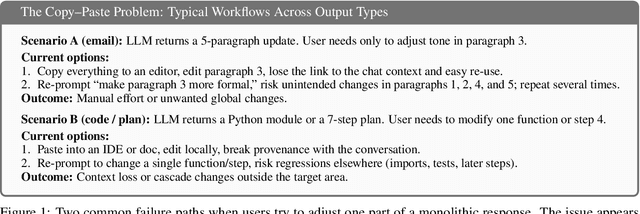
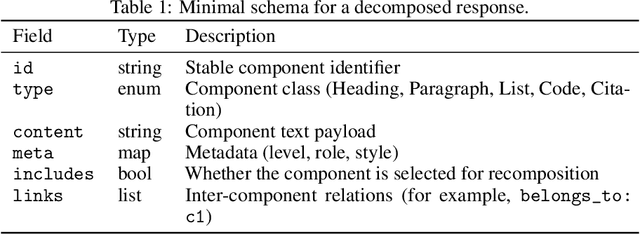
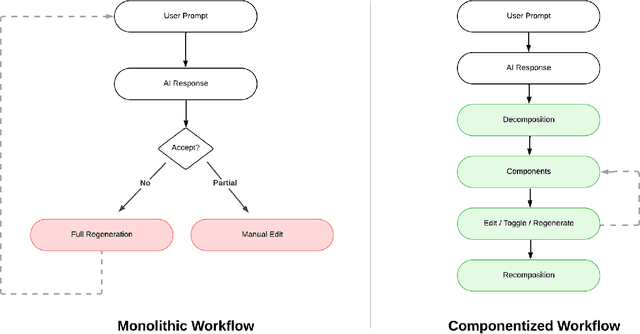
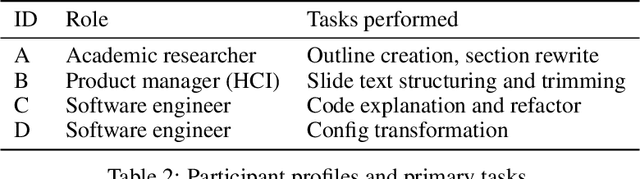
Large Language Models (LLMs) often produce monolithic text that is hard to edit in parts, which can slow down collaborative workflows. We present componentization, an approach that decomposes model outputs into modular, independently editable units while preserving context. We describe Modular and Adaptable Output Decomposition (MAOD), which segments responses into coherent components and maintains links among them, and we outline the Component-Based Response Architecture (CBRA) as one way to implement this idea. Our reference prototype, MAODchat, uses a microservices design with state-machine-based decomposition agents, vendor-agnostic model adapters, and real-time component manipulation with recomposition. In an exploratory study with four participants from academic, engineering, and product roles, we observed that component-level editing aligned with several common workflows and enabled iterative refinement and selective reuse. Participants also mentioned possible team workflows. Our contributions are: (1) a definition of componentization for transforming monolithic outputs into manipulable units, (2) CBRA and MAODchat as a prototype architecture, (3) preliminary observations from a small user study, (4) MAOD as an algorithmic sketch for semantic segmentation, and (5) example Agent-to-Agent protocols for automated decomposition. We view componentization as a promising direction for turning passive text consumption into more active, component-level collaboration.
Enhancing LLM Problem Solving with REAP: Reflection, Explicit Problem Deconstruction, and Advanced Prompting
Sep 14, 2024Large Language Models (LLMs) have transformed natural language processing, yet improving their problem-solving capabilities, particularly for complex, reasoning-intensive tasks, remains a persistent challenge. This paper introduces the REAP (Reflection, Explicit Problem Deconstruction, and Advanced Prompting) method, an innovative approach within the dynamic context generation framework. REAP guides LLMs through reflection on the query, deconstructing it into manageable components, and generating relevant context to enhance the solution process. We evaluated REAP using a dataset designed to expose LLM limitations, comparing zero-shot prompting with REAP-enhanced prompts across six state-of-the-art models: OpenAI's o1-preview, o1-mini, GPT-4o, GPT-4o-mini, Google's Gemini 1.5 Pro, and Claude 3.5 Sonnet. The results demonstrate notable performance gains, with o1-mini improving by 40.97%, GPT-4o by 66.26%, and GPT-4o-mini by 112.93%. Despite the already strong baseline performance of OpenAI's o1-preview, modest gains were observed. Beyond performance improvements, REAP offers a cost-effective solution; for example, GPT-4o-mini, which is approximately 100 times cheaper than o1-preview, delivered competitive results. REAP also improves the clarity of model outputs, making it easier for humans to understand the reasoning behind the results and simplifying the process of identifying and addressing any issues. These findings demonstrate REAP's potential to greatly improve the capabilities of LLMs, providing both better performance and increased cost-efficiency across a wide range of applications.