 Add to Chrome
 Add to Firefox
 Add to Edge
Long-Horizon Traffic Forecasting via Incident-Aware Conformal Spatio-Temporal Transformers
Mar 17, 2026
Reliable multi-horizon traffic forecasting is challenging because network conditions are stochastic, incident disruptions are intermittent, and effective spatial dependencies vary across time-of-day patterns. This study is conducted on the Ohio Department of Transportation (ODOT) traffic count data and corresponding ODOT crash records. This work utilizes a Spatio-Temporal Transformer (STT) model with Adaptive Conformal Prediction (ACP) to produce multi-horizon forecasts with calibrated uncertainty. We propose a piecewise Coefficient of Variation (CV) strategy that models hour-to-hour traveltime variability using a log-normal distribution, enabling the construction of a per-hour dynamic adjacency matrix. We further perturb edge weights using incident-related severity signals derived from the ODOT crash dataset that comprises incident clearance time, weather conditions, speed violations, work zones, and roadway functional class, to capture localized disruptions and peak/off-peak transitions. This dynamic graph construction replaces a fixed-CV assumption and better represents changing traffic conditions within the forecast window. For validation, we generate extended trips via multi-hour loop runs on the Columbus, Ohio, network in SUMO simulations and apply a Monte Carlo simulation to obtain travel-time distributions for a Vehicle Under Test (VUT). Experiments demonstrate improved long-horizon accuracy and well-calibrated prediction intervals compared to other baseline methods.

Urban Traffic Forecasting with Integrated Travel Time and Data Availability in a Conformal Graph Neural Network Framework
Jul 17, 2024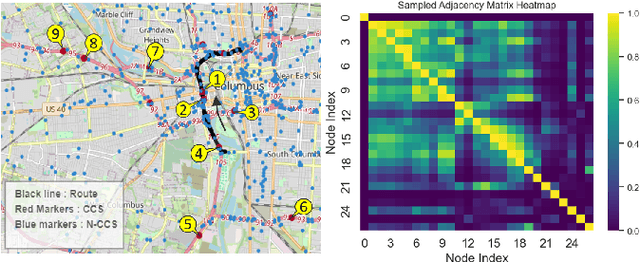
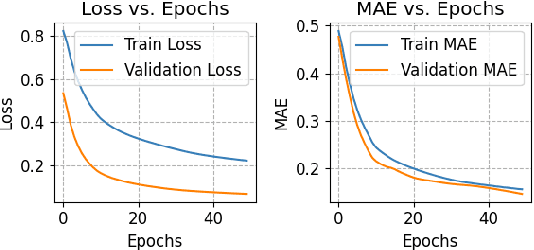
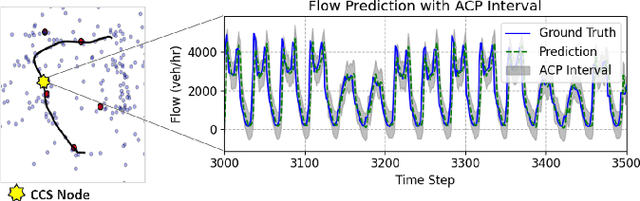
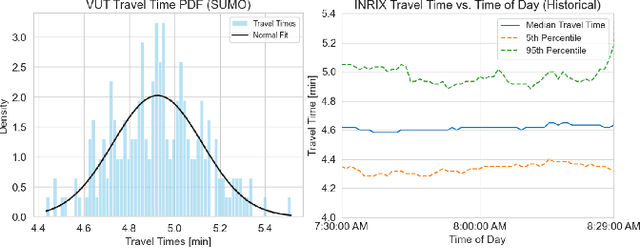
Traffic flow prediction is a big challenge for transportation authorities as it helps in planning and developing better infrastructure. State-of-the-art models often struggle to consider the data in the best way possible, intrinsic uncertainties, and the actual physics of the traffic. In this study, we propose a novel framework to incorporate travel times between stations into a weighted adjacency matrix of a Graph Neural Network (GNN) architecture with information from traffic stations based on their data availability. To handle uncertainty, we utilized the Adaptive Conformal Prediction (ACP) method that adjusts prediction intervals based on real-time validation residuals. To validate our results, we model a microscopic traffic scenario and perform a Monte-Carlo simulation to get a travel time distribution for a Vehicle Under Test (VUT) while it is navigating the traffic scenario, and this distribution is compared against the actual data. Experiments show that the proposed model outperformed the next-best model by approximately 24% in MAE and 8% in RMSE and validation showed the simulated travel time closely matches the 95th percentile of the observed travel time value.