 Add to Chrome
 Add to Firefox
 Add to Edge
mmFHE: mmWave Sensing with End-to-End Fully Homomorphic Encryption
Mar 23, 2026
We present mmFHE, the first system that enables fully homomorphic encryption (FHE) for end-to-end mmWave radar sensing. mmFHE encrypts raw range profiles on a lightweight edge device and executes the entire mmWave signal-processing and ML inference pipeline homomorphically on an untrusted cloud that operates exclusively on ciphertexts. At the core of mmFHE is a library of seven composable, data-oblivious FHE kernels that replace standard DSP routines with fixed arithmetic circuits. These kernels can be flexibly composed into different application-specific pipelines. We demonstrate this approach on two representative tasks: vital-sign monitoring and gesture recognition. We formally prove two cryptographic guarantees for any pipeline assembled from this library: input privacy, the cloud learns nothing about the sensor data; and data obliviousness, the execution trace is identical on the cloud regardless of the data being processed. These guarantees effectively neutralize various supervised and unsupervised privacy attacks on raw data, including re-identification and data-dependent privacy leakage. Evaluation on three public radar datasets (270 vital-sign recordings, 600 gesture trials) shows that encryption introduces negligible error: HR/RR MAE <10^-3 bpm versus plaintext, and 84.5% gesture accuracy (vs. 84.7% plaintext) with end-to-end cloud GPU latency of 103s for a 10s vital-sign window and 37s for a 3s gesture window. These results show that privacy-preserving end-to-end mmWave sensing is feasible on commodity hardware today.

Feasibility of Radio Frequency Based Wireless Sensing of Lead Contamination in Soil
Dec 18, 2025
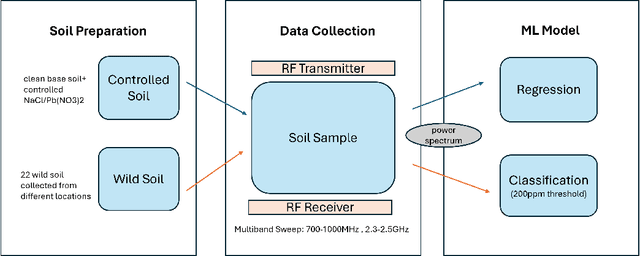
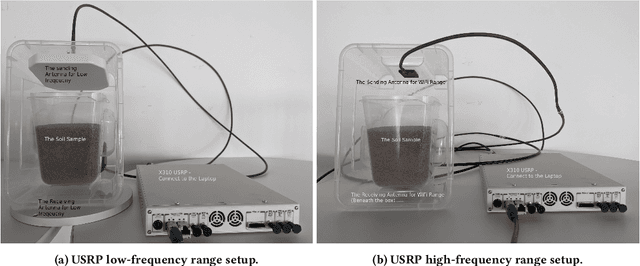

Widespread Pb (lead) contamination of urban soil significantly impacts food safety and public health and hinders city greening efforts. However, most existing technologies for measuring Pb are labor-intensive and costly. In this study, we propose SoilScanner, a radio frequency-based wireless system that can detect Pb in soils. This is based on our discovery that the propagation of different frequency band radio signals is affected differently by different salts such as NaCl and Pb(NO3)2 in the soil. In a controlled experiment, manually adding NaCl and Pb(NO3)2 in clean soil, we demonstrated that different salts reflected signals at different frequencies in distinct patterns. In addition, we confirmed the finding using uncontrolled field samples with a machine learning model. Our experiment results show that SoilScanner can classify soil samples into low-Pb and high-Pb categories (threshold at 200 ppm) with an accuracy of 72%, with no sample with > 500 ppm of Pb being misclassified. The results of this study show that it is feasible to build portable and affordable Pb detection and screening devices based on wireless technology.
Beyond-Voice: Towards Continuous 3D Hand Pose Tracking on Commercial Home Assistant Devices
Jun 30, 2023Increasingly popular home assistants are widely utilized as the central controller for smart home devices. However, current designs heavily rely on voice interfaces with accessibility and usability issues; some latest ones are equipped with additional cameras and displays, which are costly and raise privacy concerns. These concerns jointly motivate Beyond-Voice, a novel deep-learning-driven acoustic sensing system that allows commodity home assistant devices to track and reconstruct hand poses continuously. It transforms the home assistant into an active sonar system using its existing onboard microphones and speakers. We feed a high-resolution range profile to the deep learning model that can analyze the motions of multiple body parts and predict the 3D positions of 21 finger joints, bringing the granularity for acoustic hand tracking to the next level. It operates across different environments and users without the need for personalized training data. A user study with 11 participants in 3 different environments shows that Beyond-Voice can track joints with an average mean absolute error of 16.47mm without any training data provided by the testing subject.