 Add to Chrome
 Add to Firefox
 Add to Edge
Spyglass: Directional Spectrum Sensing with Single-shot AoA Estimation and Virtual Arrays
Mar 11, 2026
In this paper, we introduce Spyglass, a spectrum sensor designed to address the challenges of effective spectrum usage in dense wireless environments. Spyglass is capable of observing a frequency band and accurately estimating the Angle of Arrival (AoA) of any signal during a single transmission. This includes additional signal context such as center frequency, bandwidth, and I/Q samples. We overcome challenges such as the clutter of fleeting transmissions in common bands, the high cost of array processing for AoA estimation, and the difficulty of detecting and estimating channels for unknown signals. Our first contribution is the development of Searchlite, a protocol-agnostic signal detection and separation algorithm. We use a switched array to reduce cost and processing complexity, and we develop SSFP, a signal processing technique using Fourier transforms that is synchronized to switching boundaries. Spyglass performs multi-channel blind AoA estimation synchronized with the array. Implemented using commercially available hardware, Spyglass demonstrates a median AoA accuracy of 1.4$^\circ$ and the ability to separate simultaneous signals from multiple devices in an unconstrained RF environment, providing valuable tools for large-scale RF data collection and analysis.

LLM Rationalis? Measuring Bargaining Capabilities of AI Negotiators
Dec 15, 2025Bilateral negotiation is a complex, context-sensitive task in which human negotiators dynamically adjust anchors, pacing, and flexibility to exploit power asymmetries and informal cues. We introduce a unified mathematical framework for modeling concession dynamics based on a hyperbolic tangent curve, and propose two metrics burstiness tau and the Concession-Rigidity Index (CRI) to quantify the timing and rigidity of offer trajectories. We conduct a large-scale empirical comparison between human negotiators and four state-of-the-art large language models (LLMs) across natural-language and numeric-offers settings, with and without rich market context, as well as six controlled power-asymmetry scenarios. Our results reveal that, unlike humans who smoothly adapt to situations and infer the opponents position and strategies, LLMs systematically anchor at extremes of the possible agreement zone for negotiations and optimize for fixed points irrespective of leverage or context. Qualitative analysis further shows limited strategy diversity and occasional deceptive tactics used by LLMs. Moreover the ability of LLMs to negotiate does not improve with better models. These findings highlight fundamental limitations in current LLM negotiation capabilities and point to the need for models that better internalize opponent reasoning and context-dependent strategy.
BeamScatter: Scalable, Deployable Long-Range backscatter communication with Beam-Steering
Oct 27, 2021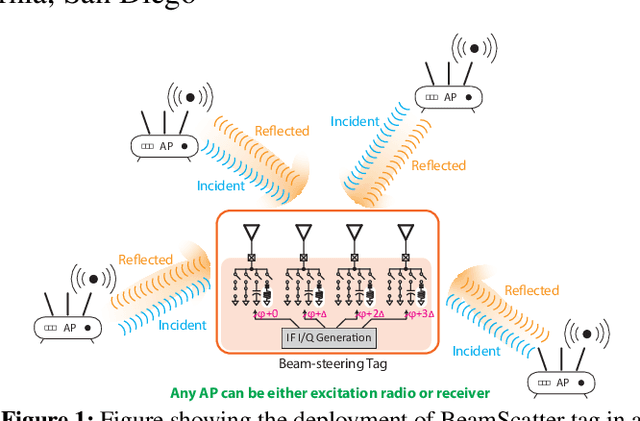

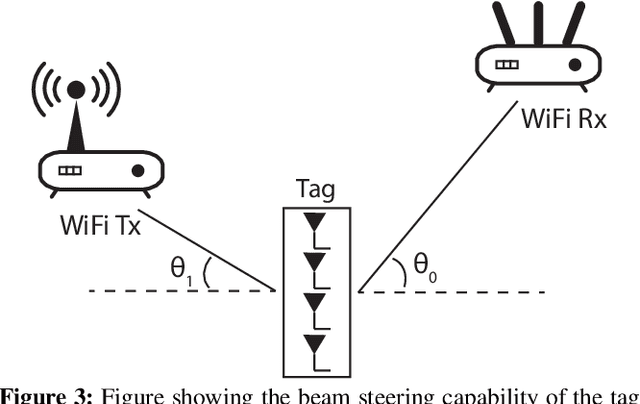

WiFi backscatter tags can enable direct connectivity of IoT devices with commodity WiFi hardware at low power. However, most state-of-the-art backscatter tag implementations in this area have a limited transmitter to tag range and are not suitable to be deployed in a WiFi mesh network nor take full advantage of today's WiFi networks. In this paper, we present BeamScatter, which can realize a backscatter tag-based onMIMO techniques that can work at a very long separation of 28m from an access point and enables their deployment in WiFi mesh networks. BeamScatter presents a novel technique to perform beam-steering on the MIMO tag at a very low power consumption of 88uW and achieve a peak throughput of 1Mbps. Next BeamScatter creates a novel modeling framework to decide the optimal phase setting on the tag to steer the backscattered signal towards a specific direction of interest.