 Add to Chrome
 Add to Firefox
 Add to Edge
Sequential and Generative Models for Vehicular Distributed MIMO Channel Prediction
Jun 24, 2026
Vehicular communication is a key 6G use case requiring reliable and high-capacity connectivity under fast mobility and highly time-varying propagation conditions. However, large-scale vehicular channel estimation is costly and limited, impacting system-level performance of vehicular communications, and realistic channel prediction models are needed. This paper proposes a vehicular channel prediction framework based on real measured urban channels collected through a dedicated measurement campaign using the MaMIMOSA channel sounder. The framework enables the training and systematic benchmarking of sequential and generative models for both single-step and multi-horizon vehicular channel state information (CSI) prediction to assess prediction robustness across different forecasting horizons, including LSTM, TCN, a CNN-enhanced Transformer, and ChannelGPT, with the goal of accurately predicting channel evolution while preserving spatiotemporal dynamics and non-stationarity. In addition, a system-level evaluation framework is introduced to assess the impact of channel prediction on the performance of vehicular distributed MIMO communications. Using predicted channels, spectral efficiency (SE) is evaluated against true CSI. Results show that ChannelGPT achieves over 94% normalized mean squared error (NMSE) reduction compared to LSTM and significant improvements over other baselines, while reducing FLOPs by 28% and inference latency by 39% relative to the CNN + Transformer. Moreover, ChannelGPT-predicted channels yield SE distributions nearly indistinguishable from those obtained with real measurements, demonstrating its effectiveness for reliable performance evaluation in high-mobility 6G vehicular networks.

Efficient Autoprecoder-based deep learning for massive MU-MIMO Downlink under PA Non-Linearities
Feb 03, 2022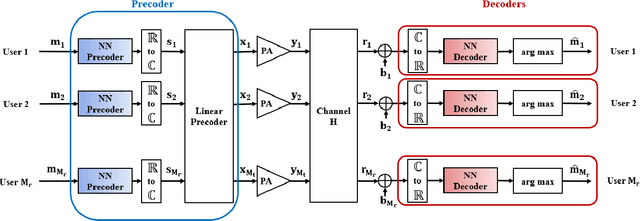

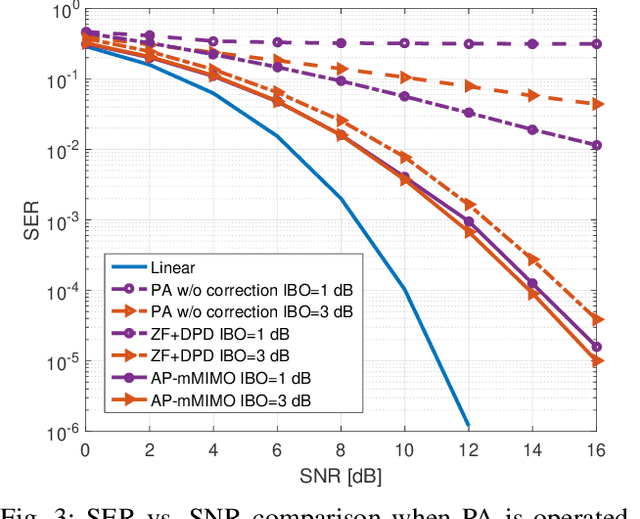
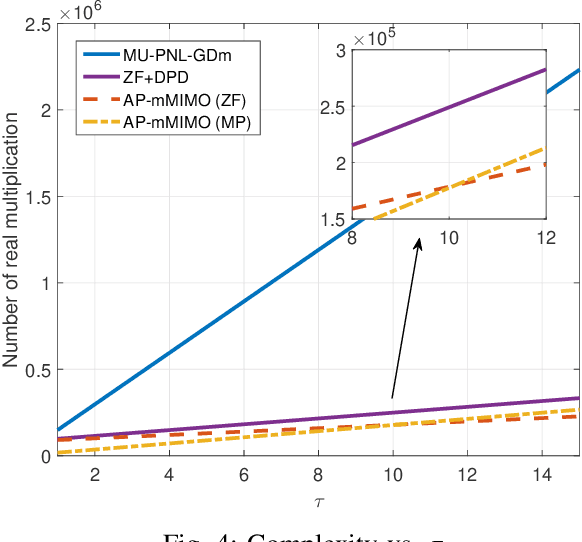
This paper introduces a new efficient autoprecoder (AP) based deep learning approach for massive multiple-input multiple-output (mMIMO) downlink systems in which the base station is equipped with a large number of antennas with energy-efficient power amplifiers (PAs) and serves multiple user terminals. We present AP-mMIMO, a new method that jointly eliminates the multiuser interference and compensates the severe nonlinear (NL) PA distortions. Unlike previous works, AP-mMIMO has a low computational complexity, making it suitable for a global energy-efficient system. Specifically, we aim to design the PA-aware precoder and the receive decoder by leveraging the concept of autoprecoder, whereas the end-to-end massive multiuser (MU)-MIMO downlink is designed using a deep neural network (NN). Most importantly, the proposed AP-mMIMO is suited for the varying block fading channel scenario. To deal with such scenarios, we consider a two-stage precoding scheme: 1) a NN-precoder is used to address the PA non-linearities and 2) a linear precoder is used to suppress the multiuser interference. The NN-precoder and the receive decoder are trained off-line and when the channel varies, only the linear precoder changes on-line. This latter is designed by using the widely used zero-forcing precoding scheme or its lowcomplexity version based on matrix polynomials. Numerical simulations show that the proposed AP-mMIMO approach achieves competitive performance with a significantly lower complexity compared to existing literature. Index Terms-multiuser (MU) precoding, massive multipleinput multiple-output (MIMO), energy-efficiency, hardware impairment, power amplifier (PA) nonlinearities, autoprecoder, deep learning, neural network (NN)