 Add to Chrome
 Add to Firefox
 Add to Edge
Tracking Intermittent Particles with Self-Learned Visual Features
Jul 10, 2026
In time-lapse fluorescence imaging, single-particle-tracking is a powerful tool to monitor the dynamics of objects of interest, and extract information about biological processes. However, tracked particles can be subject to occlusion and intermittent detectability. When these phenomena persist over a few frames, tracking algorithms tend to produce multiple tracklets for the same particle. In this work, we introduce self-supervised learning of visual features to compare tracked particles, and we exploit both visual and positional distances to robustly stitch tracklets representing the same particle. We demonstrate the performance of our stitching framework on time-lapse fluorescence sequences of Hydra vulgaris neurons. Results show high stitching precision, and reduction of errors made by previous algorithms on the same data by a factor of two.

moco: Fast Motion Correction for Calcium Imaging
Jun 19, 2015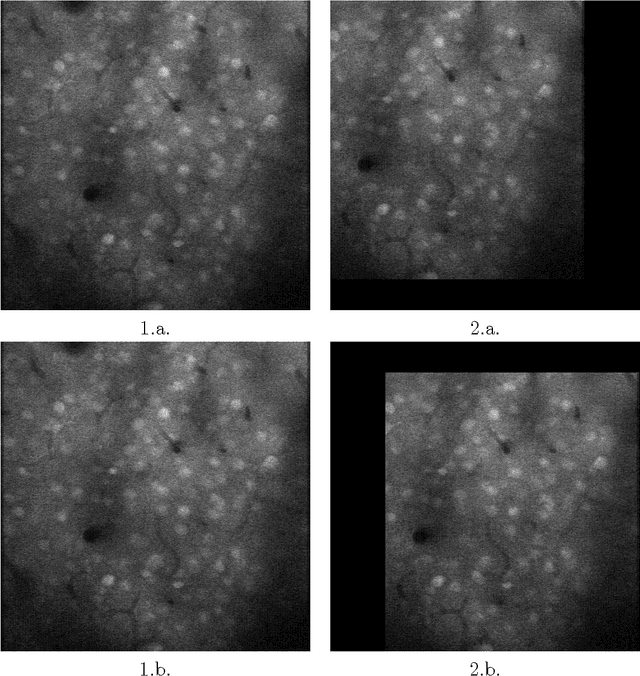
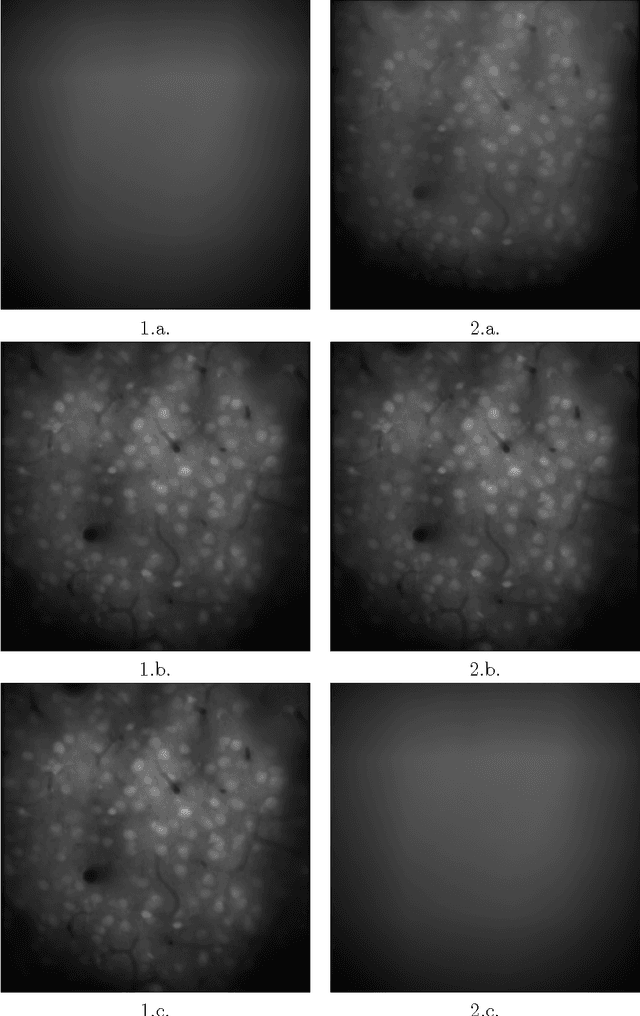
Motion correction is the first in a pipeline of algorithms to analyze calcium imaging videos and extract biologically relevant information, for example the network structure of the neurons therein. Fast motion correction would be especially critical for closed-loop activity triggered stimulation experiments, where accurate detection and targeting of specific cells in necessary. Our algorithm uses a Fourier-transform approach, and its efficiency derives from a combination of judicious downsampling and the accelerated computation of many $L_2$ norms using dynamic programming and two-dimensional, fft-accelerated convolutions. Its accuracy is comparable to that of established community-used algorithms, and it is more stable to large translational motions. It is programmed in Java and is compatible with ImageJ.