 Add to Chrome
 Add to Firefox
 Add to Edge
Evaluating Zero-Shot and One-Shot Adaptation of Small Language Models in Leader-Follower Interaction
Feb 26, 2026
Leader-follower interaction is an important paradigm in human-robot interaction (HRI). Yet, assigning roles in real time remains challenging for resource-constrained mobile and assistive robots. While large language models (LLMs) have shown promise for natural communication, their size and latency limit on-device deployment. Small language models (SLMs) offer a potential alternative, but their effectiveness for role classification in HRI has not been systematically evaluated. In this paper, we present a benchmark of SLMs for leader-follower communication, introducing a novel dataset derived from a published database and augmented with synthetic samples to capture interaction-specific dynamics. We investigate two adaptation strategies: prompt engineering and fine-tuning, studied under zero-shot and one-shot interaction modes, compared with an untrained baseline. Experiments with Qwen2.5-0.5B reveal that zero-shot fine-tuning achieves robust classification performance (86.66% accuracy) while maintaining low latency (22.2 ms per sample), significantly outperforming baseline and prompt-engineered approaches. However, results also indicate a performance degradation in one-shot modes, where increased context length challenges the model's architectural capacity. These findings demonstrate that fine-tuned SLMs provide an effective solution for direct role assignment, while highlighting critical trade-offs between dialogue complexity and classification reliability on the edge.

MIHRaGe: A Mixed-Reality Interface for Human-Robot Interaction via Gaze-Oriented Control
May 06, 2025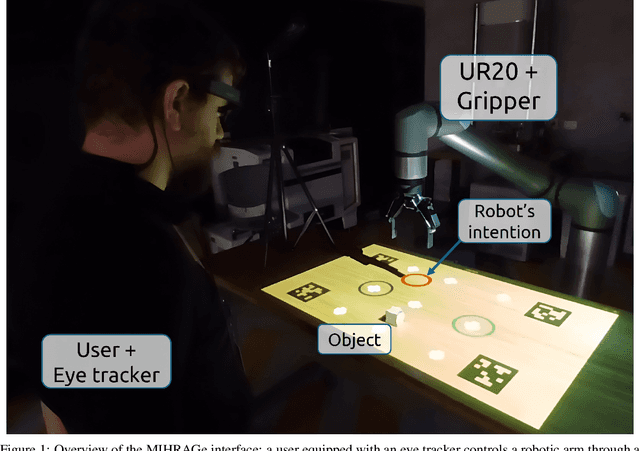
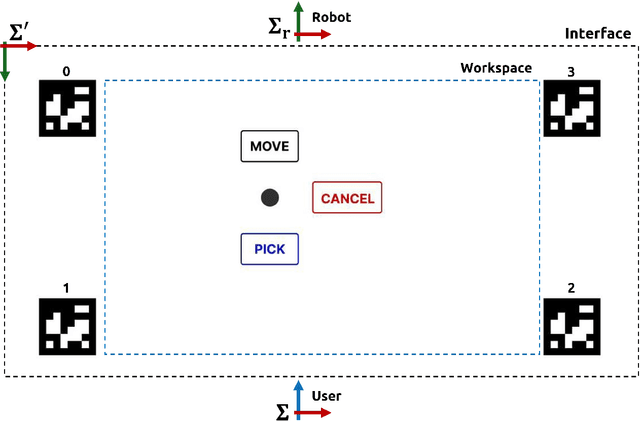
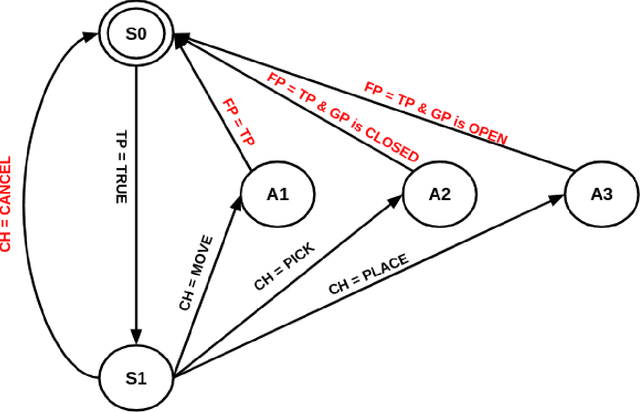
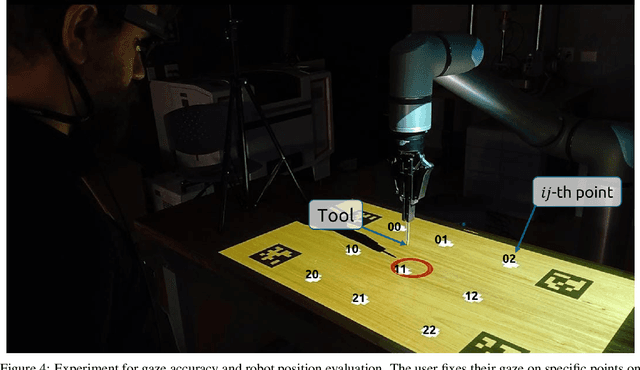
Individuals with upper limb mobility impairments often require assistive technologies to perform activities of daily living. While gaze-tracking has emerged as a promising method for robotic assistance, existing solutions lack sufficient feedback mechanisms, leading to uncertainty in user intent recognition and reduced adaptability. This paper presents the MIHRAGe interface, an integrated system that combines gaze-tracking, robotic assistance, and a mixed-reality to create an immersive environment for controlling the robot using only eye movements. The system was evaluated through an experimental protocol involving four participants, assessing gaze accuracy, robotic positioning precision, and the overall success of a pick and place task. Results showed an average gaze fixation error of 1.46 cm, with individual variations ranging from 1.28 cm to 2.14 cm. The robotic arm demonstrated an average positioning error of +-1.53 cm, with discrepancies attributed to interface resolution and calibration constraints. In a pick and place task, the system achieved a success rate of 80%, highlighting its potential for improving accessibility in human-robot interaction with visual feedback to the user.