 Add to Chrome
 Add to Firefox
 Add to Edge
UNIT: Unleash Large Language Models Potential for Graph Continual Learning
Jul 11, 2026
In real-world multimodal web scenarios, graph-structured data often arrives in a streaming manner, making graph continual learning a crucial paradigm for continuously modeling such evolving structures. However, existing graph continual learning methods still face two fundamental challenges. 1) semantic-structural separation, where the graph-based methods excel at modeling topological relationships but neglect deep semantics. 2) imbalanced knowledge transfer, where existing models fail to effectively leverage general knowledge gained from early tasks to benefit subsequent new tasks. To address above issues, we propose a novel framework, \textbf{UN}leash Large Language Models PotentIal for Graph ConTinual Learning (UNIT). By fine-tuning large language model only on the first task, we bridge the distributional gap between the pre-trained LLM corpus and the target task dataset to enhance the adaptability of LLMs for graph-structured tasks. Meanwhile, we propose an uncertain-aware anchor generation mechanism to effectively preserve representative knowledge across tasks, avoiding the neglect of universal knowledge learned from previous tasks. Additionally, we introduce structural confluence modeling to explicitly integrates graph topology information into semantic information, enhancing the collaborative capabilities between semantic understanding and structural modeling. Extensive experiments demonstrate that our proposed method achieves state-of-the-art performance in the graph continual learning task.

PeerGAN: Generative Adversarial Networks with a Competing Peer Discriminator
Jan 19, 2021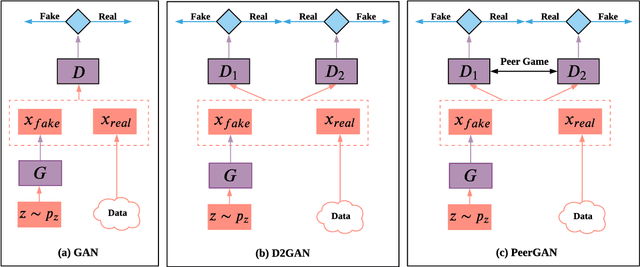
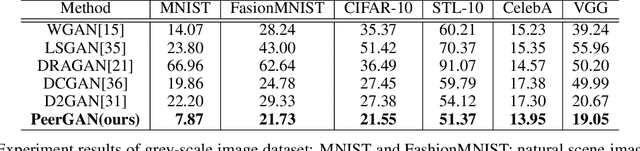
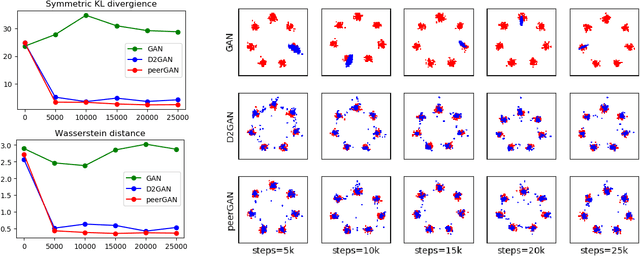
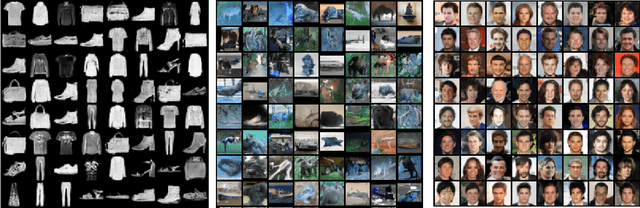
In this paper, we introduce PeerGAN, a generative adversarial network (GAN) solution to improve the stability of the generated samples and to mitigate mode collapse. Built upon the Vanilla GAN's two-player game between the discriminator $D_1$ and the generator $G$, we introduce a peer discriminator $D_2$ to the min-max game. Similar to previous work using two discriminators, the first role of both $D_1$, $D_2$ is to distinguish between generated samples and real ones, while the generator tries to generate high-quality samples that are able to fool both discriminators. Different from existing methods, we introduce another game between $D_1$ and $D_2$ to discourage their agreement and therefore increase the level of diversity of the generated samples. This property helps avoid early mode collapse by preventing $D_1$ and $D_2$ from converging too fast. We provide theoretical analysis for the equilibrium of the min-max game formed among $G, D_1, D_2$. We offer convergence behavior of PeerGAN as well as stability of the min-max game. It's worth mentioning that PeerGAN operates in the unsupervised setting, and the additional game between $D_1$ and $D_2$ does not need any label supervision. Experiments results on a synthetic dataset and on real-world image datasets (MNIST, Fashion MNIST, CIFAR-10, STL-10, CelebA, VGG) demonstrate that PeerGAN outperforms competitive baseline work in generating diverse and high-quality samples, while only introduces negligible computation cost.