 Add to Chrome
 Add to Firefox
 Add to Edge
Masked Diffusion Vision-Language Models for Temporal Action Localization
May 28, 2026
Temporal action localization (TAL) requires recognizing the target event and localizing its start and end times precisely in untrimmed videos. Recent vision-language formulations improve semantic reasoning and support language-conditioned outputs, but their autoregressive decoders still generate tokens from left to right, preventing later semantic evidence from revising earlier timestamp predictions. We adapt masked diffusion vision-language models (MDVLMs) to TAL so that semantic tokens and boundary tokens remain editable throughout iterative denoising with bidirectional attention, allowing temporal boundaries and semantic content to be refined jointly. Direct adaptation, however, creates two TAL-specific mismatches: standard masked diffusion training corrupts all positions uniformly at random, but the time tokens are more reliable when enough semantic context is available; and token-level cross-entropy does not reflect temporal IoU. To address these mismatches, we introduce a Planned Training Objective that uses boundary-aware masking and step-weighted reconstruction to rehearse the late recovery of time tokens, together with a Step-Level IoU Reward that provides overlap-aware supervision during denoising. A standard sequence-level cross-entropy term provides the base reconstruction signal. Experiments on ActivityNet-RTL, ActivityNet-1.3, and THUMOS-14 show that MDVLM-TAL improves both temporal reasoning and boundary localization over autoregressive vision-language baselines, with especially strong gains under stricter temporal IoU criteria.

FMI-TAL: Few-shot Multiple Instances Temporal Action Localization by Probability Distribution Learning and Interval Cluster Refinement
Aug 25, 2024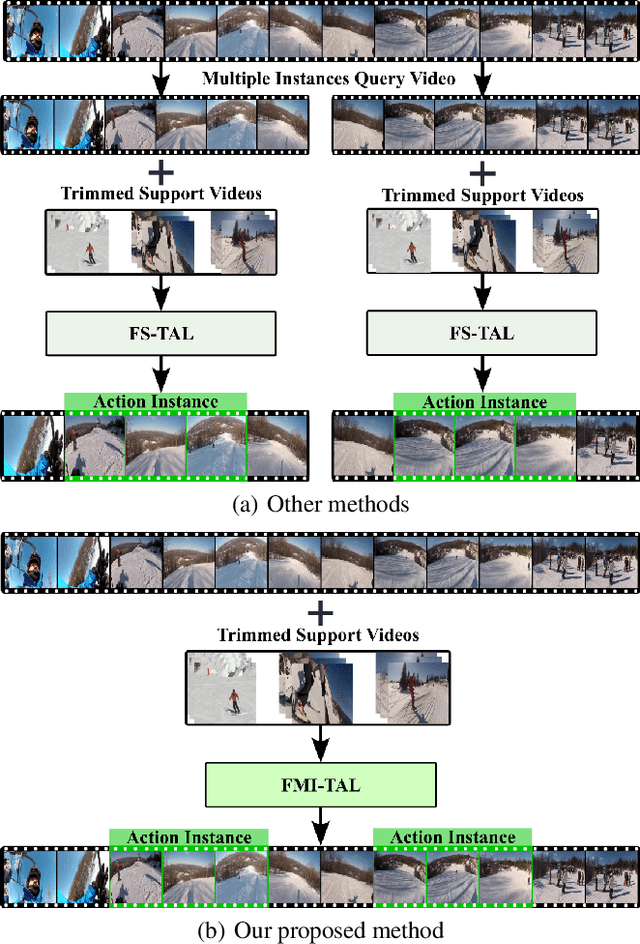
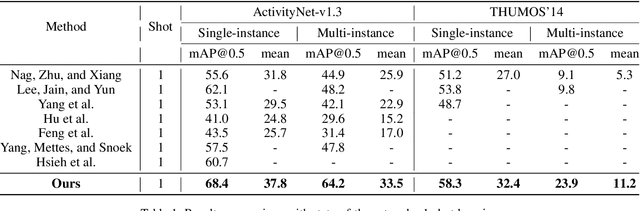
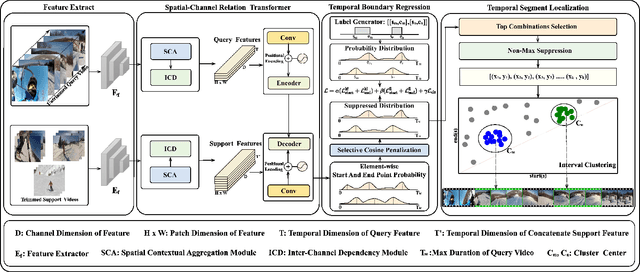
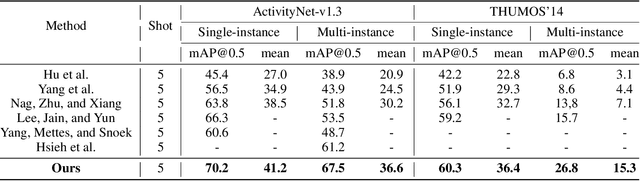
The present few-shot temporal action localization model can't handle the situation where videos contain multiple action instances. So the purpose of this paper is to achieve manifold action instances localization in a lengthy untrimmed query video using limited trimmed support videos. To address this challenging problem effectively, we proposed a novel solution involving a spatial-channel relation transformer with probability learning and cluster refinement. This method can accurately identify the start and end boundaries of actions in the query video, utilizing only a limited number of labeled videos. Our proposed method is adept at capturing both temporal and spatial contexts to effectively classify and precisely locate actions in videos, enabling a more comprehensive utilization of these crucial details. The selective cosine penalization algorithm is designed to suppress temporal boundaries that do not include action scene switches. The probability learning combined with the label generation algorithm alleviates the problem of action duration diversity and enhances the model's ability to handle fuzzy action boundaries. The interval cluster can help us get the final results with multiple instances situations in few-shot temporal action localization. Our model achieves competitive performance through meticulous experimentation utilizing the benchmark datasets ActivityNet1.3 and THUMOS14. Our code is readily available at https://github.com/ycwfs/FMI-TAL.