 Add to Chrome
 Add to Firefox
 Add to Edge
Joint Low-Dimensional Modeling and Sampling Design for Sparse On-Orbit Antenna Pattern Reconstruction
Jul 31, 2026
Accurately reconstructing satellite transmit-antenna patterns on orbit is difficult because only sparse directional measurements are available during normal mission operations. This paper develops a cooperative on-orbit pattern-reconstruction framework that converts received calibration power into normalized directional samples and represents the antenna power pattern using a truncated discrete cosine transform (DCT) basis. The resulting low-dimensional model transforms high-dimensional pattern recovery into coefficient estimation, for which a closed-form maximum-likelihood estimator and error characterization are derived. The analysis shows how DCT truncation error, measurement noise, and sampled-basis conditioning jointly affect reconstruction accuracy. For regularly accessible angular sectors, midpoint-uniform sampling provides an information-balanced baseline for the retained DCT modes. For constrained feasible opportunities, D-optimal sampling is used to select informative measurement directions. Simulations verify the accuracy of the angular discretization, the sample efficiency of the truncated-DCT model, and the reconstruction gain of D-optimal sampling under irregular orbit-generated opportunities.

CF-Net: A Cross-Feature Reconstruction Network for High-Accuracy 1-Bit Target Classification
Dec 17, 2025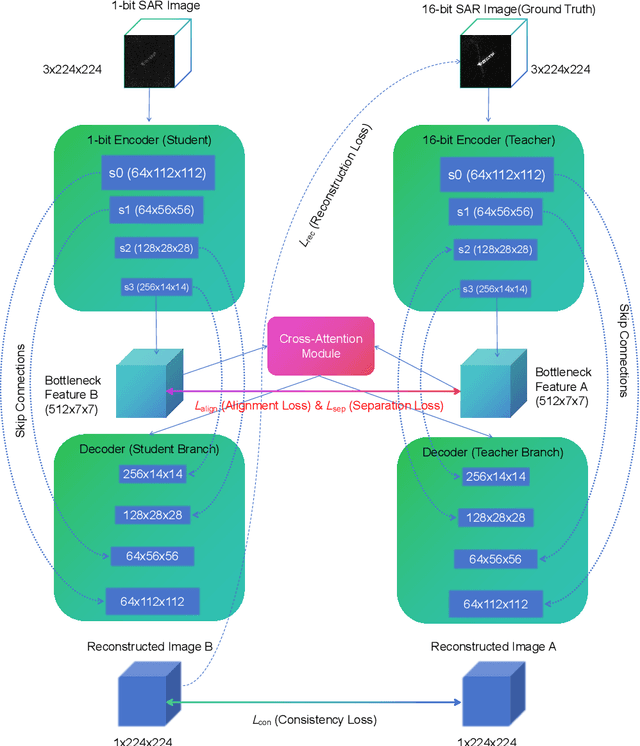

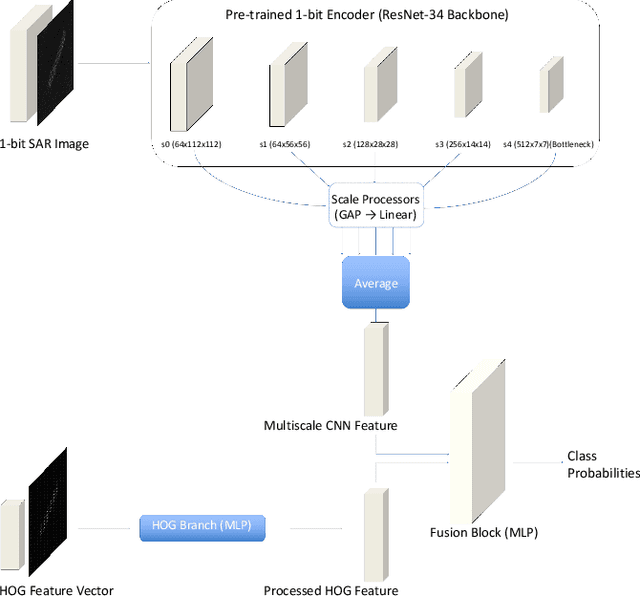
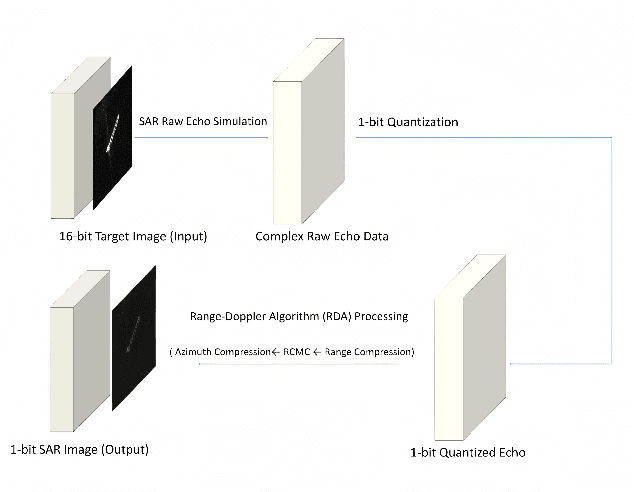
Target classification is a fundamental task in radar systems, and its performance critically depends on the quantization precision of the signal. While high-precision quantization (e.g. 16-bit) is well established, 1-bit quantization offers distinct advantages by enabling direct sampling at high frequencies and eliminating complex intermediate stages. However, its extreme quantization leads to significant information loss. Although higher sampling rates can compensate for this loss, such oversampling is impractical at the high frequencies targeted for direct sampling. To achieve high-accuracy classification directly from 1-bit radar data under the same sampling rate, this paper proposes a novel two-stage deep learning framework, CF-Net. First, we introduce a self-supervised pre-training strategy based on a dual-branch U-Net architecture. This network learns to restore high-fidelity 16-bit images from their 1-bit counterparts via a cross-feature reconstruction task, forcing the 1-bit encoder to learn robust features despite extreme quantization. Subsequently, this pre-trained encoder is repurposed and fine-tuned for the downstream multi-class target classification task. Experiments on two radar target datasets demonstrate that CF-Net can effectively extract discriminative features from 1-bit imagery, achieving comparable and even superior accuracy to some 16-bit methods without oversampling.