 Add to Chrome
 Add to Firefox
 Add to Edge
WINO: A Weak-Form Physics Informed Neural Operator for Hyperelasticity on Variable Domains
May 23, 2026
We propose a Weak-form Physics-Informed Neural Operator (WINO), a data-free framework that combines the efficiency of neural operators with the geometric flexibility of the $\varphi$-finite element method ($\varphi$-FEM). $\varphi$-FEM is an unfitted method that accommodates geometric variations without body-fitted meshes, where the domain geometry is represented by the level-set function $\varphi$. To impose the boundary conditions, Dirichlet problems adopt the $\varphi$-FEM lifting so only the homogeneous displacement contribution is learned, whereas traction-driven Neumann problems additionally predict the auxiliary fields necessary for the unfitted weak formulation. Parameters are trained by minimizing squared weak-form residuals aligned with $\varphi$-FEM together with squared penalties on the cut-cell auxiliary equations, which removes the need for large paired datasets of converged reference solutions. After training, WINO outputs can seed the nonlinear $\varphi$-FEM solvers as neural operator warm starts (NOWS), which reduce iteration counts relative to traditional cold-started solvers. Numerical benchmarks show that WINO achieves high accuracy below 0.04 across all benchmarks, while reducing total computational time by 50--80\% compared with purely data-driven methods.

Memory Group Sampling Based Online Action Recognition Using Kinetic Skeleton Features
Nov 03, 2020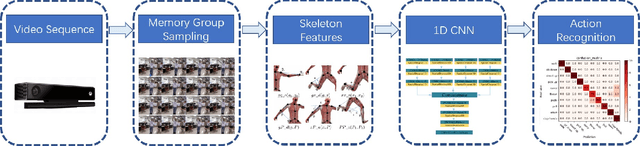
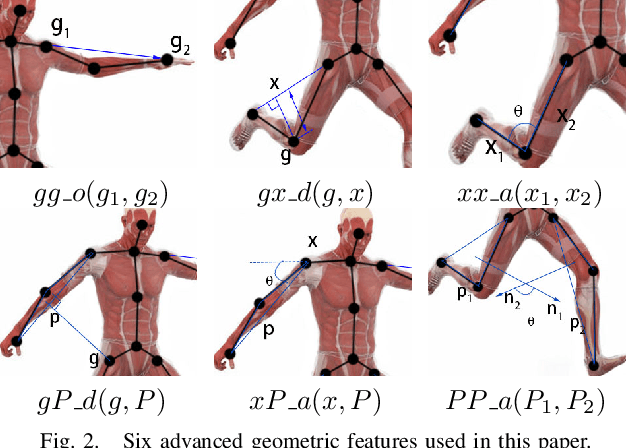
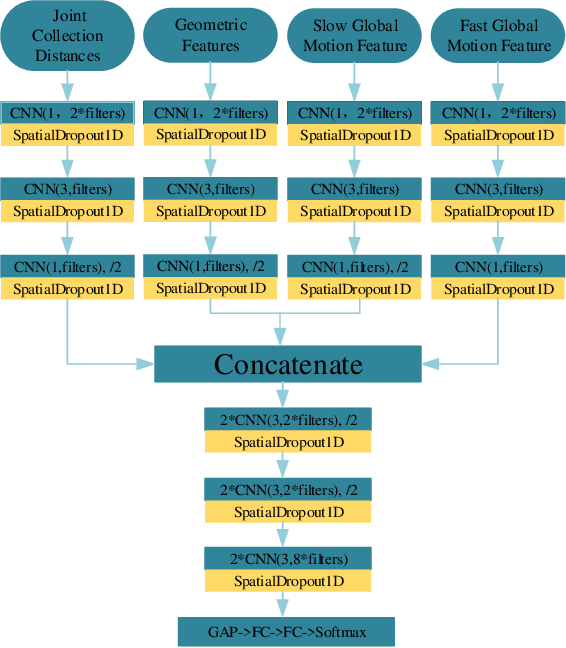
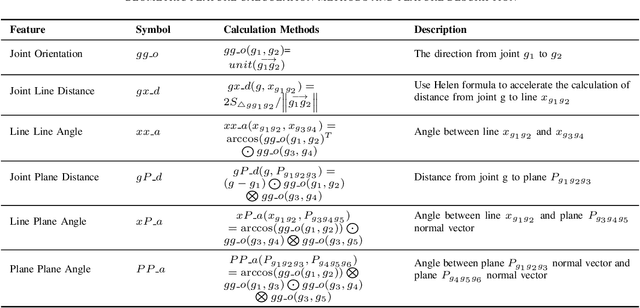
Online action recognition is an important task for human centered intelligent services, which is still difficult to achieve due to the varieties and uncertainties of spatial and temporal scales of human actions. In this paper, we propose two core ideas to handle the online action recognition problem. First, we combine the spatial and temporal skeleton features to depict the actions, which include not only the geometrical features, but also multi-scale motion features, such that both the spatial and temporal information of the action are covered. Second, we propose a memory group sampling method to combine the previous action frames and current action frames, which is based on the truth that the neighbouring frames are largely redundant, and the sampling mechanism ensures that the long-term contextual information is also considered. Finally, an improved 1D CNN network is employed for training and testing using the features from sampled frames. The comparison results to the state of the art methods using the public datasets show that the proposed method is fast and efficient, and has competitive performance
Refinement of Operator-valued Reproducing Kernels
Feb 07, 2011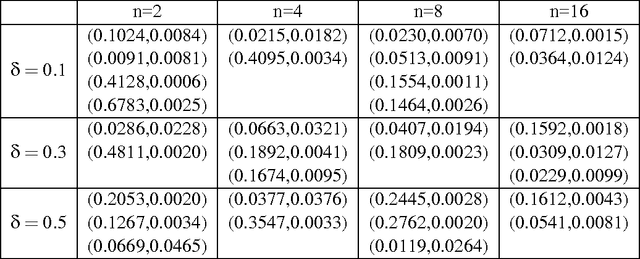
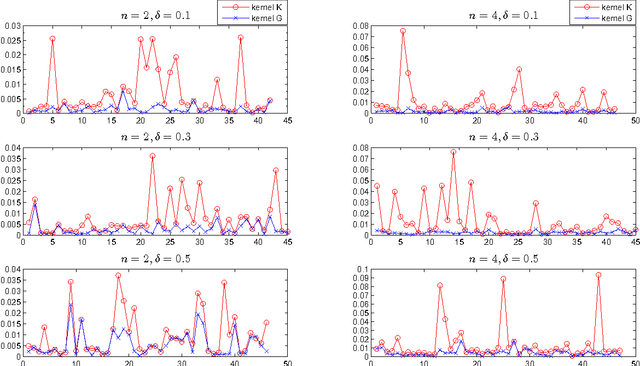
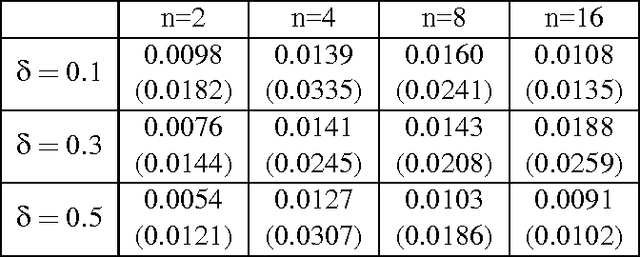
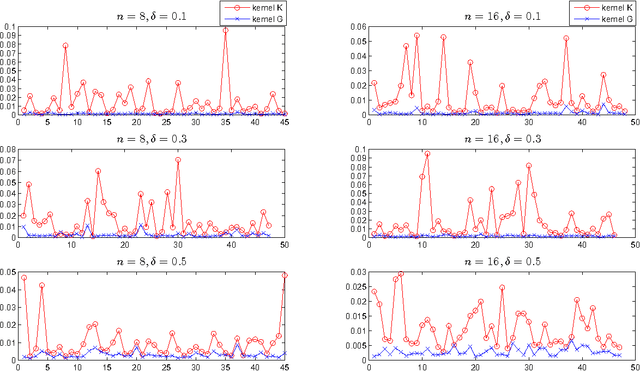
This paper studies the construction of a refinement kernel for a given operator-valued reproducing kernel such that the vector-valued reproducing kernel Hilbert space of the refinement kernel contains that of the given one as a subspace. The study is motivated from the need of updating the current operator-valued reproducing kernel in multi-task learning when underfitting or overfitting occurs. Numerical simulations confirm that the established refinement kernel method is able to meet this need. Various characterizations are provided based on feature maps and vector-valued integral representations of operator-valued reproducing kernels. Concrete examples of refining translation invariant and finite Hilbert-Schmidt operator-valued reproducing kernels are provided. Other examples include refinement of Hessian of scalar-valued translation-invariant kernels and transformation kernels. Existence and properties of operator-valued reproducing kernels preserved during the refinement process are also investigated.