 Add to Chrome
 Add to Firefox
 Add to Edge
Prior-Based Multi-Voltage Threshold Sampling as a Structured Inverse Problem
Aug 06, 2026
Prior-based Multi-Voltage Threshold (MVT) sampling reconstructs pulse parameters from sparse threshold-crossing times rather than full waveforms, making parameter recovery inherently a model-dependent inverse problem. However, prior-based MVT has lacked a formal mathematical statement, leaving identifiability, stochastic error propagation, and threshold design without a unified theoretical foundation. We formalize prior-based MVT for strictly unimodal pulse families as a structured inverse problem. On that foundation, we develop the first unified theory of prior-based MVT, comprising deterministic identifiability conditions, a stochastic timing-error model with leading-order mismatch bias, and a nuisance-profiled threshold-design theory centered on an effective-information equation for robust single-event and partial-trigger multi-event operation. We instantiate the framework for the bi-exponential pulse model, derive executable design recipes, and validate the resulting predictions on a 10,000-pulse $^{22}$Na/LYSO/SiPM dataset. The experiments confirm that the framework yields useful threshold designs in the photopeak regime while also revealing the regime boundary at which partial triggering and model mismatch limit the predictive power of Fisher-guided optimization. These results provide the first unified mathematical foundation for prior-based MVT and recast it from an empirical threshold heuristic as a principled inferential framework.

Potential Advantages of Peak Picking Multi-Voltage Threshold Digitizer in Energy Determination in Radiation Measurement
Mar 08, 2021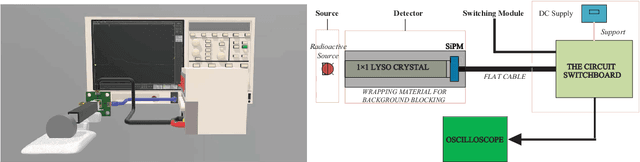
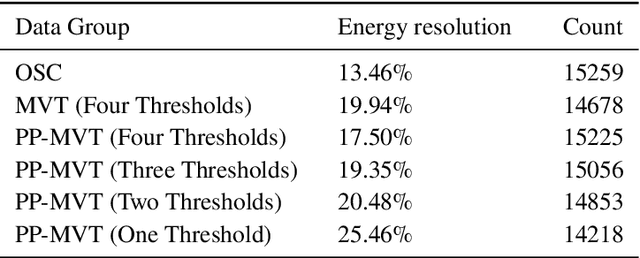
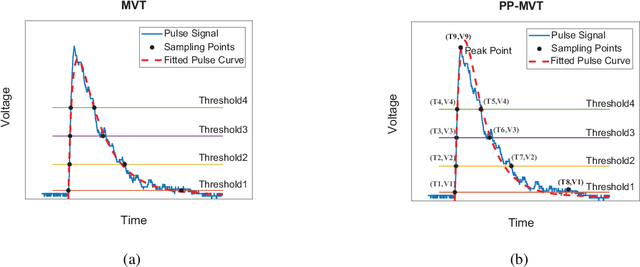
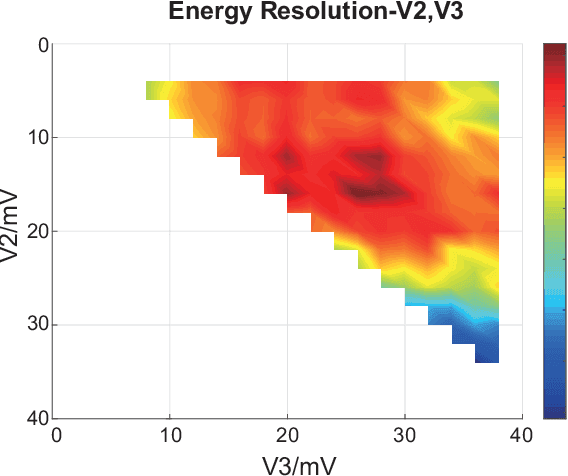
The Multi-voltage Threshold (MVT) method, which samples the signal by certain reference voltages, has been well developed as being adopted in pre-clinical and clinical digital positron emission tomography(PET) system. To improve its energy measurement performance, we propose a Peak Picking MVT(PP-MVT) Digitizer in this paper. Firstly, a sampled Peak Point(the highest point in pulse signal), which carries the values of amplitude feature voltage and amplitude arriving time, is added to traditional MVT with a simple peak sampling circuit. Secondly, an amplitude deviation statistical analysis, which compares the energy deviation of various reconstruction models, is used to select adaptive reconstruction models for signal pulses with different amplitudes. After processing 30,000 randomly-chosen pulses sampled by the oscilloscope with a 22Na point source, our method achieves an energy resolution of 17.50% within a 450-650 KeV energy window, which is 2.44% better than the result of traditional MVT with same thresholds; and we get a count number at 15225 in the same energy window while the result of MVT is at 14678. When the PP-MVT involves less thresholds than traditional MVT, the advantages of better energy resolution and larger count number can still be maintained, which shows the robustness and the flexibility of PP-MVT Digitizer. This improved method indicates that adding feature peak information could improve the performance on signal sampling and reconstruction, which canbe proved by the better performance in energy determination in radiation measurement.