 Add to Chrome
 Add to Firefox
 Add to Edge
Draft-and-Target Sampling for Video Generation Policy
Mar 13, 2026
Video generation models have been used as a robot policy to predict the future states of executing a task conditioned on task description and observation. Previous works ignore their high computational cost and long inference time. To address this challenge, we propose Draft-and-Target Sampling, a novel diffusion inference paradigm for video generation policy that is training-free and can improve inference efficiency. We introduce a self-play denoising approach by utilizing two complementary denoising trajectories in a single model, draft sampling takes large steps to generate a global trajectory in a fast manner and target sampling takes small steps to verify it. To further speedup generation, we introduce token chunking and progressive acceptance strategy to reduce redundant computation. Experiments on three benchmarks show that our method can achieve up to 2.1x speedup and improve the efficiency of current state-of-the-art methods with minimal compromise to the success rate. Our code is available.

Test Time Training for 4D Medical Image Interpolation
Feb 04, 2025
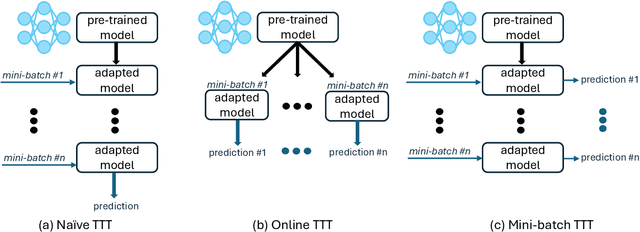


4D medical image interpolation is essential for improving temporal resolution and diagnostic precision in clinical applications. Previous works ignore the problem of distribution shifts, resulting in poor generalization under different distribution. A natural solution would be to adapt the model to a new test distribution, but this cannot be done if the test input comes without a ground truth label. In this paper, we propose a novel test time training framework which uses self-supervision to adapt the model to a new distribution without requiring any labels. Indeed, before performing frame interpolation on each test video, the model is trained on the same instance using a self-supervised task, such as rotation prediction or image reconstruction. We conduct experiments on two publicly available 4D medical image interpolation datasets, Cardiac and 4D-Lung. The experimental results show that the proposed method achieves significant performance across various evaluation metrics on both datasets. It achieves higher peak signal-to-noise ratio values, 33.73dB on Cardiac and 34.02dB on 4D-Lung. Our method not only advances 4D medical image interpolation but also provides a template for domain adaptation in other fields such as image segmentation and image registration.