 Add to Chrome
 Add to Firefox
 Add to Edge
Progressive Multimodal Alignment for Continual Instruction Tuning
Jul 29, 2026
Multimodal Large Language Models (MLLMs) rely on a projector to align visual representations with the language embedding space, making it central to cross-modal understanding. In Multimodal Continual Instruction Tuning (MCIT), however, shifting visual distributions and evolving instruction semantics cause this shared projector to drift, leading to projector-level forgetting, an issue largely overlooked by methods that focus primarily on the LLM backbone. We introduce Progressive Multimodal Alignment (PMA), a framework that enables the projector to adapt continually while preserving previously learned alignment. PMA detects multimodal distribution shifts via a lightweight representation descriptor and progressively expands projector experts only when needed. An expandable router integrates expert outputs based on multimodal features, while the original pretrained projector is retained as a stable alignment anchor. This progressive mechanism balances stability and plasticity with sub-linear parameter growth and serves as a method-agnostic add-on to existing MCIT approaches. Extensive experiments on two recent MCIT benchmarks demonstrate that mitigating projector-level forgetting yields consistent gains over prior state-of-the-art methods when combined with PMA. Moreover, PMA scales across diverse MLLM backbones, demonstrating robust and broadly applicable MCIT performance.

Deep Directly-Trained Spiking Neural Networks for Object Detection
Jul 27, 2023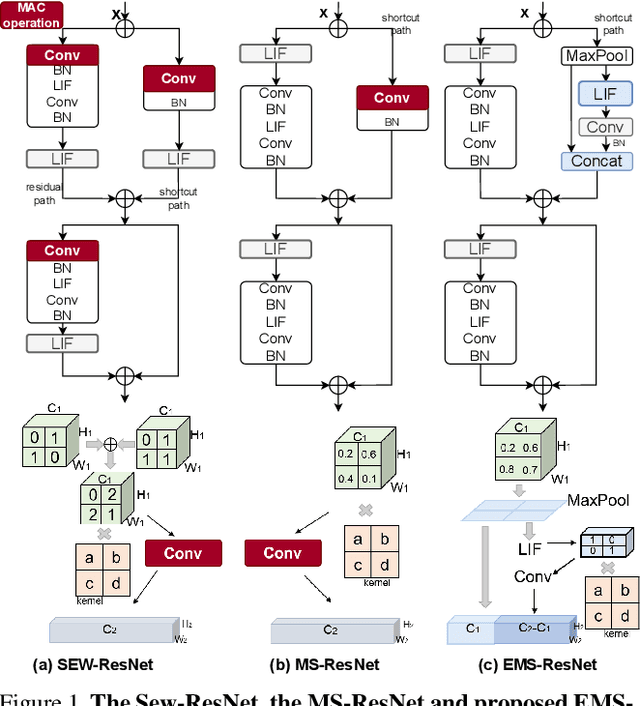
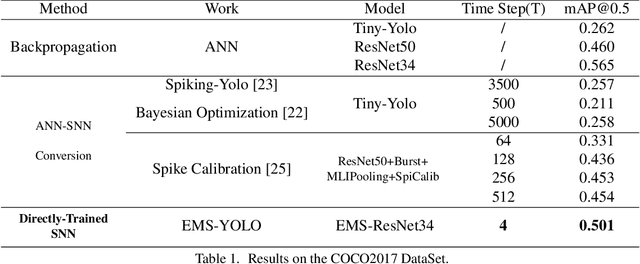
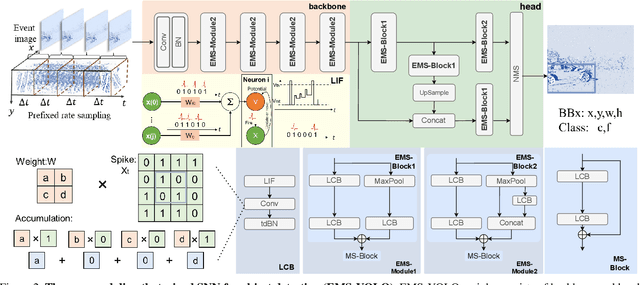
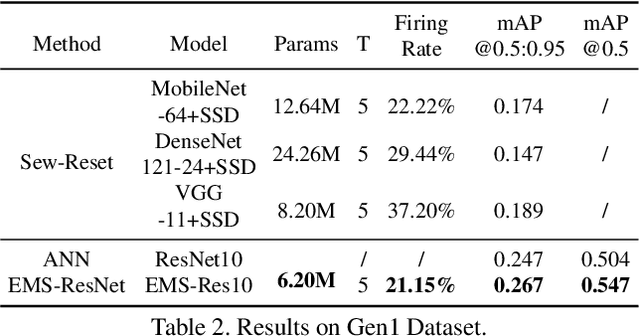
Spiking neural networks (SNNs) are brain-inspired energy-efficient models that encode information in spatiotemporal dynamics. Recently, deep SNNs trained directly have shown great success in achieving high performance on classification tasks with very few time steps. However, how to design a directly-trained SNN for the regression task of object detection still remains a challenging problem. To address this problem, we propose EMS-YOLO, a novel directly-trained SNN framework for object detection, which is the first trial to train a deep SNN with surrogate gradients for object detection rather than ANN-SNN conversion strategies. Specifically, we design a full-spike residual block, EMS-ResNet, which can effectively extend the depth of the directly-trained SNN with low power consumption. Furthermore, we theoretically analyze and prove the EMS-ResNet could avoid gradient vanishing or exploding. The results demonstrate that our approach outperforms the state-of-the-art ANN-SNN conversion methods (at least 500 time steps) in extremely fewer time steps (only 4 time steps). It is shown that our model could achieve comparable performance to the ANN with the same architecture while consuming 5.83 times less energy on the frame-based COCO Dataset and the event-based Gen1 Dataset.