 Add to Chrome
 Add to Firefox
 Add to Edge
UniRain: Unified Image Deraining with RAG-based Dataset Distillation and Multi-objective Reweighted Optimization
Mar 04, 2026
Despite significant progress has been made in image deraining, we note that most existing methods are often developed for only specific types of rain degradation and fail to generalize across diverse real-world rainy scenes. How to effectively model different rain degradations within a universal framework is important for real-world image deraining. In this paper, we propose UniRain, an effective unified image deraining framework capable of restoring images degraded by rain streak and raindrop under both daytime and nighttime conditions. To better enhance unified model generalization, we construct an intelligent retrieval augmented generation (RAG)-based dataset distillation pipeline that selects high-quality training samples from all public deraining datasets for better mixed training. Furthermore, we incorporate a simple yet effective multi-objective reweighted optimization strategy into the asymmetric mixture-of-experts (MoE) architecture to facilitate consistent performance and improve robustness across diverse scenes. Extensive experiments show that our framework performs favorably against the state-of-the-art models on our proposed benchmarks and multiple public datasets.

Rethinking Rainy 3D Scene Reconstruction via Perspective Transforming and Brightness Tuning
Nov 10, 2025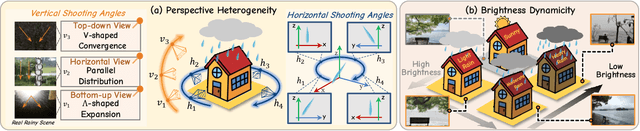

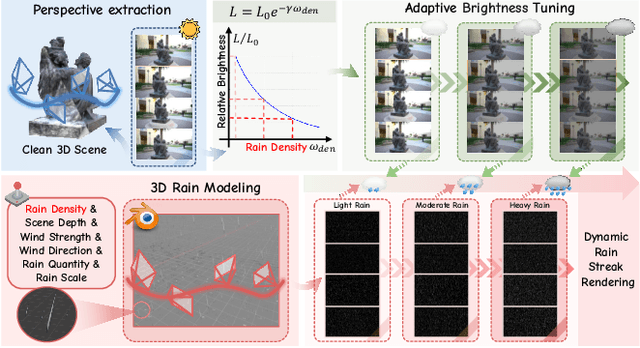

Rain degrades the visual quality of multi-view images, which are essential for 3D scene reconstruction, resulting in inaccurate and incomplete reconstruction results. Existing datasets often overlook two critical characteristics of real rainy 3D scenes: the viewpoint-dependent variation in the appearance of rain streaks caused by their projection onto 2D images, and the reduction in ambient brightness resulting from cloud coverage during rainfall. To improve data realism, we construct a new dataset named OmniRain3D that incorporates perspective heterogeneity and brightness dynamicity, enabling more faithful simulation of rain degradation in 3D scenes. Based on this dataset, we propose an end-to-end reconstruction framework named REVR-GSNet (Rain Elimination and Visibility Recovery for 3D Gaussian Splatting). Specifically, REVR-GSNet integrates recursive brightness enhancement, Gaussian primitive optimization, and GS-guided rain elimination into a unified architecture through joint alternating optimization, achieving high-fidelity reconstruction of clean 3D scenes from rain-degraded inputs. Extensive experiments show the effectiveness of our dataset and method. Our dataset and method provide a foundation for future research on multi-view image deraining and rainy 3D scene reconstruction.
SmokeBench: A Real-World Dataset for Surveillance Image Desmoking in Early-Stage Fire Scenes
Sep 16, 2025Early-stage fire scenes (0-15 minutes after ignition) represent a crucial temporal window for emergency interventions. During this stage, the smoke produced by combustion significantly reduces the visibility of surveillance systems, severely impairing situational awareness and hindering effective emergency response and rescue operations. Consequently, there is an urgent need to remove smoke from images to obtain clear scene information. However, the development of smoke removal algorithms remains limited due to the lack of large-scale, real-world datasets comprising paired smoke-free and smoke-degraded images. To address these limitations, we present a real-world surveillance image desmoking benchmark dataset named SmokeBench, which contains image pairs captured under diverse scenes setup and smoke concentration. The curated dataset provides precisely aligned degraded and clean images, enabling supervised learning and rigorous evaluation. We conduct comprehensive experiments by benchmarking a variety of desmoking methods on our dataset. Our dataset provides a valuable foundation for advancing robust and practical image desmoking in real-world fire scenes. This dataset has been released to the public and can be downloaded from https://github.com/ncfjd/SmokeBench.