 Add to Chrome
 Add to Firefox
 Add to Edge
Filter Learning for Subgraphs: Algebras and Performance Risk Bounds
Jul 23, 2026
Graph signal processing tasks that leverage spectral information typically assume access to the complete graph topology, which is often unavailable in practice. We propose a systematic framework for subgraph filter learning (SFL), where subgraph-supported operators approximate ambient graph filters under partial observations. We formulate SFL as a statistical learning problem in which optimal subgraph operators are inherently data-dependent. To address the difficulty of directly estimating such operators, we develop a subgraph filter algebra based on distance-aware Laplacian constructions, defining a structured and controllable class of filters for effective approximation. We further establish performance risk bounds under the least squares loss, quantifying how well the learned operator approximates the restricted ambient mapping. Experiments real-world datasets show that, for SFL tasks, the proposed algebraic models consistently outperform polynomial filters, distribution-agnostic operators, and direct numerical filter learning baselines that attempt to recover the underlying structure from data.

Conformal Prediction for Multi-Source Detection on a Network
Nov 12, 2025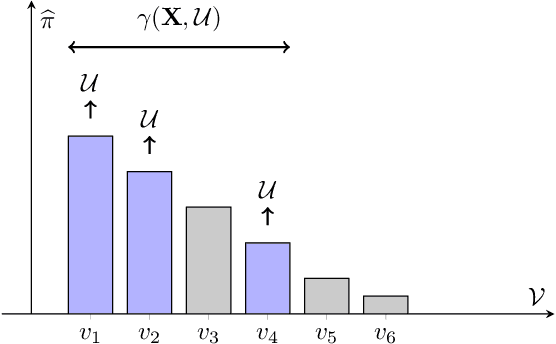
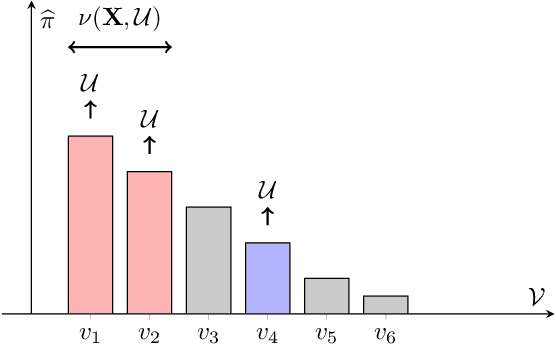
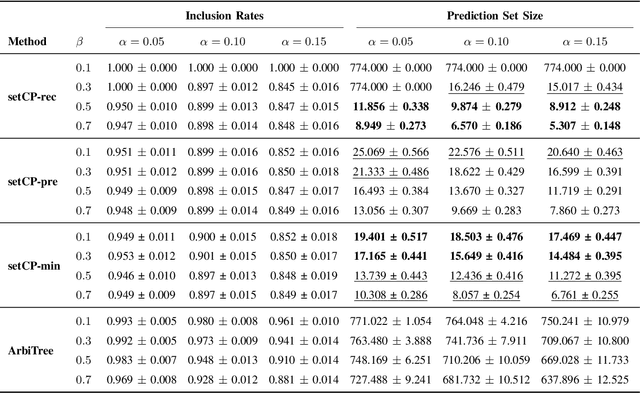
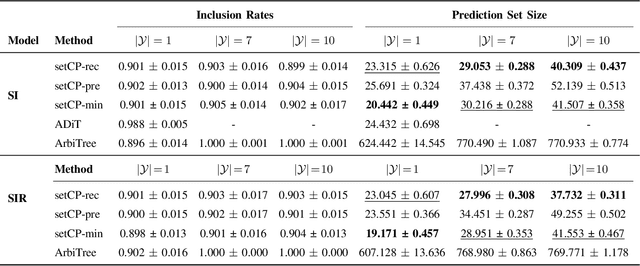
Detecting the origin of information or infection spread in networks is a fundamental challenge with applications in misinformation tracking, epidemiology, and beyond. We study the multi-source detection problem: given snapshot observations of node infection status on a graph, estimate the set of source nodes that initiated the propagation. Existing methods either lack statistical guarantees or are limited to specific diffusion models and assumptions. We propose a novel conformal prediction framework that provides statistically valid recall guarantees for source set detection, independent of the underlying diffusion process or data distribution. Our approach introduces principled score functions to quantify the alignment between predicted probabilities and true sources, and leverages a calibration set to construct prediction sets with user-specified recall and coverage levels. The method is applicable to both single- and multi-source scenarios, supports general network diffusion dynamics, and is computationally efficient for large graphs. Empirical results demonstrate that our method achieves rigorous coverage with competitive accuracy, outperforming existing baselines in both reliability and scalability.The code is available online.
Frequency Convergence of Complexon Shift Operators (Extended Version)
Sep 15, 2023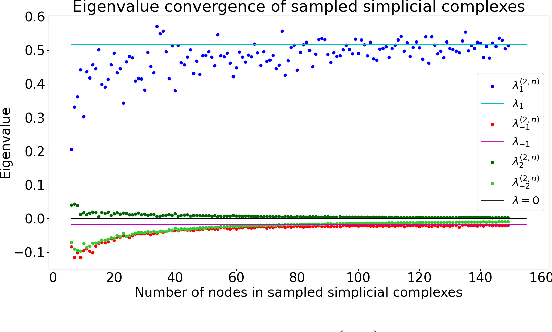
Topological Signal Processing (TSP) utilizes simplicial complexes to model structures with higher order than vertices and edges. In this paper, we study the transferability of TSP via a generalized higher-order version of graphon, known as complexon. We recall the notion of a complexon as the limit of a simplicial complex sequence. Inspired by the integral operator form of graphon shift operators, we construct a marginal complexon and complexon shift operator (CSO) according to components of all possible dimensions from the complexon. We investigate the CSO's eigenvalues and eigenvectors, and relate them to a new family of weighted adjacency matrices. We prove that when a simplicial complex sequence converges to a complexon, the eigenvalues of the corresponding CSOs converge to that of the limit complexon. This conclusion is further verified by a numerical experiment. These results hint at learning transferability on large simplicial complexes or simplicial complex sequences, which generalize the graphon signal processing framework.