 Add to Chrome
 Add to Firefox
 Add to Edge
InsightFlow: LLM-Driven Synthesis of Patient Narratives for Mental Health into Causal Models
Apr 14, 2026
Clinical case formulation organizes patient symptoms and psychosocial factors into causal models, often using the 5P framework. However, constructing such graphs from therapy transcripts is time consuming and varies across clinicians. We present InsightFlow, an LLM based approach that automatically generates 5P aligned causal graphs from patient-therapist dialogues. Using 46 psychotherapy intake transcripts annotated by clinical experts, we evaluate LLM generated graphs against human formulations using structural (NetSimile), semantic (embedding similarity), and expert rated clinical criteria. The generated graphs show structural similarity comparable to inter annotator agreement and high semantic alignment with human graphs. Expert evaluations rate the outputs as moderately complete, consistent, and clinically useful. While LLM graphs tend to form more interconnected structures compared to the chain like patterns of human graphs, overall complexity and content coverage are similar. These results suggest that LLMs can produce clinically meaningful case formulation graphs within the natural variability of expert practice. InsightFlow highlights the potential of automated causal modeling to augment clinical workflows, with future work needed to improve temporal reasoning and reduce redundancy.

Through BrokenEyes: How Eye Disorders Impact Face Detection?
Feb 26, 2026Vision disorders significantly impact millions of lives, altering how visual information is processed and perceived. In this work, a computational framework was developed using the BrokenEyes system to simulate five common eye disorders: Age-related macular degeneration, cataract, glaucoma, refractive errors, and diabetic retinopathy and analyze their effects on neural-like feature representations in deep learning models. Leveraging a combination of human and non-human datasets, models trained under normal and disorder-specific conditions revealed critical disruptions in feature maps, particularly for cataract and glaucoma, which align with known neural processing challenges in these conditions. Evaluation metrics such as activation energy and cosine similarity quantified the severity of these distortions, providing insights into the interplay between degraded visual inputs and learned representations.
coTherapist: A Behavior-Aligned Small Language Model to Support Mental Healthcare Experts
Jan 15, 2026Access to mental healthcare is increasingly strained by workforce shortages and rising demand, motivating the development of intelligent systems that can support mental healthcare experts. We introduce coTherapist, a unified framework utilizing a small language model to emulate core therapeutic competencies through domain-specific fine-tuning, retrieval augmentation, and agentic reasoning. Evaluation on clinical queries demonstrates that coTherapist generates more relevant and clinically grounded responses than contemporary baselines. Using our novel T-BARS rubric and psychometric profiling, we confirm coTherapist exhibits high empathy and therapist-consistent personality traits. Furthermore, human evaluation by domain experts validates that coTherapist delivers accurate, trustworthy, and safe responses. coTherapist was deployed and tested by clinical experts. Collectively, these findings demonstrate that small models can be engineered to exhibit expert-like behavior, offering a scalable pathway for digital mental health tools.
Exploring the Efficacy of Large Language Models in Summarizing Mental Health Counseling Sessions: A Benchmark Study
Feb 29, 2024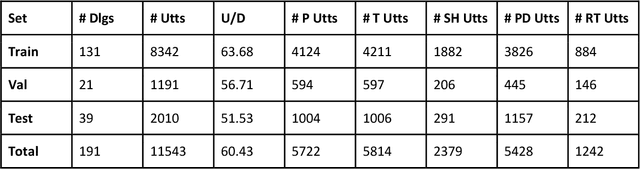
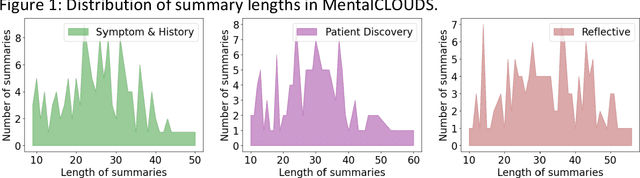
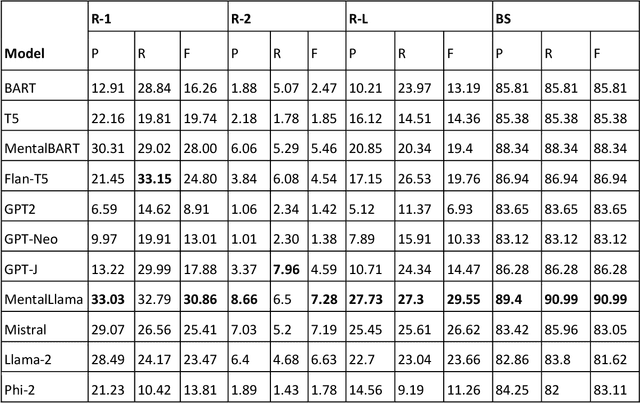
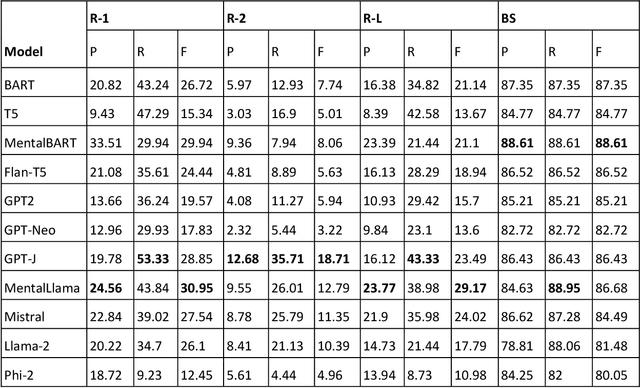
Comprehensive summaries of sessions enable an effective continuity in mental health counseling, facilitating informed therapy planning. Yet, manual summarization presents a significant challenge, diverting experts' attention from the core counseling process. This study evaluates the effectiveness of state-of-the-art Large Language Models (LLMs) in selectively summarizing various components of therapy sessions through aspect-based summarization, aiming to benchmark their performance. We introduce MentalCLOUDS, a counseling-component guided summarization dataset consisting of 191 counseling sessions with summaries focused on three distinct counseling components (aka counseling aspects). Additionally, we assess the capabilities of 11 state-of-the-art LLMs in addressing the task of component-guided summarization in counseling. The generated summaries are evaluated quantitatively using standard summarization metrics and verified qualitatively by mental health professionals. Our findings demonstrate the superior performance of task-specific LLMs such as MentalLlama, Mistral, and MentalBART in terms of standard quantitative metrics such as Rouge-1, Rouge-2, Rouge-L, and BERTScore across all aspects of counseling components. Further, expert evaluation reveals that Mistral supersedes both MentalLlama and MentalBART based on six parameters -- affective attitude, burden, ethicality, coherence, opportunity costs, and perceived effectiveness. However, these models share the same weakness by demonstrating a potential for improvement in the opportunity costs and perceived effectiveness metrics.
TRAVID: An End-to-End Video Translation Framework
Sep 20, 2023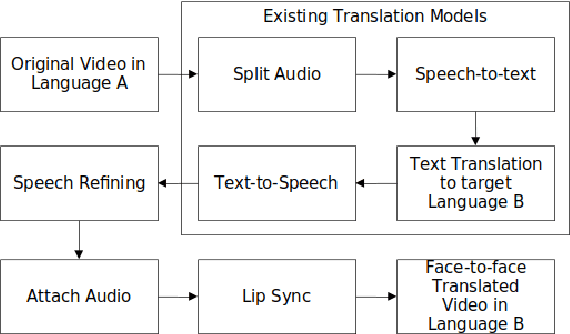

In today's globalized world, effective communication with people from diverse linguistic backgrounds has become increasingly crucial. While traditional methods of language translation, such as written text or voice-only translations, can accomplish the task, they often fail to capture the complete context and nuanced information conveyed through nonverbal cues like facial expressions and lip movements. In this paper, we present an end-to-end video translation system that not only translates spoken language but also synchronizes the translated speech with the lip movements of the speaker. Our system focuses on translating educational lectures in various Indian languages, and it is designed to be effective even in low-resource system settings. By incorporating lip movements that align with the target language and matching them with the speaker's voice using voice cloning techniques, our application offers an enhanced experience for students and users. This additional feature creates a more immersive and realistic learning environment, ultimately making the learning process more effective and engaging.