 Add to Chrome
 Add to Firefox
 Add to Edge
Cheap Thrills: Effective Amortized Optimization Using Inexpensive Labels
Mar 05, 2026
To scale the solution of optimization and simulation problems, prior work has explored machine-learning surrogates that inexpensively map problem parameters to corresponding solutions. Commonly used approaches, including supervised and self-supervised learning with either soft or hard feasibility enforcement, face inherent challenges such as reliance on expensive, high-quality labels or difficult optimization landscapes. To address their trade-offs, we propose a novel framework that first collects "cheap" imperfect labels, then performs supervised pretraining, and finally refines the model through self-supervised learning to improve overall performance. Our theoretical analysis and merit-based criterion show that labeled data need only place the model within a basin of attraction, confirming that only modest numbers of inexact labels and training epochs are required. We empirically validate our simple three-stage strategy across challenging domains, including nonconvex constrained optimization, power-grid operation, and stiff dynamical systems, and show that it yields faster convergence; improved accuracy, feasibility, and optimality; and up to 59x reductions in total offline cost.

Enforcing Policy Feasibility Constraints through Differentiable Projection for Energy Optimization
May 19, 2021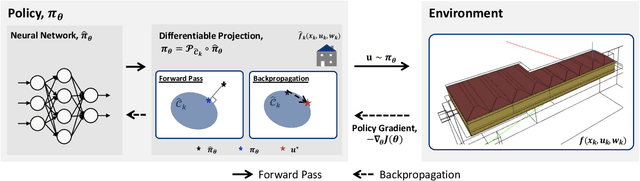
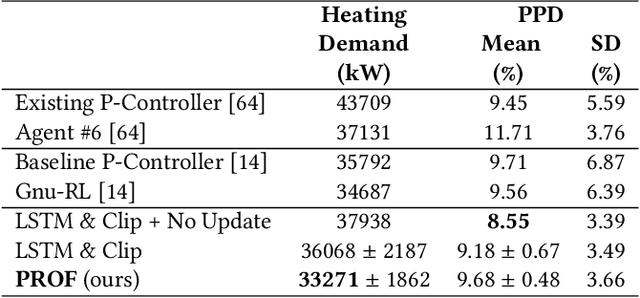
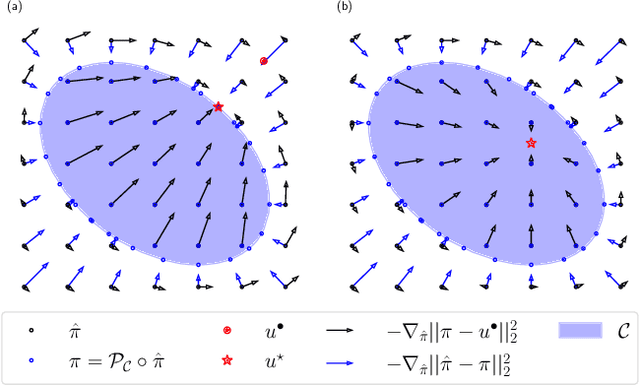
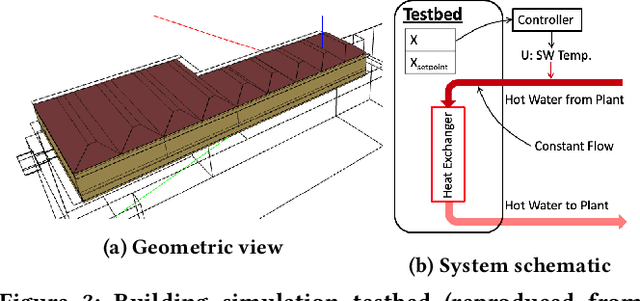
While reinforcement learning (RL) is gaining popularity in energy systems control, its real-world applications are limited due to the fact that the actions from learned policies may not satisfy functional requirements or be feasible for the underlying physical system. In this work, we propose PROjected Feasibility (PROF), a method to enforce convex operational constraints within neural policies. Specifically, we incorporate a differentiable projection layer within a neural network-based policy to enforce that all learned actions are feasible. We then update the policy end-to-end by propagating gradients through this differentiable projection layer, making the policy cognizant of the operational constraints. We demonstrate our method on two applications: energy-efficient building operation and inverter control. In the building operation setting, we show that PROF maintains thermal comfort requirements while improving energy efficiency by 4% over state-of-the-art methods. In the inverter control setting, PROF perfectly satisfies voltage constraints on the IEEE 37-bus feeder system, as it learns to curtail as little renewable energy as possible within its safety set.