 Add to Chrome
 Add to Firefox
 Add to Edge
Tools to Explain Neural Networks for Power System Dynamics
Aug 08, 2026
This paper presents, for the first time in power systems literature to our knowledge, analytical tools to explain the training performance of machine learning surrogate models for power system dynamics. Power system simulations are increasingly challenged by stiff and multi-timescale dynamics arising from converter-interfaced resources and fast control loops. Machine learning surrogates emerge as promising tools to handle this complexity and accelerate dynamic simulations. However, their performance remains difficult to interpret, which limits their adoption. Building on the small-signal eigenvalue analysis in power systems, this paper uses the Neural Tangent Kernel (NTK) method. NTK delivers a modal interpretation of the learning performance, identifying error modes that decay rapidly versus others that converge slowly. This connection explains how physical stiffness and timescale separation in power system dynamic models appear as optimization stiffness during Neural Network (NN) training. Based on this analysis, we develop adaptive loss-weighting strategies to improve and explain why structure-aware neural architectures, such as ActNet, perform better than vanilla NNs. We assess the proposed approach on physics-informed machine learning surrogate models of \acp{SM} and power electronic converters. The methods introduced in this paper can deliver the necessary analytical tools to interpret and improve the performance of machine learning surrogates, paving the way for the systematic, physics-aware design of NN architectures and training strategies. By moving beyond trial-and-error development, these tools reveal training dynamics and failure modes, support more reliable design decisions, and strengthen confidence in machine-learning surrogates for engineering applications.

Verification and Validation of Physics-Informed Surrogate Component Models for Dynamic Power-System Simulation
Mar 18, 2026Physics-informed machine learning surrogates are increasingly explored to accelerate dynamic simulation of generators, converters, and other power grid components. The key question, however, is not only whether a surrogate matches a stand-alone component model on average, but whether it remains accurate after insertion into a differential-algebraic simulator, where the surrogate outputs enter the algebraic equations coupling the component to the rest of the system. This paper formulates that in-simulator use as a verification and validation (V\&V) problem. A finite-horizon bound is derived that links allowable component-output error to algebraic-coupling sensitivity, dynamic error amplification, and the simulation horizon. Two complementary settings are then studied: model-based verification against a reference component solver, and data-based validation through conformal calibration of the component-output variables exchanged with the simulator. The framework is general, but the case study focuses on physics-informed neural-network surrogates of second-, fourth-, and sixth-order synchronous-machine models. Results show that good stand-alone surrogate accuracy does not by itself guarantee accurate in-simulator behavior, that the largest discrepancies concentrate in stressed operating regions, and that small equation residuals do not necessarily imply small state-trajectory errors.
Cheap Thrills: Effective Amortized Optimization Using Inexpensive Labels
Mar 05, 2026To scale the solution of optimization and simulation problems, prior work has explored machine-learning surrogates that inexpensively map problem parameters to corresponding solutions. Commonly used approaches, including supervised and self-supervised learning with either soft or hard feasibility enforcement, face inherent challenges such as reliance on expensive, high-quality labels or difficult optimization landscapes. To address their trade-offs, we propose a novel framework that first collects "cheap" imperfect labels, then performs supervised pretraining, and finally refines the model through self-supervised learning to improve overall performance. Our theoretical analysis and merit-based criterion show that labeled data need only place the model within a basin of attraction, confirming that only modest numbers of inexact labels and training epochs are required. We empirically validate our simple three-stage strategy across challenging domains, including nonconvex constrained optimization, power-grid operation, and stiff dynamical systems, and show that it yields faster convergence; improved accuracy, feasibility, and optimality; and up to 59x reductions in total offline cost.
Correctness Verification of Neural Networks Approximating Differential Equations
Feb 12, 2024

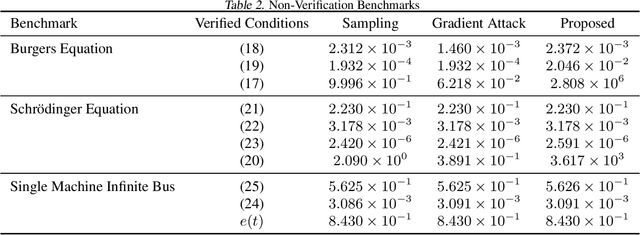
Verification of Neural Networks (NNs) that approximate the solution of Partial Differential Equations (PDEs) is a major milestone towards enhancing their trustworthiness and accelerating their deployment, especially for safety-critical systems. If successful, such NNs can become integral parts of simulation software tools which can accelerate the simulation of complex dynamic systems more than 100 times. However, the verification of these functions poses major challenges; it is not straightforward how to efficiently bound them or how to represent the derivative of the NN. This work addresses both these problems. First, we define the NN derivative as a finite difference approximation. Then, we formulate the PDE residual bounding problem alongside the Initial Value Problem's error propagation. Finally, for the first time, we tackle the problem of bounding an NN function without a priori knowledge of the output domain. For this, we build a parallel branching algorithm that combines the incomplete CROWN solver and Gradient Attack for termination and domain rejection conditions. We demonstrate the strengths and weaknesses of the proposed framework, and we suggest further work to enhance its efficiency.