 Add to Chrome
 Add to Firefox
 Add to Edge
Resolving Interference (RI): Disentangling Models for Improved Model Merging
Mar 13, 2026
Model merging has shown that multitask models can be created by directly combining the parameters of different models that are each specialized on tasks of interest. However, models trained independently on distinct tasks often exhibit interference that degrades the merged model's performance. To solve this problem, we formally define the notion of Cross-Task Interference as the drift in the representation of the merged model relative to its constituent models. Reducing cross-task interference is key to improving merging performance. To address this issue, we propose our method, Resolving Interference (RI), a light-weight adaptation framework which disentangles expert models to be functionally orthogonal to the space of other tasks, thereby reducing cross-task interference. RI does this whilst using only unlabeled auxiliary data as input (i.e., no task-data is needed), allowing it to be applied in data-scarce scenarios. RI consistently improves the performance of state-of-the-art merging methods by up to 3.8% and generalization to unseen domains by up to 2.3%. We also find RI to be robust to the source of auxiliary input while being significantly less sensitive to tuning of merging hyperparameters. Our codebase is available at: https://github.com/pramesh39/resolving_interference

Model merging with SVD to tie the Knots
Oct 25, 2024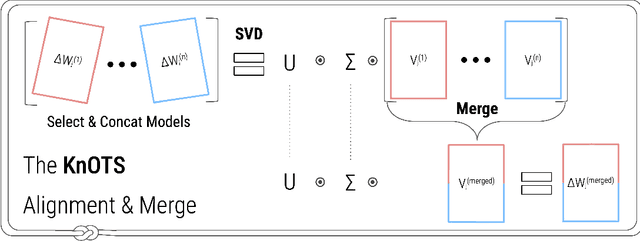
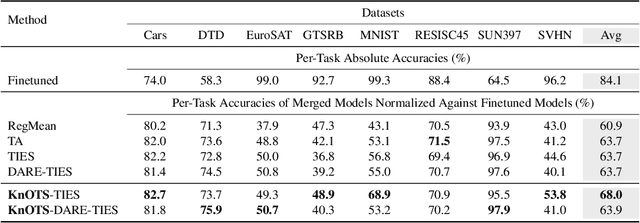
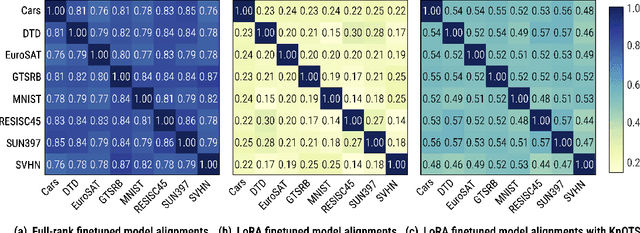
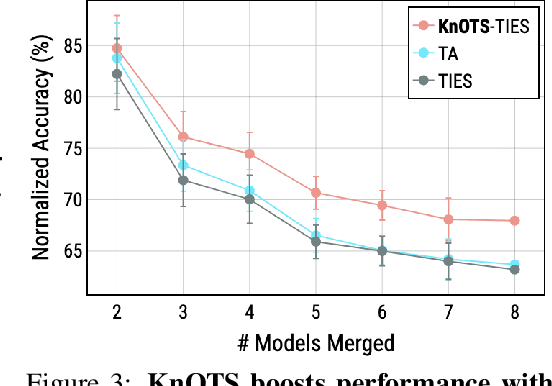
Recent model merging methods demonstrate that the parameters of fully-finetuned models specializing in distinct tasks can be combined into one model capable of solving all tasks without retraining. Yet, this success does not transfer well when merging LoRA finetuned models. We study this phenomenon and observe that the weights of LoRA finetuned models showcase a lower degree of alignment compared to their fully-finetuned counterparts. We hypothesize that improving this alignment is key to obtaining better LoRA model merges, and propose KnOTS to address this problem. KnOTS uses the SVD to jointly transform the weights of different LoRA models into an aligned space, where existing merging methods can be applied. In addition, we introduce a new benchmark that explicitly evaluates whether merged models are general models. Notably, KnOTS consistently improves LoRA merging by up to 4.3% across several vision and language benchmarks, including our new setting. We release our code at: https://github.com/gstoica27/KnOTS.
FACTS: First Amplify Correlations and Then Slice to Discover Bias
Sep 29, 2023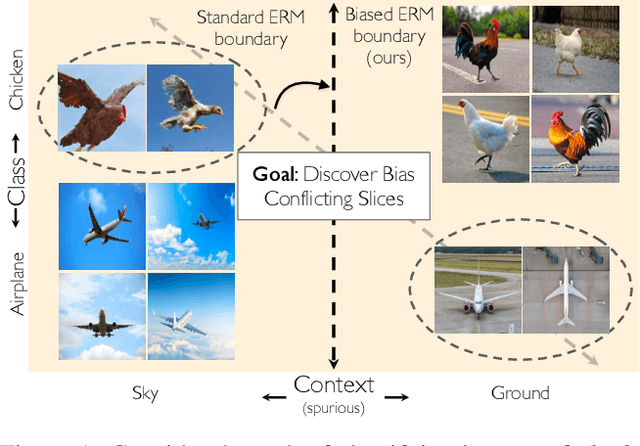

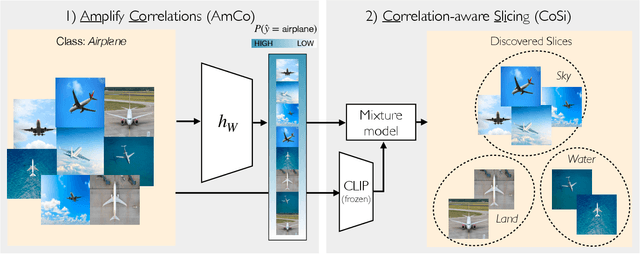

Computer vision datasets frequently contain spurious correlations between task-relevant labels and (easy to learn) latent task-irrelevant attributes (e.g. context). Models trained on such datasets learn "shortcuts" and underperform on bias-conflicting slices of data where the correlation does not hold. In this work, we study the problem of identifying such slices to inform downstream bias mitigation strategies. We propose First Amplify Correlations and Then Slice to Discover Bias (FACTS), wherein we first amplify correlations to fit a simple bias-aligned hypothesis via strongly regularized empirical risk minimization. Next, we perform correlation-aware slicing via mixture modeling in bias-aligned feature space to discover underperforming data slices that capture distinct correlations. Despite its simplicity, our method considerably improves over prior work (by as much as 35% precision@10) in correlation bias identification across a range of diverse evaluation settings. Our code is available at: https://github.com/yvsriram/FACTS.