 Add to Chrome
 Add to Firefox
 Add to Edge
Automated Quality Assessment of Blind Sweep Obstetric Ultrasound for Improved Diagnosis
Mar 26, 2026
Blind Sweep Obstetric Ultrasound (BSOU) enables scalable fetal imaging in low-resource settings by allowing minimally trained operators to acquire standardized sweep videos for automated Artificial Intelligence(AI) interpretation. However, the reliability of such AI systems depends critically on the quality of the acquired sweeps, and little is known about how deviations from the intended protocol affect downstream predictions. In this work, we present a systematic evaluation of BSOU quality and its impact on three key AI tasks: sweep-tag classification, fetal presentation classification, and placenta-location classification. We simulate plausible acquisition deviations, including reversed sweep direction, probe inversion, and incomplete sweeps, to quantify model robustness, and we develop automated quality-assessment models capable of detecting these perturbations. To approximate real-world deployment, we simulate a feedback loop in which flagged sweeps are re-acquired, showing that such correction improves downstream task performance. Our findings highlight the sensitivity of BSOU-based AI models to acquisition variability and demonstrate that automated quality assessment can play a central role in building reliable, scalable AI-assisted prenatal ultrasound workflows, particularly in low-resource environments.

Synthetic Boost: Leveraging Synthetic Data for Enhanced Vision-Language Segmentation in Echocardiography
Sep 22, 2023Accurate segmentation is essential for echocardiography-based assessment of cardiovascular diseases (CVDs). However, the variability among sonographers and the inherent challenges of ultrasound images hinder precise segmentation. By leveraging the joint representation of image and text modalities, Vision-Language Segmentation Models (VLSMs) can incorporate rich contextual information, potentially aiding in accurate and explainable segmentation. However, the lack of readily available data in echocardiography hampers the training of VLSMs. In this study, we explore using synthetic datasets from Semantic Diffusion Models (SDMs) to enhance VLSMs for echocardiography segmentation. We evaluate results for two popular VLSMs (CLIPSeg and CRIS) using seven different kinds of language prompts derived from several attributes, automatically extracted from echocardiography images, segmentation masks, and their metadata. Our results show improved metrics and faster convergence when pretraining VLSMs on SDM-generated synthetic images before finetuning on real images. The code, configs, and prompts are available at https://github.com/naamiinepal/synthetic-boost.
Exploring Transfer Learning in Medical Image Segmentation using Vision-Language Models
Aug 15, 2023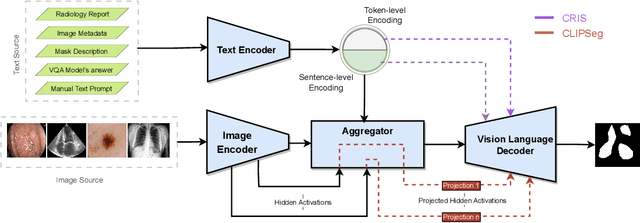
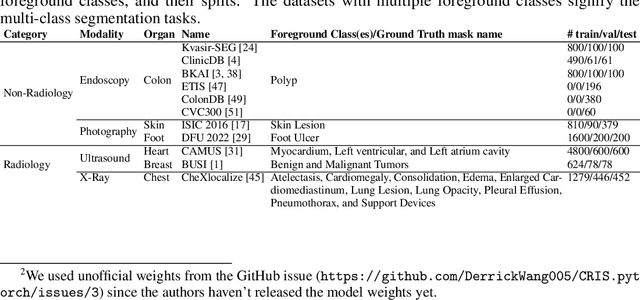
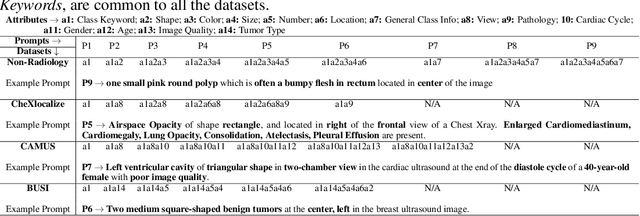
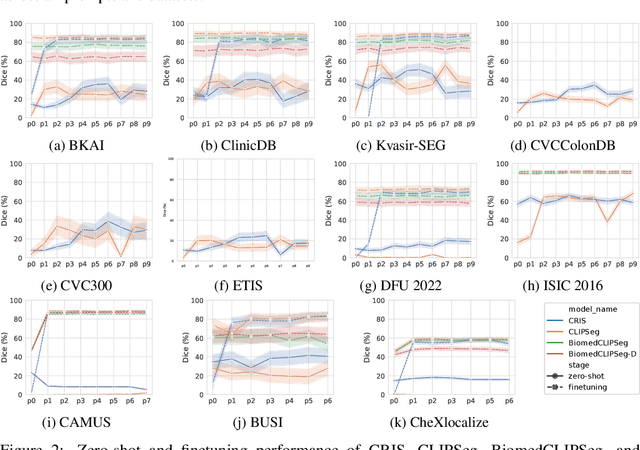
Medical Image Segmentation is crucial in various clinical applications within the medical domain. While state-of-the-art segmentation models have proven effective, integrating textual guidance to enhance visual features for this task remains an area with limited progress. Existing segmentation models that utilize textual guidance are primarily trained on open-domain images, raising concerns about their direct applicability in the medical domain without manual intervention or fine-tuning. To address these challenges, we propose using multimodal vision-language models for capturing semantic information from image descriptions and images, enabling the segmentation of diverse medical images. This study comprehensively evaluates existing vision language models across multiple datasets to assess their transferability from the open domain to the medical field. Furthermore, we introduce variations of image descriptions for previously unseen images in the dataset, revealing notable variations in model performance based on the generated prompts. Our findings highlight the distribution shift between the open-domain images and the medical domain and show that the segmentation models trained on open-domain images are not directly transferrable to the medical field. But their performance can be increased by finetuning them in the medical datasets. We report the zero-shot and finetuned segmentation performance of 4 Vision Language Models (VLMs) on 11 medical datasets using 9 types of prompts derived from 14 attributes.