 Add to Chrome
 Add to Firefox
 Add to Edge
Automated Quality Assessment of Blind Sweep Obstetric Ultrasound for Improved Diagnosis
Mar 26, 2026
Blind Sweep Obstetric Ultrasound (BSOU) enables scalable fetal imaging in low-resource settings by allowing minimally trained operators to acquire standardized sweep videos for automated Artificial Intelligence(AI) interpretation. However, the reliability of such AI systems depends critically on the quality of the acquired sweeps, and little is known about how deviations from the intended protocol affect downstream predictions. In this work, we present a systematic evaluation of BSOU quality and its impact on three key AI tasks: sweep-tag classification, fetal presentation classification, and placenta-location classification. We simulate plausible acquisition deviations, including reversed sweep direction, probe inversion, and incomplete sweeps, to quantify model robustness, and we develop automated quality-assessment models capable of detecting these perturbations. To approximate real-world deployment, we simulate a feedback loop in which flagged sweeps are re-acquired, showing that such correction improves downstream task performance. Our findings highlight the sensitivity of BSOU-based AI models to acquisition variability and demonstrate that automated quality assessment can play a central role in building reliable, scalable AI-assisted prenatal ultrasound workflows, particularly in low-resource environments.

Modeling Image Structure with Factorized Phase-Coupled Boltzmann Machines
Nov 17, 2010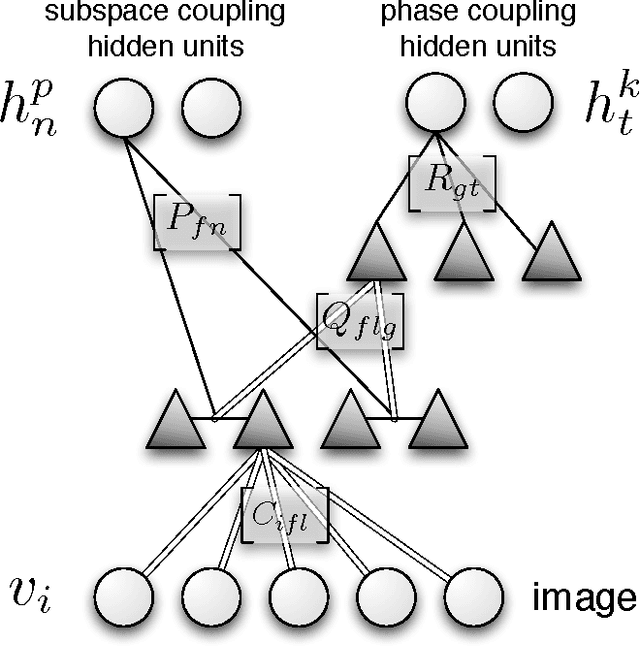
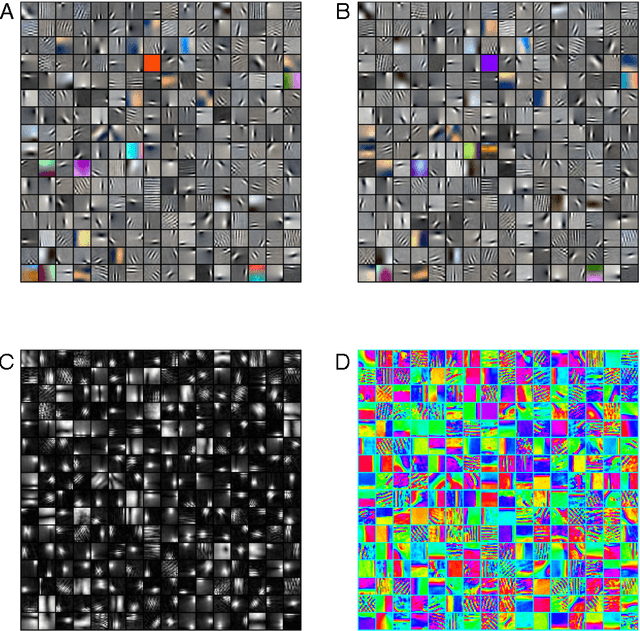
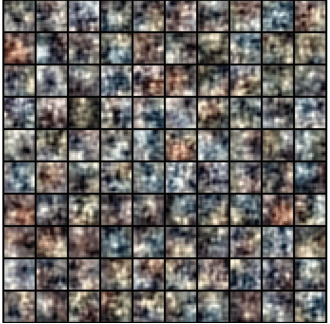
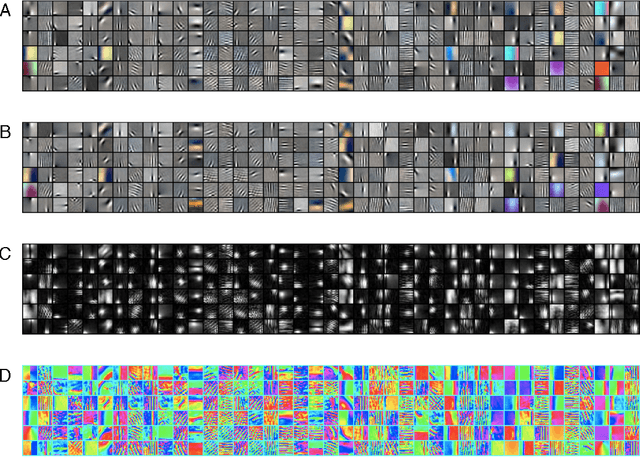
We describe a model for capturing the statistical structure of local amplitude and local spatial phase in natural images. The model is based on a recently developed, factorized third-order Boltzmann machine that was shown to be effective at capturing higher-order structure in images by modeling dependencies among squared filter outputs (Ranzato and Hinton, 2010). Here, we extend this model to $L_p$-spherically symmetric subspaces. In order to model local amplitude and phase structure in images, we focus on the case of two dimensional subspaces, and the $L_2$-norm. When trained on natural images the model learns subspaces resembling quadrature-pair Gabor filters. We then introduce an additional set of hidden units that model the dependencies among subspace phases. These hidden units form a combinatorial mixture of phase coupling distributions, concentrated in the sum and difference of phase pairs. When adapted to natural images, these distributions capture local spatial phase structure in natural images.