 Add to Chrome
 Add to Firefox
 Add to Edge
Matching Rates and Optimal Allocation for Federated Probe-Logit Distillation under Heterogeneous Bandwidth Budgets
May 28, 2026
In federated language modeling, $K$ nodes each hold $n$ samples but cannot pool data or exchange full-precision gradients or weights. We study the minimax rate at which a conditional distribution over $V$ tokens can be estimated when each node may upload at most $B$ bits per query in a public probe set. In federated probe-logit distillation (FPLD), each node transmits a scalar-quantized logit vector on the probe set, and an aggregator distills a global parametric student. Prior work (Dubey and Huo, 2026) establishes a high-probability KL rate $O(d/(Kn) + ρ\sqrt{V \log V / m} + K^{-1} \cdot 2^{-2B/V})$ plus optimization slack, with the bandwidth term in its trace-sharpened form. Whether this bandwidth-term rate is tight, and how the upper bound generalizes to heterogeneous per-node bandwidths, are left open. We close both gaps. First, the dithered FPLD construction has a matching single-round lower bound $Ω(K^{-1} \cdot 2^{-2B/V})$ under non-degeneracy, pinning the bandwidth-axis rate at $Θ(K^{-1} \cdot 2^{-2B/V})$. $T$-round sequential refinement with nested/scaled residual quantizers achieves $O(K^{-1} \cdot 2^{-2TB/V})$; vanilla FPLD's $T$-independent bandwidth term is suboptimal for every $T > 1$. Second, we establish a heterogeneous-bandwidth upper bound for per-node budgets $B_i$, paired with a closed-form optimal allocation $B_i^* = B_{\mathrm{tot}}/K + (V/2) \log_2(w_i / \bar{w}_g)$, a log-tilted water-filling rule that is the per-node analogue of reverse water-filling for distortion-rate optimization. A plug-in adaptive variant estimates the weights from a short warm-up phase and attains $1 + O(\sqrt{\log(K/δ)/(m T_0)})$ relative suboptimality. Synthetic n-gram simulations confirm that empirical KL is bracketed by the upper and lower bounds and that the optimal allocation strictly dominates uniform and inverse-weighted baselines under heterogeneous clipping.

Anytime-Valid Federated Conformal RAG for LLM Swarms
May 27, 2026Federated Conformal RAG (FC-RAG) provides distribution-free coverage for a bandwidth-limited swarm of weak language models, but only at a fixed horizon. We extend it to anytime-valid sequential coverage: validity at every stopping time, preserved under predictable adaptive control (recalibration, per-node bandwidth escalation, distilled-student refresh), at no extra cost in assumptions over fixed-horizon FC-RAG. Naive composition fails because FC-RAG's marginal coverage bound makes the betting e-process a non-supermartingale on adverse calibration draws, and Ville's inequality cannot be invoked. We give Anytime-FC-RAG, a sequential extension built on a summable per-step calibration-deviation budget that converts the marginal bound into a strict conditional bound on a calibration-good event, paired with a truncated betting e-process that is a nonnegative supermartingale on the entire probability space. From these two ingredients, we obtain four guarantees: time-uniform alarm validity $\mathbb{P}(\sup_t E_t \ge 1/δ_e) \le δ_e + δ_{\mathrm{cal}}$, a Hoeffding-stitched cumulative-miscoverage envelope at the same total budget, safety under any predictable controller (recalibration, bandwidth escalation, student refresh), and training-side error propagation across an unbounded sequence of Federated Probe-Logit Distillation (FPLD) refreshes via a summable training budget. As a practical consequence, an adaptive controller that escalates retrieval bandwidth only when the e-process crosses a warning threshold matches the alarm rate of a fixed-high-bandwidth schedule at substantially lower communication cost. Experiments on a GPT-2-small + MiniLM swarm across MMLU, DBpedia, and AG News verify the predicted alarm rate, detection delay, envelope coverage, and $14$-$57\%$ bandwidth savings; the alarm fires when and only when coverage genuinely breaks.
Federated Language Models Under Bandwidth Budgets: Distillation Rates and Conformal Coverage
May 11, 2026Training a language model on data scattered across bandwidth-limited nodes that cannot be centralized is a setting that arises in clinical networks, enterprise knowledge bases, and scientific consortia. We study the regime in which data must remain distributed across nodes, and ask what statistical guarantees are in principle achievable under explicit bandwidth budgets; we aim to characterize what is provably possible, not to demonstrate a deployment-ready system. Existing theory treats either training-time consistency or inference-time calibration in isolation, and none makes bandwidth a first-class statistical parameter. We analyze two protocols, Federated Probe-Logit Distillation (FPLD) for training and Federated Conformal RAG (FC-RAG) for inference, as the analytical vehicles for our results. Our first main result is an explicit high-probability KL-consistency rate for FPLD with simultaneous dependence on node count $K$, per-node sample size $n$, quantization budget $B$, probe-set size $m$, and vocabulary size $V$; bandwidth enters only through an exponentially vanishing quantization term. Our second main result is a distribution-free marginal-coverage bound for FC-RAG, whose novel retrieval-bandwidth slack $Δ_{\mathrm{RAG}} = f_{\max}\sqrt{K^{-2}\sum_i v(B_i)}$ makes per-node retrieval bandwidth a first-class statistical parameter, with arithmetic aggregation across $K$ nodes shrinking the slack as $K^{-1/2}$ in the per-node-uniform regime. A Pinsker-type corollary composes the two bounds into an end-to-end coverage guarantee. Synthetic experiments verify the predicted scaling along the bounds' parameters; small-scale experiments on a GPT-2 testbed illustrate that the qualitative bandwidth-accuracy tradeoff survives on a real language model. A deployment-scale empirical evaluation is out of scope.
LLmFPCA-detect: LLM-powered Multivariate Functional PCA for Anomaly Detection in Sparse Longitudinal Texts
Dec 16, 2025Sparse longitudinal (SL) textual data arises when individuals generate text repeatedly over time (e.g., customer reviews, occasional social media posts, electronic medical records across visits), but the frequency and timing of observations vary across individuals. These complex textual data sets have immense potential to inform future policy and targeted recommendations. However, because SL text data lack dedicated methods and are noisy, heterogeneous, and prone to anomalies, detecting and inferring key patterns is challenging. We introduce LLmFPCA-detect, a flexible framework that pairs LLM-based text embeddings with functional data analysis to detect clusters and infer anomalies in large SL text datasets. First, LLmFPCA-detect embeds each piece of text into an application-specific numeric space using LLM prompts. Sparse multivariate functional principal component analysis (mFPCA) conducted in the numeric space forms the workhorse to recover primary population characteristics, and produces subject-level scores which, together with baseline static covariates, facilitate data segmentation, unsupervised anomaly detection and inference, and enable other downstream tasks. In particular, we leverage LLMs to perform dynamic keyword profiling guided by the data segments and anomalies discovered by LLmFPCA-detect, and we show that cluster-specific functional PC scores from LLmFPCA-detect, used as features in existing pipelines, help boost prediction performance. We support the stability of LLmFPCA-detect with experiments and evaluate it on two different applications using public datasets, Amazon customer-review trajectories, and Wikipedia talk-page comment streams, demonstrating utility across domains and outperforming state-of-the-art baselines.
Generalization Bounds for Magnitude-Based Pruning via Sparse Matrix Sketching
May 30, 2023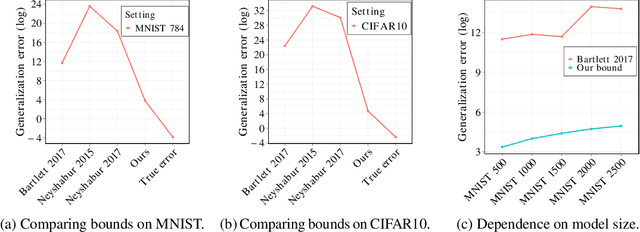
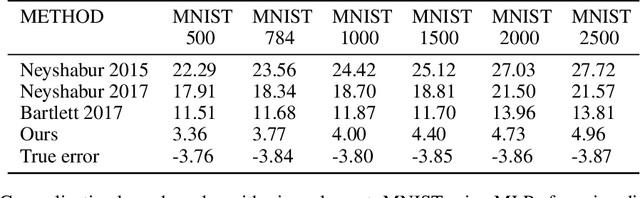
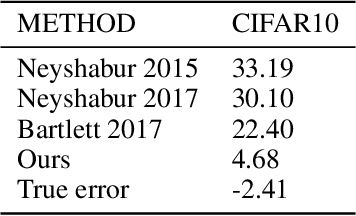
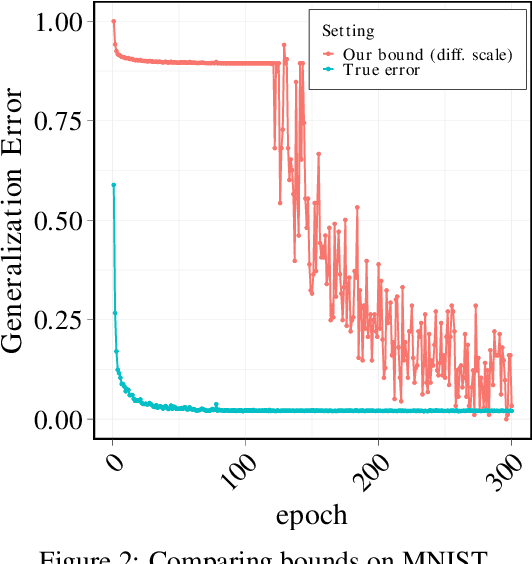
In this paper, we derive a novel bound on the generalization error of Magnitude-Based pruning of overparameterized neural networks. Our work builds on the bounds in Arora et al. [2018] where the error depends on one, the approximation induced by pruning, and two, the number of parameters in the pruned model, and improves upon standard norm-based generalization bounds. The pruned estimates obtained using our new Magnitude-Based compression algorithm are close to the unpruned functions with high probability, which improves the first criteria. Using Sparse Matrix Sketching, the space of the pruned matrices can be efficiently represented in the space of dense matrices of much smaller dimensions, thereby lowering the second criterion. This leads to stronger generalization bound than many state-of-the-art methods, thereby breaking new ground in the algorithm development for pruning and bounding generalization error of overparameterized models. Beyond this, we extend our results to obtain generalization bound for Iterative Pruning [Frankle and Carbin, 2018]. We empirically verify the success of this new method on ReLU-activated Feed Forward Networks on the MNIST and CIFAR10 datasets.