 Add to Chrome
 Add to Firefox
 Add to Edge
PatientAgentBench: A Benchmark Framework for Evaluating Patient-Facing Health AI Agents
Jul 28, 2026
Health AI is evolving from answering questions to agentic systems that converse with patients, reason about health records, and act on their behalf. Primary care guards against diagnostic errors and unsafe care; agents assisting in this domain warrant evaluation against the same risks. Current benchmarks focus on medical knowledge, assessed through isolated question-answering or clinician-facing tasks. PatientAgentBench benchmarks patient-facing agentic healthcare; it evaluates a foundation model, wrapped in an agent with a sandbox of healthcare tools, conversing with a simulated patient. Each conversation is scored by an LLM-as-a-Jury across six dimensions via over a hundred conversation-agnostic, clinician-grounded criteria. To validate alignment, licensed clinicians annotated shared conversations, yielding 79-93% adjacent agreement between jury and expert raters, on par with or exceeding clinician inter-rater agreement. We benchmarked 10 models across four families on the same 1,200 scenarios and found clinical gaps. Triage quality is the most discriminating dimension: pass rates rise from 32% for the weakest models to 88% for the strongest, with agents often acting on administrative requests without clinical screening. Clinical safety and workflow accuracy follow the same pattern: the weakest models fail often, fabricating unexecuted actions, while frontier models fail on only 1-3% of cases, from unverified tool outputs and omitted crisis resources in an emergency. More capable models narrow these gaps but do not close them; the strongest scores only 4.25 of 5 overall. These failures surface only in sustained, tool-using conversations against realistic patient records, confirming that static benchmarks are insufficient as healthcare agentic systems gain autonomy. We release the framework as a reproducible, clinician-validated evaluation standard to help the field close this gap.

IMCBench: A benchmark for multimodal LLMs in Image-grounded Medical Conversations
Jun 26, 2026Recent advances in large language models and vision-language models have enabled reasoning over multimodal data, offering opportunities for clinical applications such as decision support and triaging. However, existing medical AI benchmarks are fragmented: some support multi-turn dialogues but lack images, while others provide multimodal inputs but focus on single-turn QA tasks. To address this gap, we introduce IMCBench, an image-grounded, multi-turn medical conversation benchmark that pairs real, publicly available clinical images with synthetic patient profiles to simulate realistic patient-clinician interactions. Each conversation is evaluated across three clinical dimensions: safety, accuracy, and appropriate use of uncertainty in diagnosis. We benchmark eight multimodal frontier models across four model families (Claude, GPT, Nova, and Llama), scoring each on a 1-5 scale using LLM-as-Jury scoring calibrated against expert clinician annotations. Our results show that Claude Opus 4.6 achieves the highest overall score (3.61), followed by Claude Sonnet 4.6 (3.30) and GPT-5.2 (3.29), though no model dominates all dimensions and safety degrades for both malignant and rare conditions ($Δ$ = -0.27 each). Ablation studies further reveal that both visual input and EHR context contribute to safe guidance (safety drops of 0.18 and 0.23 on average when each is removed), with stronger models leveraging visual features more effectively. Together, these findings demonstrate that accurate clinical description does not guarantee safe patient guidance, motivating the need for multi-dimensional evaluation frameworks in medical AI.
Finding Needles in Images: Can Multimodal LLMs Locate Fine Details?
Aug 07, 2025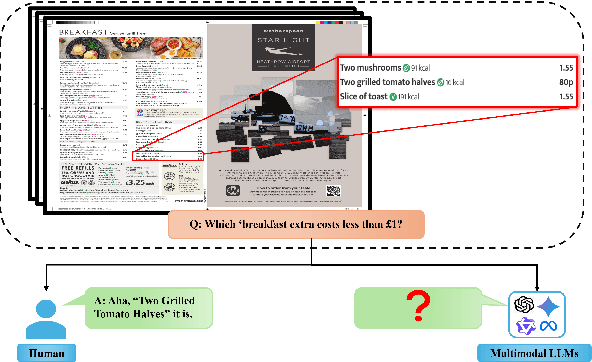
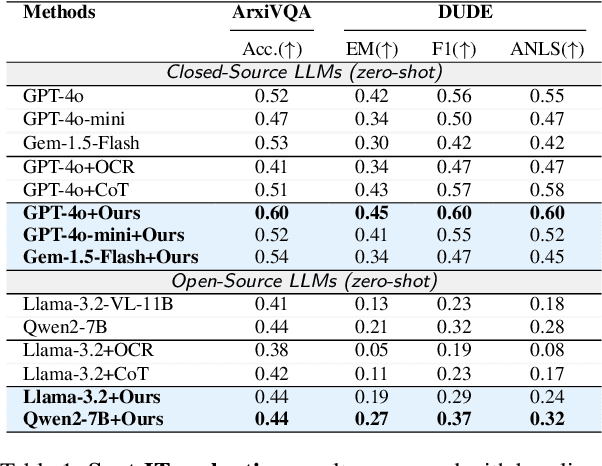
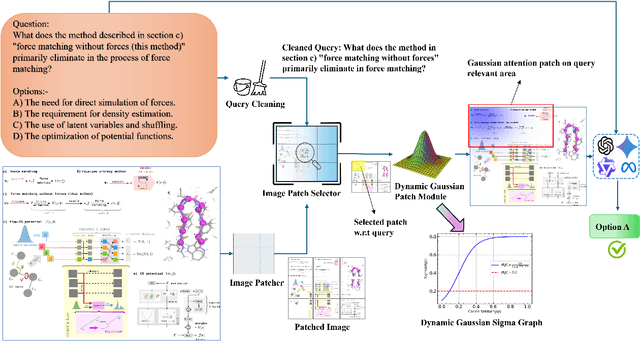
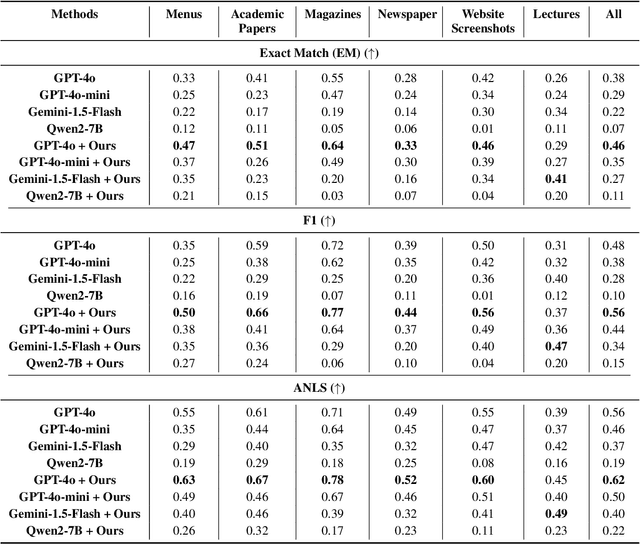
While Multi-modal Large Language Models (MLLMs) have shown impressive capabilities in document understanding tasks, their ability to locate and reason about fine-grained details within complex documents remains understudied. Consider searching a restaurant menu for a specific nutritional detail or identifying a disclaimer in a lengthy newspaper article tasks that demand careful attention to small but significant details within a broader narrative, akin to Finding Needles in Images (NiM). To address this gap, we introduce NiM, a carefully curated benchmark spanning diverse real-world documents including newspapers, menus, and lecture images, specifically designed to evaluate MLLMs' capability in these intricate tasks. Building on this, we further propose Spot-IT, a simple yet effective approach that enhances MLLMs capability through intelligent patch selection and Gaussian attention, motivated from how humans zoom and focus when searching documents. Our extensive experiments reveal both the capabilities and limitations of current MLLMs in handling fine-grained document understanding tasks, while demonstrating the effectiveness of our approach. Spot-IT achieves significant improvements over baseline methods, particularly in scenarios requiring precise detail extraction from complex layouts.
* Accepted at ACL 2025 in the main track