 Add to Chrome
 Add to Firefox
 Add to Edge
TelcoAgent: A Scalable 5G Multi-KPM Forecasting With 3GPP-Grounded Explainability
Jun 18, 2026
Key Performance Measurement (KPM) forecasting is essential for proactive network management of 5G and next-generation telecom networks. However, existing machine learning (ML) approaches face significant limitations in scalability and explainability, restricting their effectiveness in real-world deployments. We propose TelcoAgent, a foundation model-based framework that enables accurate, scalable, and explainable forecasting of multiple KPMs across diverse network cells without the need for site-specific training. Specifically, the framework comprises three key components: (i) an automated three-agent pipeline that constructs a 3rd Generation Partnership Project (3GPP) knowledge graph directly from specification documents, (ii) a scalable, time-series foundation model (TSFM)-based prediction pipeline to deliver accurate, zero-shot forecasting, and finally (iii) a reasoning and explanation pipeline that provides actionable, domain-grounded diagnostics. Evaluated using a 3-month, real-world, city-scale 5G KPM dataset from a U.S.-based network operator, TelcoAgent demonstrates high forecasting accuracy for all 7 considered KPMs per cell across 200 cells, while delivering explainable insights and actionable instructions to address network degradations.

TeleResilienceBench: Quantifying Resilience for LLM Reasoning in Telecommunications
May 11, 2026Deploying large language models in telecommunications requires more than task accuracy. In realistic workflows, a model may inherit partially completed reasoning from a prior step, an upstream agent, or its own earlier generation, and must continue that reasoning even when it is already going wrong. We introduce TeleResilienceBench, a benchmark that quantifies this capability, which we term reasoning resilience, across seven telecom sub-domains drawn from the GSMA Open-Telco LLM suite. Instances are constructed by collecting failures from a weak generator model, truncating the flawed reasoning trace at its midpoint, and asking a target model to continue and correct it. We propose the Correct Flip Rate (CFR) as a direct measure of successful recovery and evaluate eight models spanning the Qwen3.5, Gemma4, and Nemotron-3 families. Our results show that even the strongest model achieves a macro-average CFR of only 29.1%, and scale does not reliably improve resilience within families. Nemotron-3-nano 4b outperforms all Qwen3.5 variants including the 27b model and leads the auxiliary TeleMath numerical evaluation at 23.4% CR%, offering the best resilience-to-cost ratio in the set. A difficulty-stratified analysis further reveals that existing telecom benchmark difficulty labels reflect factual specificity rather than reasoning depth, suggesting that current evaluations measure knowledge coverage more than reasoning ability.
TeleEmbedBench: A Multi-Corpus Embedding Benchmark for RAG in Telecommunications
Apr 20, 2026Large language models (LLMs) are increasingly deployed in the telecommunications domain for critical tasks, relying heavily on Retrieval-Augmented Generation (RAG) to adapt general-purpose models to continuously evolving standards. However, a significant gap exists in evaluating the embedding models that power these RAG pipelines, as general-purpose benchmarks fail to capture the dense, acronym-heavy, and highly cross-referential nature of telecommunications corpora. To address this, we introduce TeleEmbedBench, the first large-scale, multi-corpus embedding benchmark designed specifically for telecommunications. The benchmark spans three heterogeneous corpora: O-RAN Alliance specifications, 3GPP release documents, and the srsRAN open-source codebase, comprising 9,000 question-chunk pairs across three standard chunk sizes (512, 1024, and 2048 tokens). To construct this dataset at scale without manual annotation bottlenecks, we employ a novel automated pipeline where one LLM generates specific queries from text chunks and a secondary LLM validates them across strict criteria. We comprehensively evaluate eight embedding models, spanning standard sentence-transformers and LLM-based embedders. Our results demonstrate that LLM-based embedders, such as Qwen3 and EmbeddingGemma, consistently and significantly outperform traditional sentence-transformers in both retrieval accuracy and robustness against cross-domain interference. Additionally, we introduce TeleEmbedBench-Clean to evaluate model robustness against noisy, incomplete user queries. Finally, our analysis reveals that while domain-specific task instructions improve embedder performance for raw source code, they paradoxically degrade retrieval performance for natural language telecommunications specifications.
LLM-AUG: Robust Wireless Data Augmentation with In-Context Learning in Large Language Models
Apr 20, 2026Data scarcity remains a fundamental bottleneck in applying deep learning to wireless communication problems, particularly in scenarios where collecting labeled Radio Frequency (RF) data is expensive, time-consuming, or operationally constrained. This paper proposes LLM-AUG, a data augmentation framework that leverages in-context learning in large language models (LLMs) to generate synthetic training samples directly in a learned embedding space. Unlike conventional generative approaches that require training task-specific models, LLM-AUG performs data generation through structured prompting, enabling rapid adaptation in low-shot regimes. We evaluate LLM-AUG on two representative tasks: modulation classification and interference classification using the RadioML 2016.10A dataset, and the Interference Classification (IC) dataset respectively. Results show that LLM-AUG consistently outperforms traditional augmentation and deep generative baselines across low-shot settings and reaches near oracle performance using only 15% labeled data. LLM-AUG further demonstrates improved robustness under distribution shifts, yielding a 29.4% relative gain over diffusion-based augmentation at a lower SNR value. On the RadioML and IC datasets, LLM-AUG yields a relative gain of 67.6% and 35.7% over the diffusion-based baseline. The t-SNE visualizations further validate that synthetic samples generated by better preserve class structure in the embedding space, leading to more consistent and informative augmentations. These results demonstrate that LLMs can serve as effective and practical data augmenters for wireless machine learning, enabling robust and data-efficient learning in evolving wireless environments.
Enhancing Confidence Estimation in Telco LLMs via Twin-Pass CoT-Ensembling
Apr 14, 2026Large Language Models (LLMs) are increasingly applied to complex telecommunications tasks, including 3GPP specification analysis and O-RAN network troubleshooting. However, a critical limitation remains: LLM-generated confidence scores are often biased and unreliable, frequently exhibiting systematic overconfidence. This lack of trustworthy self-assessment makes it difficult to verify model outputs and safely rely on them in practice. In this paper, we study confidence calibration in telecom-domain LLMs using the representative Gemma-3 model family (4B, 12B, and 27B parameters), evaluated on TeleQnA, ORANBench, and srsRANBench. We show that standard single-pass, verbalized confidence estimates fail to reflect true correctness, often assigning high confidence to incorrect predictions. To address this, we propose a novel Twin-Pass Chain of Thought (CoT)-Ensembling methodology for improving confidence estimation by leveraging multiple independent reasoning evaluations and aggregating their assessments into a calibrated confidence score. Our approach reduces Expected Calibration Error (ECE) by up to 88% across benchmarks, significantly improving the reliability of model self-assessment. These results highlight the limitations of current confidence estimation practices and demonstrate a practical path toward more trustworthy evaluation of LLM outputs in telecommunications.
Tele-LLM-Hub: Building Context-Aware Multi-Agent LLM Systems for Telecom Networks
Nov 18, 2025This paper introduces Tele-LLM-Hub, a user friendly low-code solution for rapid prototyping and deployment of context aware multi-agent (MA) Large Language Model (LLM) systems tailored for 5G and beyond. As telecom wireless networks become increasingly complex, intelligent LLM applications must share a domainspecific understanding of network state. We propose TeleMCP, the Telecom Model Context Protocol, to enable structured and context-rich communication between agents in telecom environments. Tele-LLM-Hub actualizes TeleMCP through a low-code interface that supports agent creation, workflow composition, and interaction with software stacks such as srsRAN. Key components include a direct chat interface, a repository of pre-built systems, an Agent Maker leveraging finetuning with our RANSTRUCT framework, and an MA-Maker for composing MA workflows. The goal of Tele-LLM-Hub is to democratize the design of contextaware MA systems and accelerate innovation in next-generation wireless networks.
AI5GTest: AI-Driven Specification-Aware Automated Testing and Validation of 5G O-RAN Components
Jun 11, 2025The advent of Open Radio Access Networks (O-RAN) has transformed the telecommunications industry by promoting interoperability, vendor diversity, and rapid innovation. However, its disaggregated architecture introduces complex testing challenges, particularly in validating multi-vendor components against O-RAN ALLIANCE and 3GPP specifications. Existing frameworks, such as those provided by Open Testing and Integration Centres (OTICs), rely heavily on manual processes, are fragmented and prone to human error, leading to inconsistency and scalability issues. To address these limitations, we present AI5GTest -- an AI-powered, specification-aware testing framework designed to automate the validation of O-RAN components. AI5GTest leverages a cooperative Large Language Models (LLM) framework consisting of Gen-LLM, Val-LLM, and Debug-LLM. Gen-LLM automatically generates expected procedural flows for test cases based on 3GPP and O-RAN specifications, while Val-LLM cross-references signaling messages against these flows to validate compliance and detect deviations. If anomalies arise, Debug-LLM performs root cause analysis, providing insight to the failure cause. To enhance transparency and trustworthiness, AI5GTest incorporates a human-in-the-loop mechanism, where the Gen-LLM presents top-k relevant official specifications to the tester for approval before proceeding with validation. Evaluated using a range of test cases obtained from O-RAN TIFG and WG5-IOT test specifications, AI5GTest demonstrates a significant reduction in overall test execution time compared to traditional manual methods, while maintaining high validation accuracy.
ORANSight-2.0: Foundational LLMs for O-RAN
Mar 07, 2025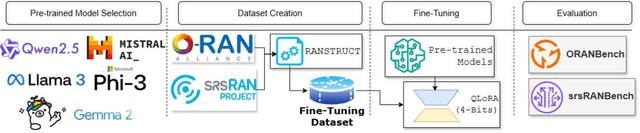
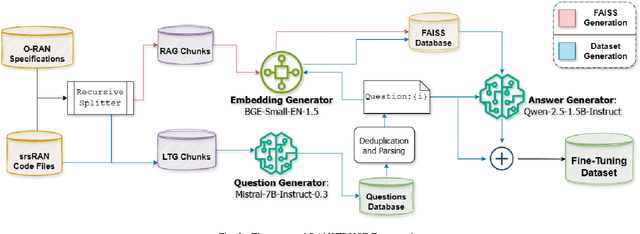

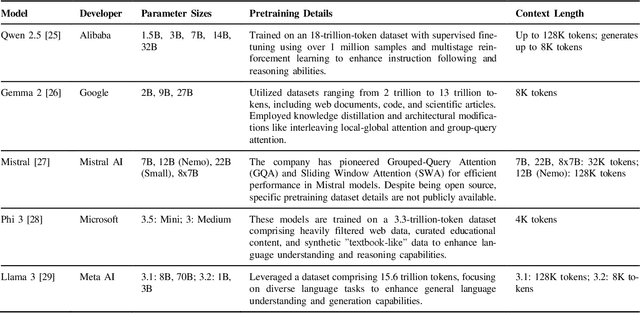
Despite the transformative impact of Large Language Models (LLMs) across critical domains such as healthcare, customer service, and business marketing, their integration into Open Radio Access Networks (O-RAN) remains limited. This gap is primarily due to the absence of domain-specific foundational models, with existing solutions often relying on general-purpose LLMs that fail to address the unique challenges and technical intricacies of O-RAN. To bridge this gap, we introduce ORANSight-2.0 (O-RAN Insights), a pioneering initiative aimed at developing specialized foundational LLMs tailored for O-RAN. Built on 18 LLMs spanning five open-source LLM frameworks, ORANSight-2.0 fine-tunes models ranging from 1 to 70B parameters, significantly reducing reliance on proprietary, closed-source models while enhancing performance for O-RAN. At the core of ORANSight-2.0 is RANSTRUCT, a novel Retrieval-Augmented Generation (RAG) based instruction-tuning framework that employs two LLM agents to create high-quality instruction-tuning datasets. The generated dataset is then used to fine-tune the 18 pre-trained open-source LLMs via QLoRA. To evaluate ORANSight-2.0, we introduce srsRANBench, a novel benchmark designed for code generation and codebase understanding in the context of srsRAN, a widely used 5G O-RAN stack. We also leverage ORANBench13K, an existing benchmark for assessing O-RAN-specific knowledge. Our comprehensive evaluations demonstrate that ORANSight-2.0 models outperform general-purpose and closed-source models, such as ChatGPT-4o and Gemini, by 5.421% on ORANBench and 18.465% on srsRANBench, achieving superior performance while maintaining lower computational and energy costs. We also experiment with RAG-augmented variants of ORANSight-2.0 LLMs and thoroughly evaluate their energy characteristics, demonstrating costs for training, standard inference, and RAG-augmented inference.
ORAN-Bench-13K: An Open Source Benchmark for Assessing LLMs in Open Radio Access Networks
Jul 08, 2024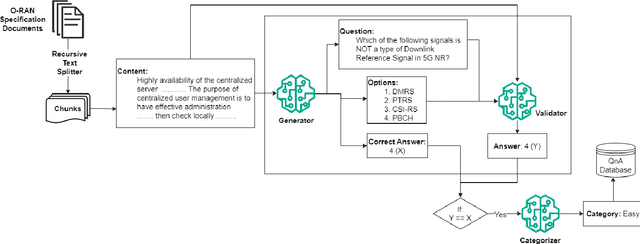
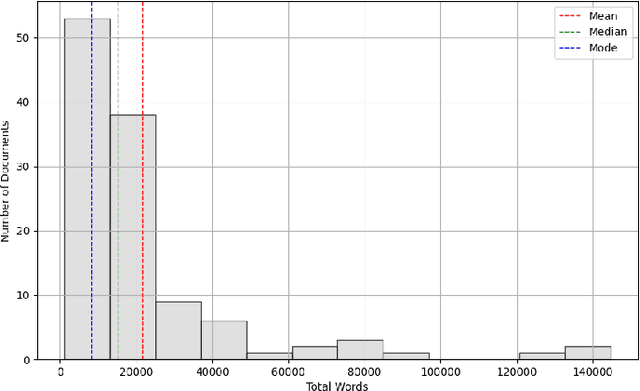
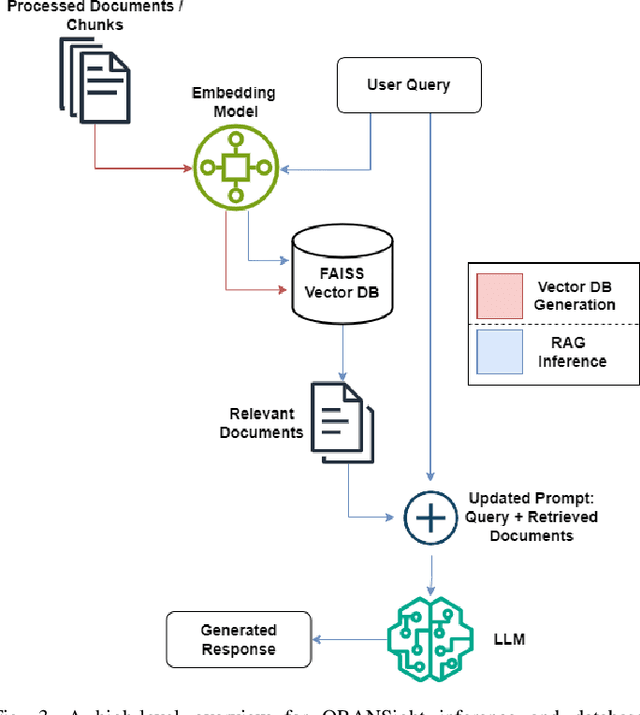
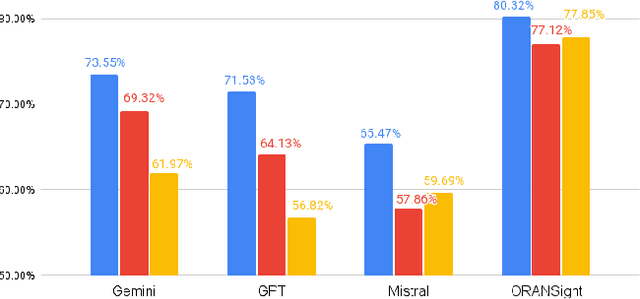
Large Language Models (LLMs) can revolutionize how we deploy and operate Open Radio Access Networks (O-RAN) by enhancing network analytics, anomaly detection, and code generation and significantly increasing the efficiency and reliability of a plethora of O-RAN tasks. In this paper, we present ORAN-Bench-13K, the first comprehensive benchmark designed to evaluate the performance of Large Language Models (LLMs) within the context of O-RAN. Our benchmark consists of 13,952 meticulously curated multiple-choice questions generated from 116 O-RAN specification documents. We leverage a novel three-stage LLM framework, and the questions are categorized into three distinct difficulties to cover a wide spectrum of ORAN-related knowledge. We thoroughly evaluate the performance of several state-of-the-art LLMs, including Gemini, Chat-GPT, and Mistral. Additionally, we propose ORANSight, a Retrieval-Augmented Generation (RAG)-based pipeline that demonstrates superior performance on ORAN-Bench-13K compared to other tested closed-source models. Our findings indicate that current popular LLM models are not proficient in O-RAN, highlighting the need for specialized models. We observed a noticeable performance improvement when incorporating the RAG-based ORANSight pipeline, with a Macro Accuracy of 0.784 and a Weighted Accuracy of 0.776, which was on average 21.55% and 22.59% better than the other tested LLMs.
Preserving Data Privacy for ML-driven Applications in Open Radio Access Networks
Feb 15, 2024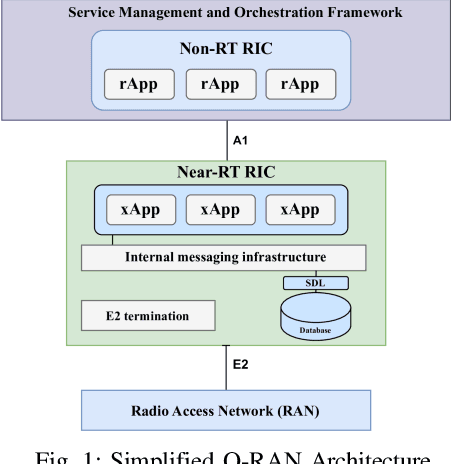
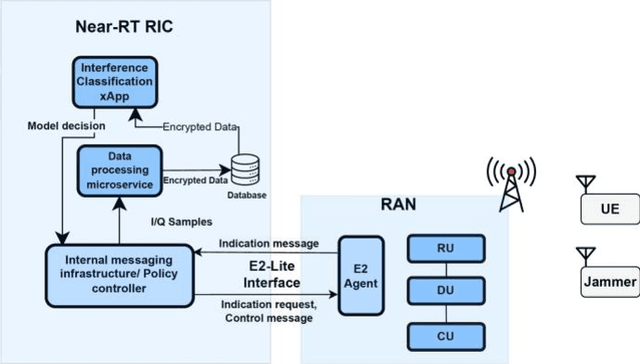


Deep learning offers a promising solution to improve spectrum access techniques by utilizing data-driven approaches to manage and share limited spectrum resources for emerging applications. For several of these applications, the sensitive wireless data (such as spectrograms) are stored in a shared database or multistakeholder cloud environment and are therefore prone to privacy leaks. This paper aims to address such privacy concerns by examining the representative case study of shared database scenarios in 5G Open Radio Access Network (O-RAN) networks where we have a shared database within the near-real-time (near-RT) RAN intelligent controller. We focus on securing the data that can be used by machine learning (ML) models for spectrum sharing and interference mitigation applications without compromising the model and network performances. The underlying idea is to leverage a (i) Shuffling-based learnable encryption technique to encrypt the data, following which, (ii) employ a custom Vision transformer (ViT) as the trained ML model that is capable of performing accurate inferences on such encrypted data. The paper offers a thorough analysis and comparisons with analogous convolutional neural networks (CNN) as well as deeper architectures (such as ResNet-50) as baselines. Our experiments showcase that the proposed approach significantly outperforms the baseline CNN with an improvement of 24.5% and 23.9% for the percent accuracy and F1-Score respectively when operated on encrypted data. Though deeper ResNet-50 architecture is obtained as a slightly more accurate model, with an increase of 4.4%, the proposed approach boasts a reduction of parameters by 99.32%, and thus, offers a much-improved prediction time by nearly 60%.