 Add to Chrome
 Add to Firefox
 Add to Edge
Immersive Social Interaction with VR and LLM-Assisted Humanoids
Jul 08, 2026
Humanoid robots can extend human presence to remote, constrained, or hazardous environments, but existing teleoperation interfaces often require physically demanding motion tracking or cognitively demanding low-level control. This paper presents an immersive teleoperation framework that integrates voice-controlled locomotion, VR-based manipulation, and bidirectional social interaction for whole-body humanoid control. Using Apple Vision Pro, the operator receives egocentric visual feedback, issues natural-language locomotion commands, and teleoperates the robot's arms and dexterous hands through wrist and finger tracking. An LLM-assisted voice-control module converts spoken instructions into high-level locomotion commands, while the manipulation module retargets human hand motions to the robot through inverse kinematics and PD control. The system also records multimodal data, including egocentric RGB observations, voice/text commands, joint states, hand motions, and eye-gaze signals, supporting future imitation learning and autonomy. We evaluate the framework on a Unitree H1 humanoid equipped with dexterous hands in manipulation and social interaction tasks. Results show that novice users can successfully operate the system after brief familiarization, achieving 80\% success in object manipulation and 70\% success in a social cube-passing task. These results demonstrate the potential of immersive, language-assisted teleoperation as an accessible interface for humanoid interaction, remote assistance, and multimodal data collection.

ManeuverGPT Agentic Control for Safe Autonomous Stunt Maneuvers
Mar 12, 2025The next generation of active safety features in autonomous vehicles should be capable of safely executing evasive hazard-avoidance maneuvers akin to those performed by professional stunt drivers to achieve high-agility motion at the limits of vehicle handling. This paper presents a novel framework, ManeuverGPT, for generating and executing high-dynamic stunt maneuvers in autonomous vehicles using large language model (LLM)-based agents as controllers. We target aggressive maneuvers, such as J-turns, within the CARLA simulation environment and demonstrate an iterative, prompt-based approach to refine vehicle control parameters, starting tabula rasa without retraining model weights. We propose an agentic architecture comprised of three specialized agents (1) a Query Enricher Agent for contextualizing user commands, (2) a Driver Agent for generating maneuver parameters, and (3) a Parameter Validator Agent that enforces physics-based and safety constraints. Experimental results demonstrate successful J-turn execution across multiple vehicle models through textual prompts that adapt to differing vehicle dynamics. We evaluate performance via established success criteria and discuss limitations regarding numeric precision and scenario complexity. Our findings underscore the potential of LLM-driven control for flexible, high-dynamic maneuvers, while highlighting the importance of hybrid approaches that combine language-based reasoning with algorithmic validation.
LLM-Enhanced Path Planning: Safe and Efficient Autonomous Navigation with Instructional Inputs
Dec 03, 2024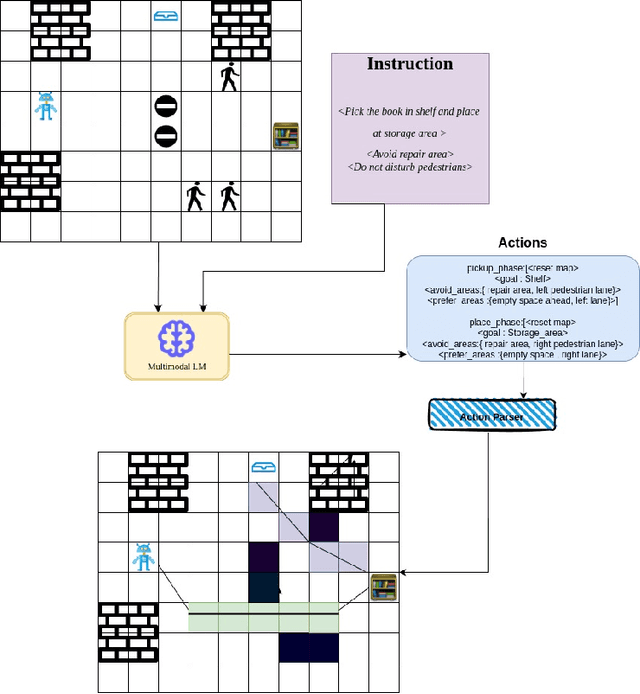
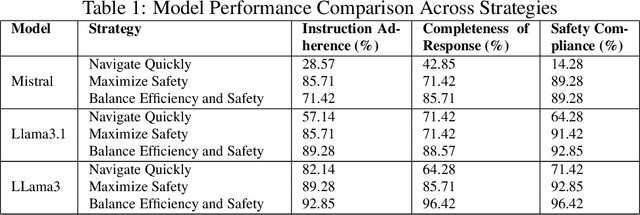
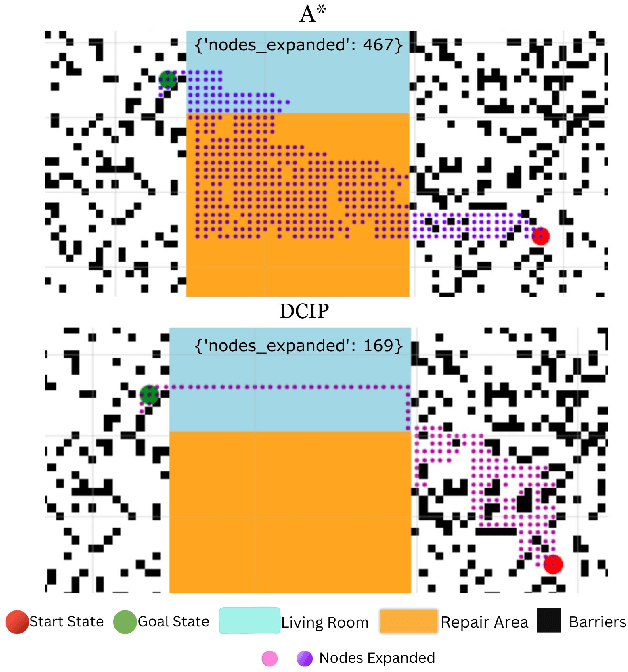
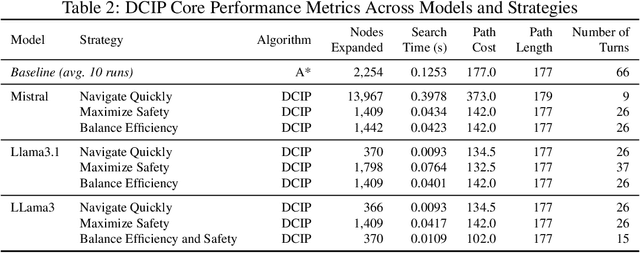
Autonomous navigation guided by natural language instructions is essential for improving human-robot interaction and enabling complex operations in dynamic environments. While large language models (LLMs) are not inherently designed for planning, they can significantly enhance planning efficiency by providing guidance and informing constraints to ensure safety. This paper introduces a planning framework that integrates LLMs with 2D occupancy grid maps and natural language commands to improve spatial reasoning and task execution in resource-limited settings. By decomposing high-level commands and real-time environmental data, the system generates structured navigation plans for pick-and-place tasks, including obstacle avoidance, goal prioritization, and adaptive behaviors. The framework dynamically recalculates paths to address environmental changes and aligns with implicit social norms for seamless human-robot interaction. Our results demonstrates the potential of LLMs to design context-aware system to enhance navigation efficiency and safety in industrial and dynamic environments.