 Add to Chrome
 Add to Firefox
 Add to Edge
ISAC Privacy: Challenges and Solutions for 6G
May 27, 2026
Integrated sensing and communication (ISAC) is a promising feature of future communication networks. While spatial sensing can improve network performance and enable external services, it also creates privacy challenges that go beyond the confidentiality of communication content. Future networks using millimeter-wave (mmWave) and sub-terahertz (THz) frequencies may collect or infer detailed information about people, devices, bystanders, passive objects, and environments in a sixth-generation (6G) deployment area. Such sensing can reveal location and environment data, support behavioral profiling such as movement or activity recognition, and, in advanced cases, expose physiological information such as breathing frequency or heart-rate-related data. Thus, the capabilities of spatial sensing must be controlled to satisfy privacy requirements. In this work, we organize privacy-sensitive ISAC data into three sensing levels: location and environment data, behavioral data, and physiological data, and use this classification as the organizing principle throughout the paper. Based on this classification, we discuss internal and external ISAC applications, identify privacy challenges related to consent, transparency, data ownership, profiling, bystander exposure, and sensitive sensing data, review representative solution directions, and outline future research directions for privacy-preserving ISAC.

Cross-layer Integrated Sensing and Communication: A Joint Industrial and Academic Perspective
May 16, 2025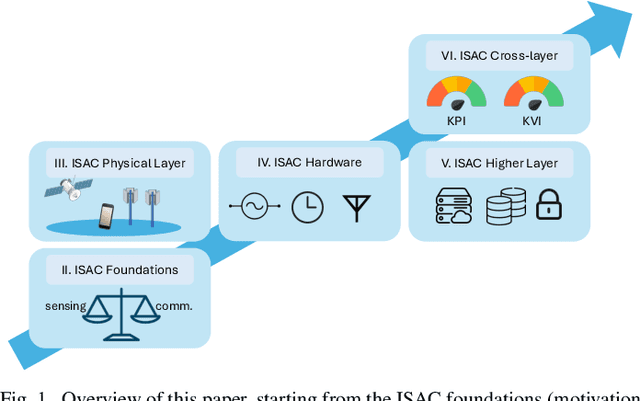
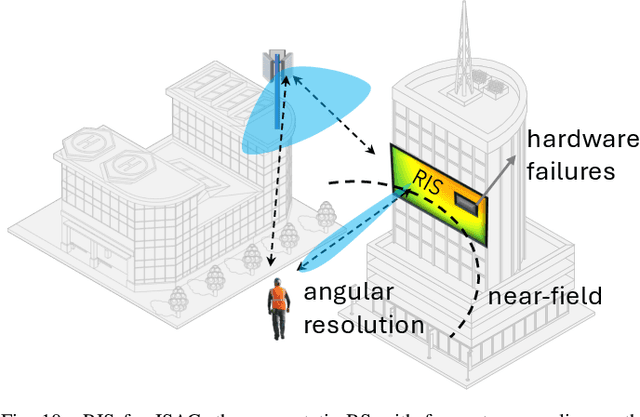
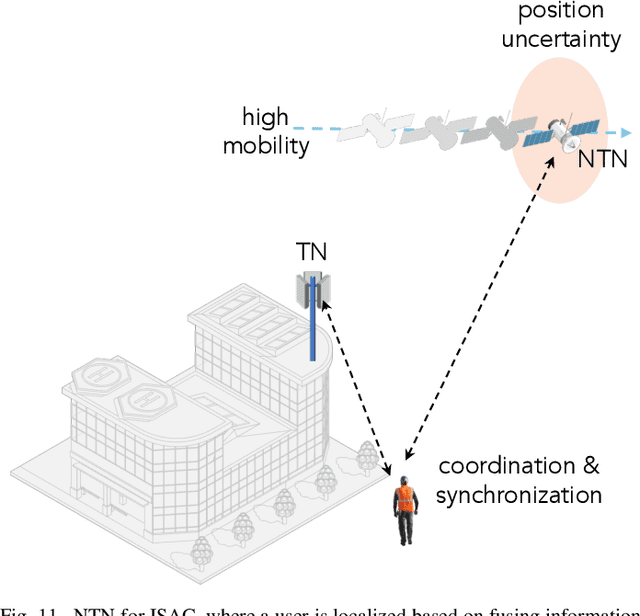
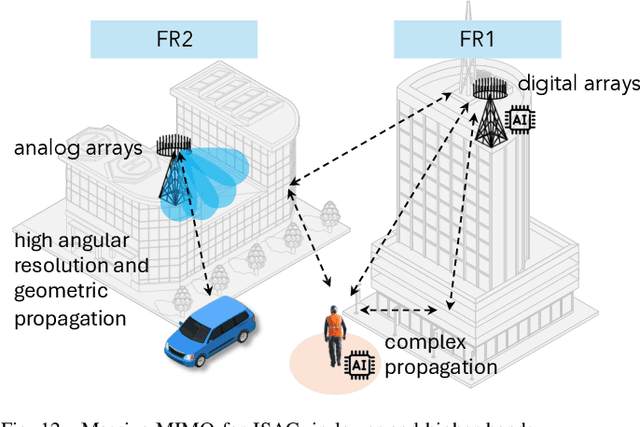
Integrated sensing and communication (ISAC) enables radio systems to simultaneously sense and communicate with their environment. This paper, developed within the Hexa-X-II project funded by the European Union, presents a comprehensive cross-layer vision for ISAC in 6G networks, integrating insights from physical-layer design, hardware architectures, AI-driven intelligence, and protocol-level innovations. We begin by revisiting the foundational principles of ISAC, highlighting synergies and trade-offs between sensing and communication across different integration levels. Enabling technologies, such as multiband operation, massive and distributed MIMO, non-terrestrial networks, reconfigurable intelligent surfaces, and machine learning, are analyzed in conjunction with hardware considerations including waveform design, synchronization, and full-duplex operation. To bridge implementation and system-level evaluation, we introduce a quantitative cross-layer framework linking design parameters to key performance and value indicators. By synthesizing perspectives from both academia and industry, this paper outlines how deeply integrated ISAC can transform 6G into a programmable and context-aware platform supporting applications from reliable wireless access to autonomous mobility and digital twinning.