 Add to Chrome
 Add to Firefox
 Add to Edge
Language Models are not Equally Robust to Non-Canonical Tokenization across Languages
Jul 29, 2026
Despite the existence of exponentially many valid tokenizations for a given string, language models operate on a single canonical sequence deterministically produced by the tokenizer, leaving the broader tokenization space largely uncharacterized. In this paper, we investigate this overlooked space by studying the behavior of language models under non-canonical tokenizations across diverse languages. For English, prior work shows that models are largely invariant to alternative tokenizations that represent the same underlying string. We ask whether this invariance generalizes to other languages beyond English. We conduct a multilingual study across 27 languages spanning diverse scripts and evaluate LLM behavior under alternative tokenizations across six downstream tasks. We find that tokenization invariance does not generalize: model behavior varies substantially across languages with instruction-tuned models exhibiting an average relative performance drop of 23.7% for Llama-3.1-8B, 11.4% for Qwen3-8B, and 9.9% for Gemma-3-12B. The variation of tokenization invariance is systematic across languages. Languages that exhibit higher token fragmentation show significantly greater sensitivity to non-canonical tokenizations. Our study of tokenization robustness serves as a diagnostic of how tightly a model is coupled to its tokenizer. These results demonstrate that tokenization robustness is not a universal property of language models, but depends strongly on the language and its interaction with the tokenizer. We also show that LoRA fine-tuning with multi-tokenization training data provides an effective mitigation for tokenization sensitivity. Fine-tuning on English alone improves tokenization robustness across languages, while systematically sampling diverse non-canonical tokenizations achieves the strongest overall performance.

Are Language Models Agnostic to Linguistically Grounded Perturbations? A Case Study of Indic Languages
Dec 14, 2024

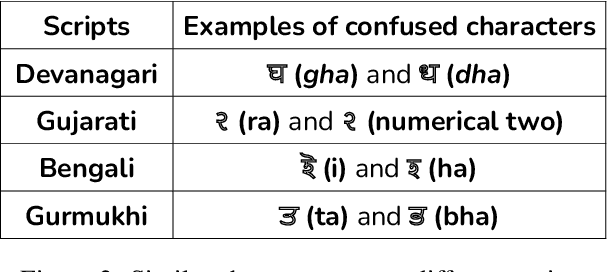

Pre-trained language models (PLMs) are known to be susceptible to perturbations to the input text, but existing works do not explicitly focus on linguistically grounded attacks, which are subtle and more prevalent in nature. In this paper, we study whether PLMs are agnostic to linguistically grounded attacks or not. To this end, we offer the first study addressing this, investigating different Indic languages and various downstream tasks. Our findings reveal that although PLMs are susceptible to linguistic perturbations, when compared to non-linguistic attacks, PLMs exhibit a slightly lower susceptibility to linguistic attacks. This highlights that even constrained attacks are effective. Moreover, we investigate the implications of these outcomes across a range of languages, encompassing diverse language families and different scripts.
A Morphology-Based Investigation of Positional Encodings
Apr 06, 2024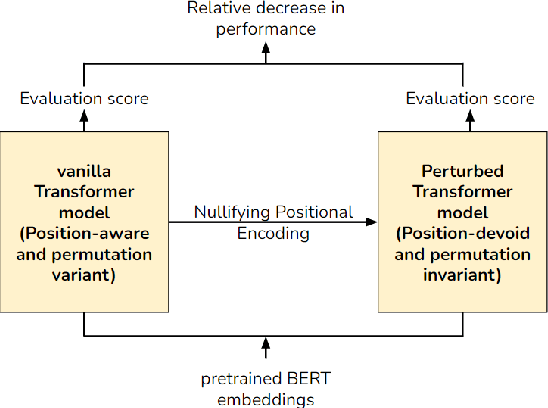
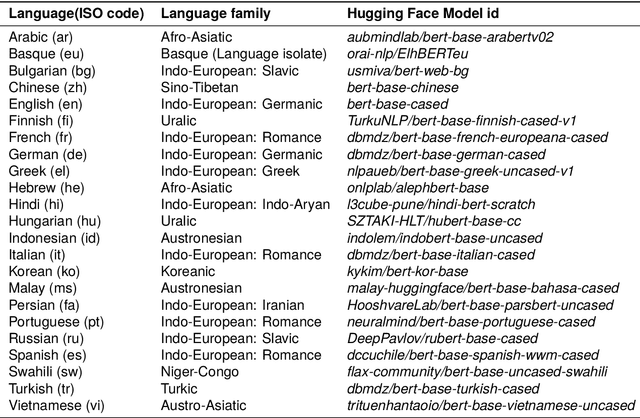
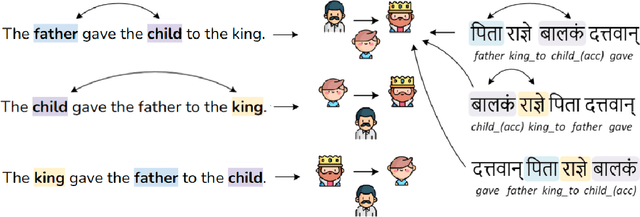
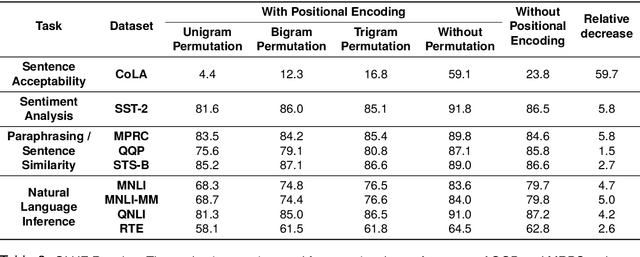
How does the importance of positional encoding in pre-trained language models (PLMs) vary across languages with different morphological complexity? In this paper, we offer the first study addressing this question, encompassing 23 morphologically diverse languages and 5 different downstream tasks. We choose two categories of tasks: syntactic tasks (part-of-speech tagging, named entity recognition, dependency parsing) and semantic tasks (natural language inference, paraphrasing). We consider language-specific BERT models trained on monolingual corpus for our investigation. The main experiment consists of nullifying the effect of positional encoding during fine-tuning and investigating its impact across various tasks and languages. Our findings demonstrate that the significance of positional encoding diminishes as the morphological complexity of a language increases. Across all experiments, we observe clustering of languages according to their morphological typology - with analytic languages at one end and synthetic languages at the opposite end.