 Add to Chrome
 Add to Firefox
 Add to Edge
Explainable and Resource-Efficient Spatial Reasoning in Multimodal LLMs for Decision-Critical Applications
Jul 29, 2026
As Multimodal Large Language Models (MLLMs) are increasingly deployed in decision-critical pipelines such as robotics, embodied AI, and safety monitoring, the opacity of their spatial judgments limits operator trust and auditability. MLLMs demonstrate strong reasoning but often struggle with fine-grained spatial understanding and object hallucination. Prior work, ByDeWay, introduced Layered-Depth-Based Prompting (LDP), a training-free framework that mitigates hallucinations by structuring prompts using monocular depth estimation. However, coarse depth layering falls short in resolving object-to-object spatial relationships within the same geometric plane, such as projective ("left of", "above") and topological ("inside", "touching") relations. We propose ByDeWay-V2, which integrates explicit spatial relational context alongside depth cues, expressed as human-readable predicates that serve as auditable evidence for downstream decision support. Using an open-vocabulary object detector (YOLO-World-L), our framework computes pairwise geometric relations between detected objects and injects them as structured spatial predicates into the MLLM prompt, bridging 3D scene depth and 2D spatial semantics without any training. We evaluate ByDeWay-V2 on the Visual Spatial Reasoning (VSR) and BLINK benchmarks across multiple MLLMs, with hallucination grounding assessed via POPE. On the BLINK spatial subset, ByDeWay-V2 achieves a 46 percent relative F1 improvement over LDP for Qwen2.5-VL, and recovers BLIP-Base's spatial reasoning on VSR from near-random performance to a competitive F1 of 0.53. Our lightest configuration operates under a strict 40-token context budget on CPU, showing the framework's suitability for resource-constrained, real-time decision-support settings.

A review of machine learning applications in wildfire science and management
Mar 02, 2020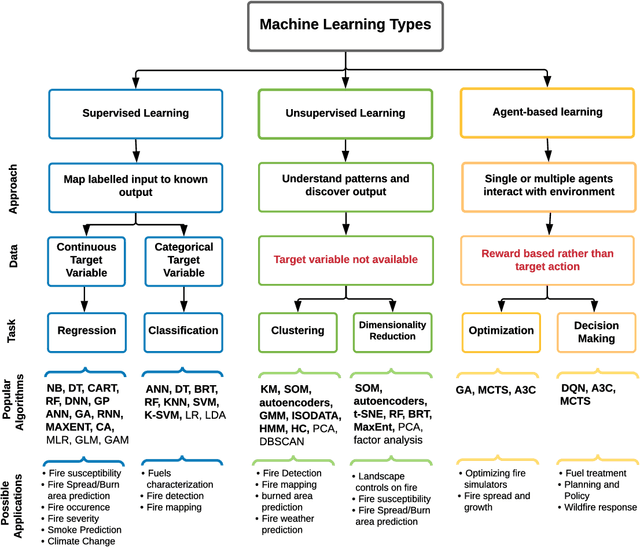
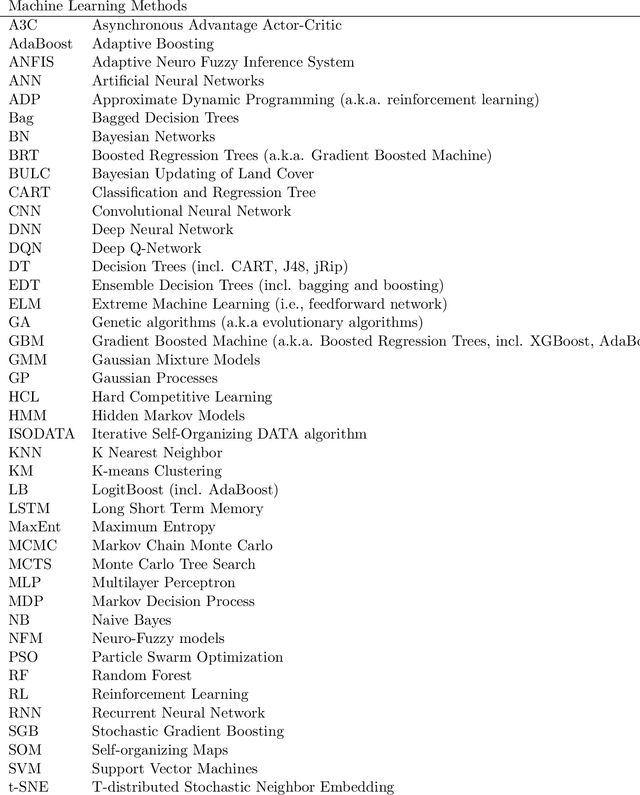
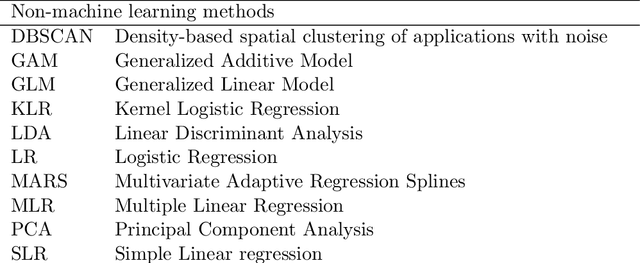
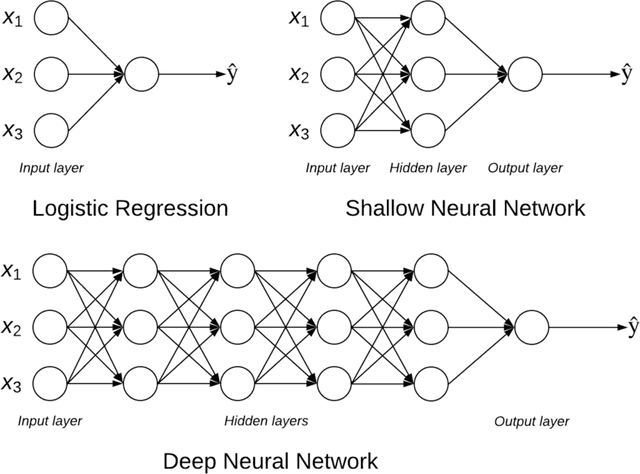
Artificial intelligence has been applied in wildfire science and management since the 1990s, with early applications including neural networks and expert systems. Since then the field has rapidly progressed congruently with the wide adoption of machine learning (ML) in the environmental sciences. Here, we present a scoping review of ML in wildfire science and management. Our objective is to improve awareness of ML among wildfire scientists and managers, as well as illustrate the challenging range of problems in wildfire science available to data scientists. We first present an overview of popular ML approaches used in wildfire science to date, and then review their use in wildfire science within six problem domains: 1) fuels characterization, fire detection, and mapping; 2) fire weather and climate change; 3) fire occurrence, susceptibility, and risk; 4) fire behavior prediction; 5) fire effects; and 6) fire management. We also discuss the advantages and limitations of various ML approaches and identify opportunities for future advances in wildfire science and management within a data science context. We identified 298 relevant publications, where the most frequently used ML methods included random forests, MaxEnt, artificial neural networks, decision trees, support vector machines, and genetic algorithms. There exists opportunities to apply more current ML methods (e.g., deep learning and agent based learning) in wildfire science. However, despite the ability of ML models to learn on their own, expertise in wildfire science is necessary to ensure realistic modelling of fire processes across multiple scales, while the complexity of some ML methods requires sophisticated knowledge for their application. Finally, we stress that the wildfire research and management community plays an active role in providing relevant, high quality data for use by practitioners of ML methods.