 Add to Chrome
 Add to Firefox
 Add to Edge
Safe, Fluent and Acceptable Motion Generation and Execution for Human--Robot Interaction in Manufacturing Environments
Jun 07, 2026
Robots operating in human environments must not only ensure physical safety but also exhibit behaviors that are understandable, fluent, and acceptable to human partners. This paper investigates motion generation strategies that combine safety guarantees with interaction quality considerations, such as motion smoothness and human comfort. While the design of robots capable of ensuring safety in shared human-robot environments has enabled closer and more advanced forms of interaction, these new proximity-based tasks require moving beyond purely technical considerations. In particular, robot behavior must also be addressed from psycho-cognitive and social perspectives. In this context, we argue for the relevance of integrating social-aware motion control into robotic systems. First, we identify the motion parameters that influence human perception and operator experience. Then, we implement a Model Predictive Control (MPC) framework that generates four distinct socially-informed robot behaviors. Finally, we conduct a user study to evaluate and validate these behaviors and assess their social impact on non-expert participants. The results demonstrate that variations in robot behavior significantly affect the perceived social acceptability of the system. These findings highlight the importance of incorporating human-centered considerations into motion generation strategies for robots operating in shared environments.

Motion Accuracy and Computational Effort in QP-based Robot Control
Jul 23, 2024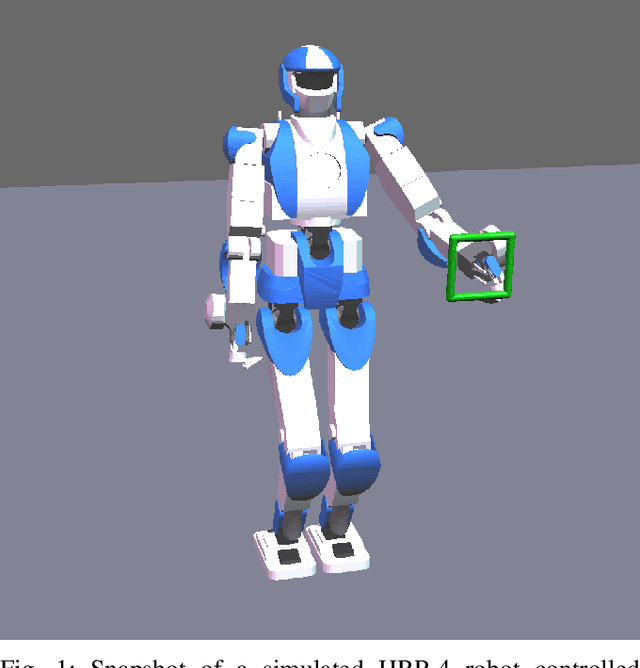
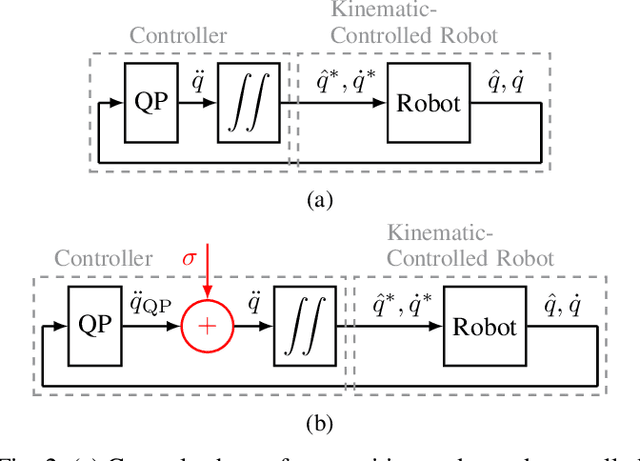
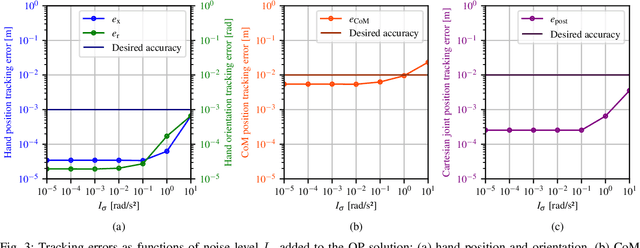
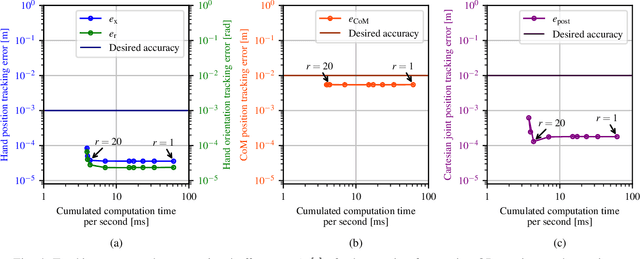
Quadratic Programs (QPs) have become a mature technology for the control of robots of all kinds, including humanoid robots. One aspect has been largely overlooked, however, which is the accuracy with which these QPs should be solved. Typical QP solvers aim at providing solutions accurate up to floating point precision ($\approx10^{-8}$). Considering physical quantities expressed in SI or similar units (meters, radians, etc.), such precision seems completely unrelated to both task requirements and hardware capacity. Typically, humanoid robots never achieve, nor are capable of achieving sub-millimeter precision in manipulation tasks. With this observation in mind, our objectives in this paper are two-fold: first examine how the QP solution accuracy impacts the resulting robot motion accuracy, then evaluate how a reduced solution accuracy requirement can be leveraged to reduce the corresponding computational effort. Numerical experiments with a dynamic simulation of a HRP-4 robot indicate that computational effort can be divided by more than 20 while maintaining the desired motion accuracy.
Sensitivity of Legged Balance Control to Uncertainties and Sampling Period
Jul 03, 2019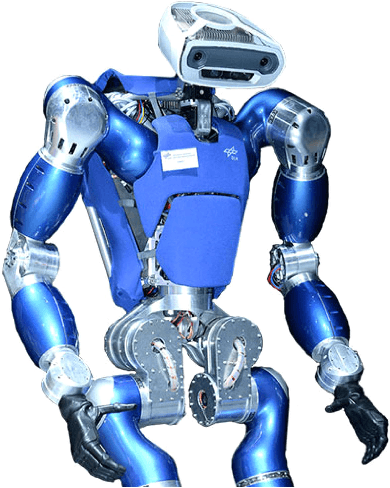
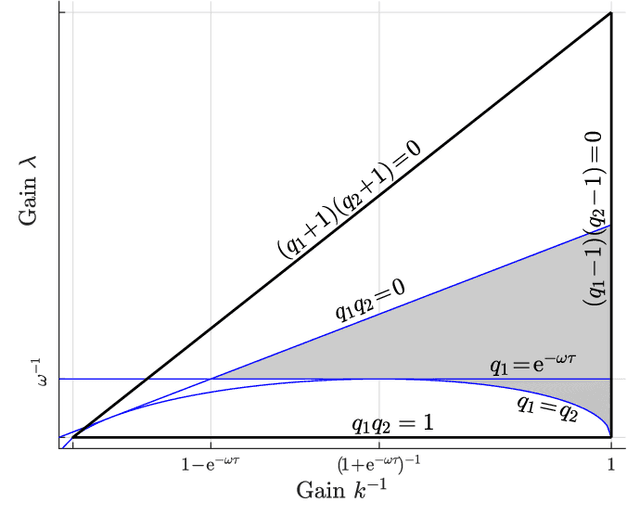
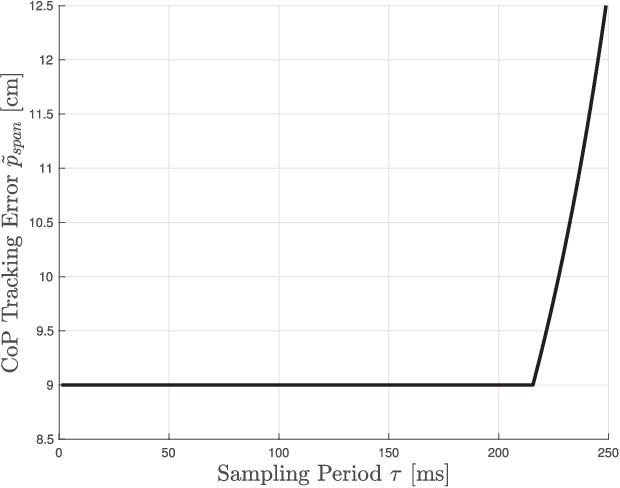
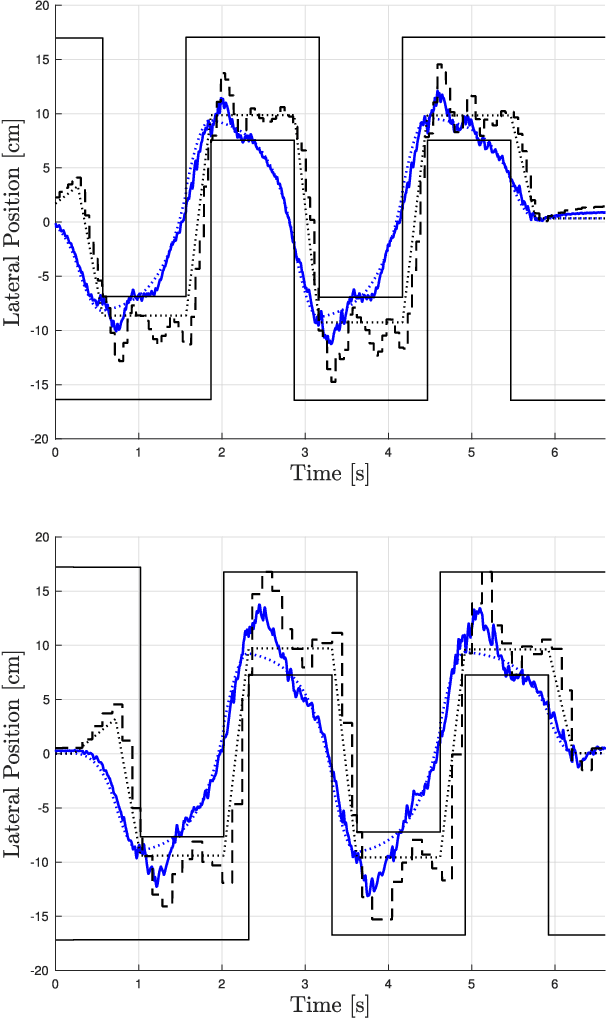
We propose to quantify the effect of sensor and actuator uncertainties on the control of the center of mass and center of pressure in legged robots, since this is central for maintaining their balance with a limited support polygon. Our approach is based on robust control theory, considering uncertainties that can take any value between specified bounds. This provides a principled approach to deciding optimal feedback gains. Surprisingly, our main observation is that the sampling period can be as long as 200 ms with literally no impact on maximum tracking error and, as a result, on the guarantee that balance can be maintained safely. Our findings are validated in simulations and experiments with the torque-controlled humanoid robot Toro developed at DLR. The proposed mathematical derivations and results apply nevertheless equally to biped and quadruped robots.