 Add to Chrome
 Add to Firefox
 Add to Edge
Learning to Bid in FCR Markets: A Best-of-Both-Worlds Approach
May 29, 2026
Bidding in the European Frequency Containment Reserve (FCR) market is challenging for flexibility providers because competing offers are hidden and bidders observe only partial feedback form the market, such as, clearing price and awarded quantity. For a participant active in a single country, we show that the multi-country FCR clearing problem can be recast as a repeated multi-unit uniform-price auction against an endogenous vector of opposing bids. This reformulation yields an online learning problem and allows us to adapt a Best-of-Both-Worlds combinatorial semi-bandit algorithm implementable from this standard market feedback. The resulting bidder achieves logarithmic pseudo-regret in stochastic environments and $\mathcal{O}(\sqrt{T})$ regret in adversarial ones. Synthetic experiments confirm the expected scaling, and backtests on historical European FCR data show competitive performance in practice: the method performs especially well on stable products, while EXP3-type baselines can be safer under stronger non-stationarity. Overall, the results show that learning-based bidding in FCR markets is theoretically grounded and practically useful when the learning rule matches product-level market stability.

New random projections for isotropic kernels using stable spectral distributions
Nov 05, 2024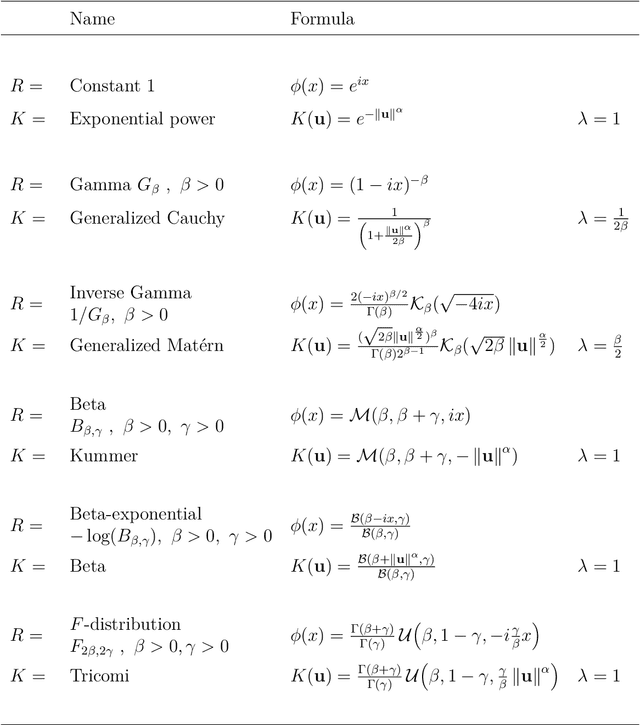


Rahimi and Recht [31] introduced the idea of decomposing shift-invariant kernels by randomly sampling from their spectral distribution. This famous technique, known as Random Fourier Features (RFF), is in principle applicable to any shift-invariant kernel whose spectral distribution can be identified and simulated. In practice, however, it is usually applied to the Gaussian kernel because of its simplicity, since its spectral distribution is also Gaussian. Clearly, simple spectral sampling formulas would be desirable for broader classes of kernel functions. In this paper, we propose to decompose spectral kernel distributions as a scale mixture of $\alpha$-stable random vectors. This provides a simple and ready-to-use spectral sampling formula for a very large class of multivariate shift-invariant kernels, including exponential power kernels, generalized Mat\'ern kernels, generalized Cauchy kernels, as well as newly introduced kernels such as the Beta, Kummer, and Tricomi kernels. In particular, we show that the spectral densities of all these kernels are scale mixtures of the multivariate Gaussian distribution. This provides a very simple way to modify existing Random Fourier Features software based on Gaussian kernels to cover a much richer class of multivariate kernels. This result has broad applications for support vector machines, kernel ridge regression, Gaussian processes, and other kernel-based machine learning techniques for which the random Fourier features technique is applicable.