 Add to Chrome
 Add to Firefox
 Add to Edge
Chronicles-OCR: A Cross-Temporal Perception Benchmark for the Evolutionary Trajectory of Chinese Characters
May 12, 2026
Vision Large Language Models (VLLMs) have achieved remarkable success in modern text-rich visual understanding. However, their perceptual robustness in the face of the continuous morphological evolution of historical writing systems remains largely unexplored. Existing ancient text datasets typically focus on isolated historical periods, failing to capture the systematic visual distribution shifts spanning thousands of years. To bridge this gap and empower Digital Humanities, we introduce Chronicles-OCR, the first comprehensive benchmark specifically designed to evaluate the cross-temporal visual perception capabilities of VLLMs across the complete evolutionary trajectory of Chinese characters, known as the Seven Chinese Scripts. Curated in collaboration with top-tier institutional domain experts, the dataset comprises 2,800 strictly balanced images encompassing highly diverse physical media, ranging from tortoise shells to paper-based calligraphy. To accommodate the drastic morphological and topological variations across different historical stages, we propose a novel Stage-Adaptive Annotation Paradigm. Based on this, Chronicles-OCR formulates four rigorous quantitative tasks: cross-period character spotting, fine-grained archaic character recognition via visual referring, ancient text parsing, and script classification. By isolating visual perception from semantic reasoning, Chronicles-OCR provides an authoritative platform to expose the limitations of current VLLMs, paving the way for robust, evolution-aware historical text perception. Chronicles-OCR is publicly available at https://github.com/VirtualLUOUCAS/Chronicles-OCR.

Oracle Bone Inscriptions Multi-modal Dataset
Jul 04, 2024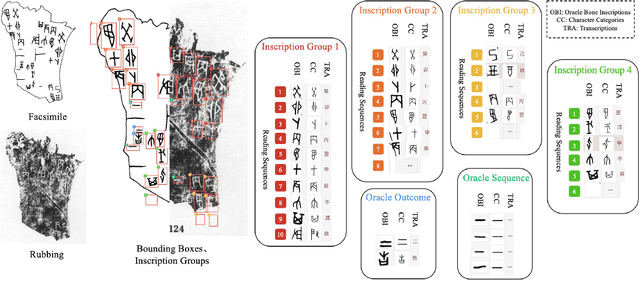
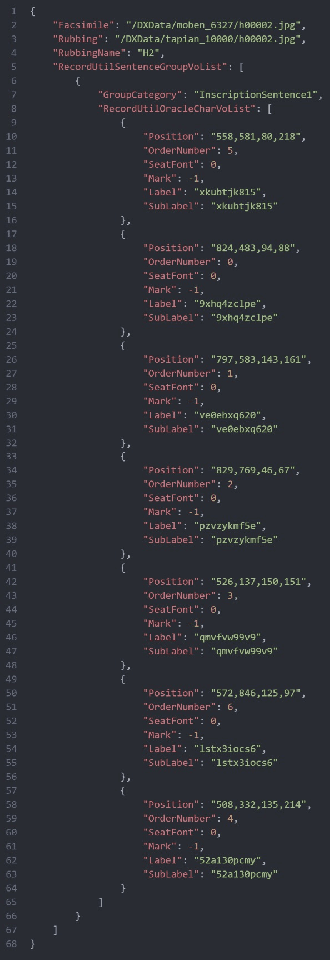
Oracle bone inscriptions(OBI) is the earliest developed writing system in China, bearing invaluable written exemplifications of early Shang history and paleography. However, the task of deciphering OBI, in the current climate of the scholarship, can prove extremely challenging. Out of the 4,500 oracle bone characters excavated, only a third have been successfully identified. Therefore, leveraging the advantages of advanced AI technology to assist in the decipherment of OBI is a highly essential research topic. However, fully utilizing AI's capabilities in these matters is reliant on having a comprehensive and high-quality annotated OBI dataset at hand whereas most existing datasets are only annotated in just a single or a few dimensions, limiting the value of their potential application. For instance, the Oracle-MNIST dataset only offers 30k images classified into 10 categories. Therefore, this paper proposes an Oracle Bone Inscriptions Multi-modal Dataset(OBIMD), which includes annotation information for 10,077 pieces of oracle bones. Each piece has two modalities: pixel-level aligned rubbings and facsimiles. The dataset annotates the detection boxes, character categories, transcriptions, corresponding inscription groups, and reading sequences in the groups of each oracle bone character, providing a comprehensive and high-quality level of annotations. This dataset can be used for a variety of AI-related research tasks relevant to the field of OBI, such as OBI Character Detection and Recognition, Rubbing Denoising, Character Matching, Character Generation, Reading Sequence Prediction, Missing Characters Completion task and so on. We believe that the creation and publication of a dataset like this will help significantly advance the application of AI algorithms in the field of OBI research.