 Add to Chrome
 Add to Firefox
 Add to Edge
Benchmarking Language Modeling for Lossless Compression of Full-Fidelity Audio
Mar 09, 2026
Autoregressive "language" models (LMs) trained on raw waveforms can be repurposed for lossless audio compression, but prior work is limited to 8-bit audio, leaving open whether such approaches work for practical settings (16/24-bit) and can compete with existing codecs. We benchmark LM-based compression on full-fidelity audio across diverse domains (music, speech, bioacoustics), sampling rates (16kHz-48kHz), and bit depths (8, 16, 24-bit). Standard sample-level tokenization becomes intractable at higher bit depths due to vocabulary size (65K for 16-bit; 16.7M for 24-bit). We propose Trilobyte, a byte-level tokenization schema for full resolution audio, improving vocabulary scaling from $O(2^{b})$ to $O(1)$ and enabling the first tractable 24-bit LM-based lossless compression. While LMs consistently outperform FLAC and yield state-of-the-art compression at 8-bit and 16-bit, we observe that compression gains become more modest as bit depth increases beyond 8-bit.

PDMX: A Large-Scale Public Domain MusicXML Dataset for Symbolic Music Processing
Sep 17, 2024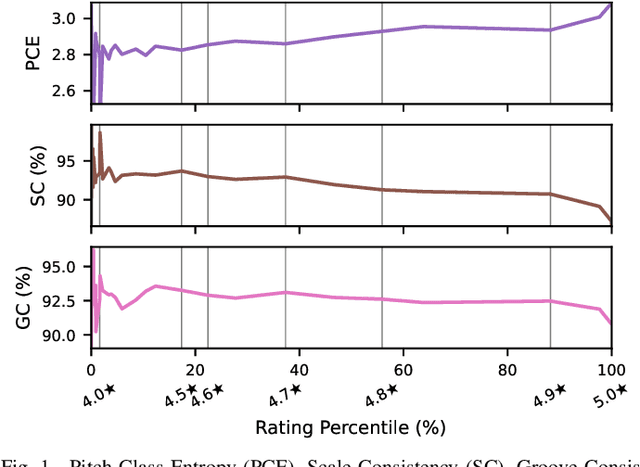
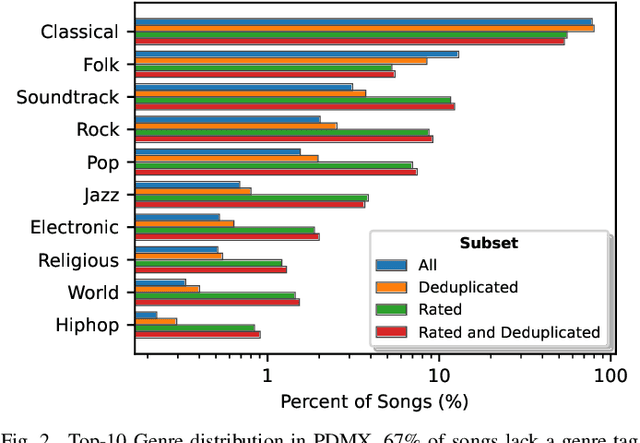
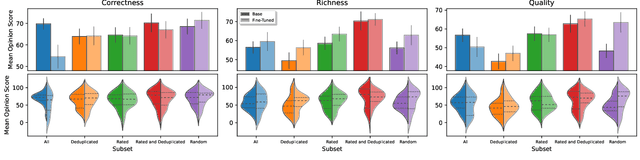
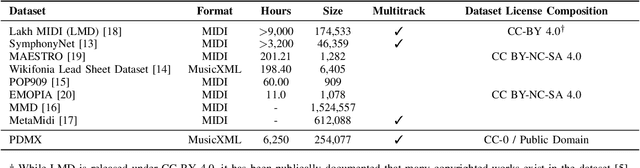
The recent explosion of generative AI-Music systems has raised numerous concerns over data copyright, licensing music from musicians, and the conflict between open-source AI and large prestige companies. Such issues highlight the need for publicly available, copyright-free musical data, in which there is a large shortage, particularly for symbolic music data. To alleviate this issue, we present PDMX: a large-scale open-source dataset of over 250K public domain MusicXML scores collected from the score-sharing forum MuseScore, making it the largest available copyright-free symbolic music dataset to our knowledge. PDMX additionally includes a wealth of both tag and user interaction metadata, allowing us to efficiently analyze the dataset and filter for high quality user-generated scores. Given the additional metadata afforded by our data collection process, we conduct multitrack music generation experiments evaluating how different representative subsets of PDMX lead to different behaviors in downstream models, and how user-rating statistics can be used as an effective measure of data quality. Examples can be found at https://pnlong.github.io/PDMX.demo/.