 Add to Chrome
 Add to Firefox
 Add to Edge
A Job I Like or a Job I Can Get: Designing Job Recommender Systems Using Field Experiments
Mar 23, 2026
Recommendation systems (RSs) are increasingly used to guide job seekers on online platforms, yet the algorithms currently deployed are typically optimized for predictive objectives such as clicks, applications, or hires, rather than job seekers' welfare. We develop a job-search model with an application stage in which the value of a vacancy depends on two dimensions: the utility it delivers to the worker and the probability that an application succeeds. The model implies that welfare-optimal RSs rank vacancies by an expected-surplus index combining both, and shows why rankings based solely on utility, hiring probabilities, or observed application behavior are generically suboptimal, an instance of the inversion problem between behavior and welfare. We test these predictions and quantify their practical importance through two randomized field experiments conducted with the French public employment service. The first experiment, comparing existing algorithms and their combinations, provides behavioral evidence that both dimensions shape application decisions. Guided by the model and these results, the second experiment extends the comparison to an RS designed to approximate the welfare-optimal ranking. The experiments generate exogenous variation in the vacancies shown to job seekers, allowing us to estimate the model, validate its behavioral predictions, and construct a welfare metric. Algorithms informed by the model-implied optimal ranking substantially outperform existing approaches and perform close to the welfare-optimal benchmark. Our results show that embedding predictive tools within a simple job-search framework and combining it with experimental evidence yields recommendation rules with substantial welfare gains in practice.

Causal Generative Neural Networks
Feb 05, 2018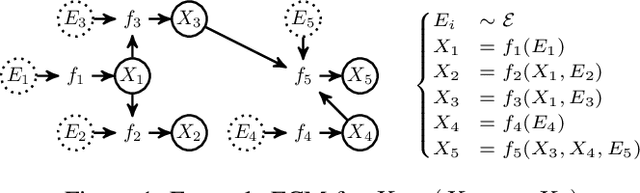
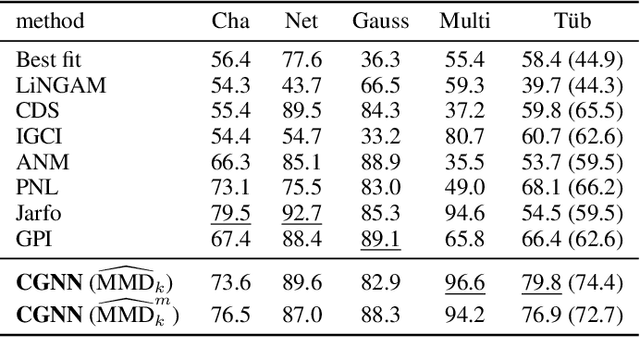
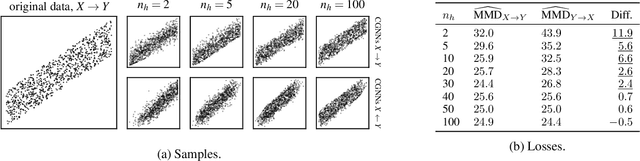
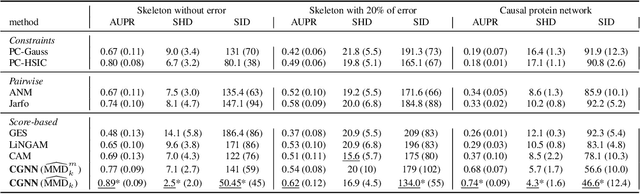
We present Causal Generative Neural Networks (CGNNs) to learn functional causal models from observational data. CGNNs leverage conditional independencies and distributional asymmetries to discover bivariate and multivariate causal structures. CGNNs make no assumption regarding the lack of confounders, and learn a differentiable generative model of the data by using backpropagation. Extensive experiments show their good performances comparatively to the state of the art in observational causal discovery on both simulated and real data, with respect to cause-effect inference, v-structure identification, and multivariate causal discovery.
Learning Functional Causal Models with Generative Neural Networks
Oct 04, 2017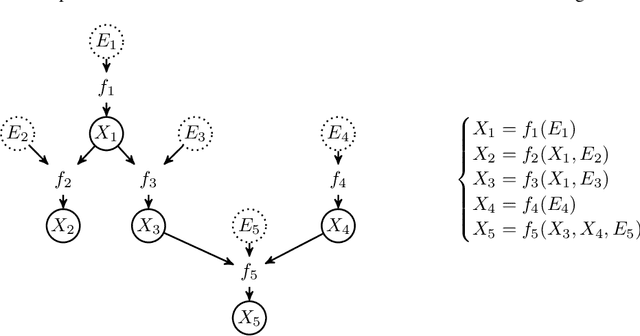
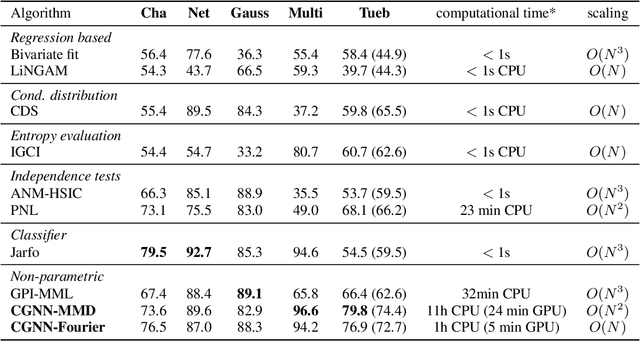
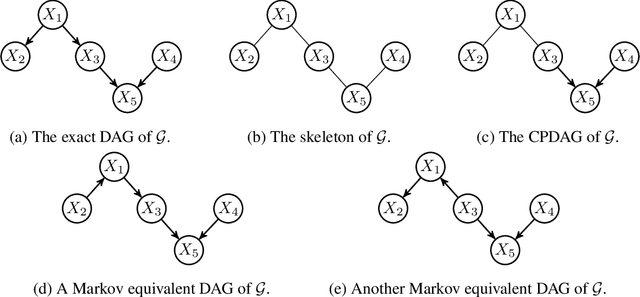
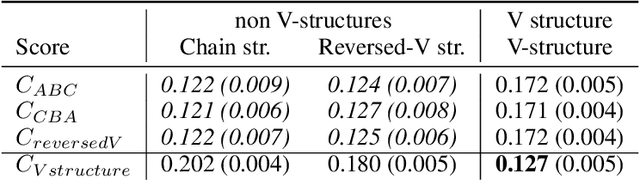
We introduce a new approach to functional causal modeling from observational data. The approach, called Causal Generative Neural Networks (CGNN), leverages the power of neural networks to learn a generative model of the joint distribution of the observed variables, by minimizing the Maximum Mean Discrepancy between generated and observed data. An approximate learning criterion is proposed to scale the computational cost of the approach to linear complexity in the number of observations. The performance of CGNN is studied throughout three experiments. First, we apply CGNN to the problem of cause-effect inference, where two CGNNs model $P(Y|X,\textrm{noise})$ and $P(X|Y,\textrm{noise})$ identify the best causal hypothesis out of $X\rightarrow Y$ and $Y\rightarrow X$. Second, CGNN is applied to the problem of identifying v-structures and conditional independences. Third, we apply CGNN to problem of multivariate functional causal modeling: given a skeleton describing the dependences in a set of random variables $\{X_1, \ldots, X_d\}$, CGNN orients the edges in the skeleton to uncover the directed acyclic causal graph describing the causal structure of the random variables. On all three tasks, CGNN is extensively assessed on both artificial and real-world data, comparing favorably to the state-of-the-art. Finally, we extend CGNN to handle the case of confounders, where latent variables are involved in the overall causal model.