 Add to Chrome
 Add to Firefox
 Add to Edge
GaelEval: Benchmarking LLM Performance for Scottish Gaelic
Apr 02, 2026
Multilingual large language models (LLMs) often exhibit emergent 'shadow' capabilities in languages without official support, yet their performance on these languages remains uneven and under-measured. This is particularly acute for morphosyntactically rich minority languages such as Scottish Gaelic, where translation benchmarks fail to capture structural competence. We introduce GaelEval, the first multi-dimensional benchmark for Gaelic, comprising: (i) an expert-authored morphosyntactic MCQA task; (ii) a culturally grounded translation benchmark and (iii) a large-scale cultural knowledge Q&A task. Evaluating 19 LLMs against a fluent-speaker human baseline ($n=30$), we find that Gemini 3 Pro Preview achieves $83.3\%$ accuracy on the linguistic task, surpassing the human baseline ($78.1\%$). Proprietary models consistently outperform open-weight systems, and in-language (Gaelic) prompting yields a small but stable advantage (+$2.4\%$). On the cultural task, leading models exceed $90\%$ accuracy, though most systems perform worse under Gaelic prompting and absolute scores are inflated relative to the manual benchmark. Overall, GaelEval reveals that frontier models achieve above-human performance on several dimensions of Gaelic grammar, demonstrates the effect of Gaelic prompting and shows a consistent performance gap favouring proprietary over open-weight models.

DLT-Corpus: A Large-Scale Text Collection for the Distributed Ledger Technology Domain
Feb 25, 2026We introduce DLT-Corpus, the largest domain-specific text collection for Distributed Ledger Technology (DLT) research to date: 2.98 billion tokens from 22.12 million documents spanning scientific literature (37,440 publications), United States Patent and Trademark Office (USPTO) patents (49,023 filings), and social media (22 million posts). Existing Natural Language Processing (NLP) resources for DLT focus narrowly on cryptocurrencies price prediction and smart contracts, leaving domain-specific language under explored despite the sector's ~$3 trillion market capitalization and rapid technological evolution. We demonstrate DLT-Corpus' utility by analyzing technology emergence patterns and market-innovation correlations. Findings reveal that technologies originate in scientific literature before reaching patents and social media, following traditional technology transfer patterns. While social media sentiment remains overwhelmingly bullish even during crypto winters, scientific and patent activity grow independently of market fluctuations, tracking overall market expansion in a virtuous cycle where research precedes and enables economic growth that funds further innovation. We publicly release the full DLT-Corpus; LedgerBERT, a domain-adapted model achieving 23% improvement over BERT-base on a DLT-specific Named Entity Recognition (NER) task; and all associated tools and code.
Kakugo: Distillation of Low-Resource Languages into Small Language Models
Jan 20, 2026We present Kakugo, a novel and cost-effective pipeline designed to train general-purpose Small Language Models (SLMs) for low-resource languages using only the language name as input. By using a large teacher model to generate synthetic prompts and translate instruction datasets, we produced training data and SLMs for 54 low-resource languages. Evaluations across a diverse set of general natural language processing tasks, including translation, classification, and question answering, demonstrate that our pipeline consistently improves performance over base models. With a total generation and training cost of under $50 per language, Kakugo offers an accessible method for communities to develop language-specific AI.
M-IFEval: Multilingual Instruction-Following Evaluation
Feb 07, 2025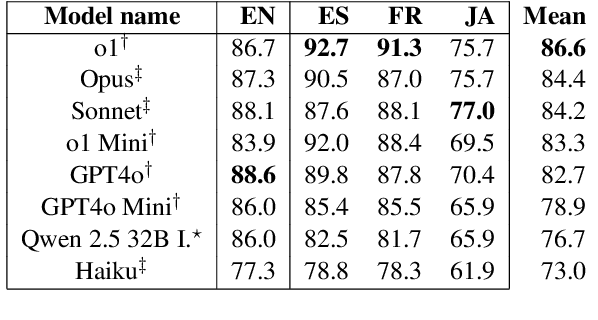
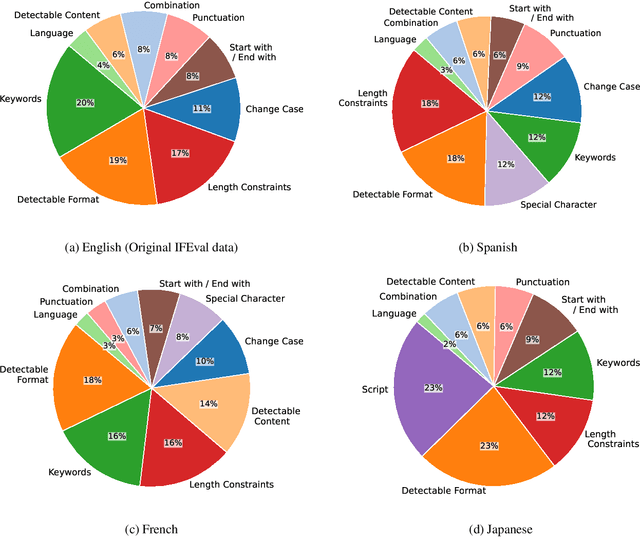
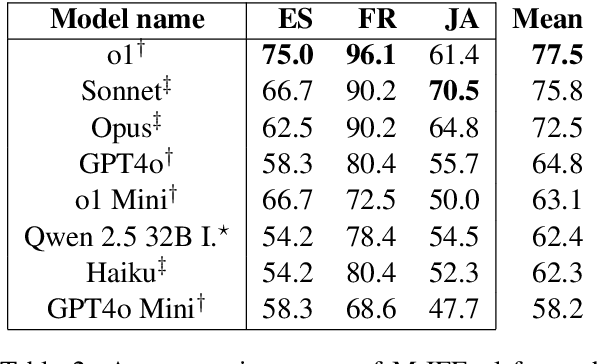
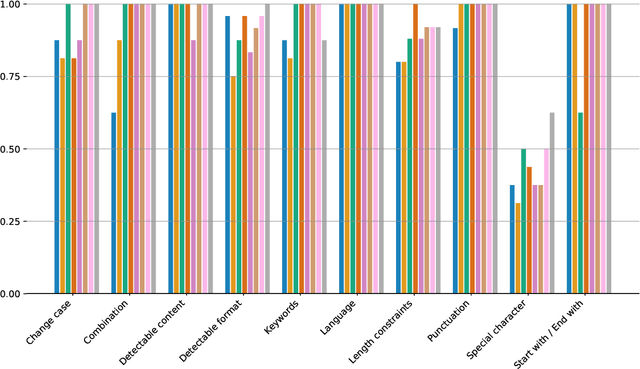
Instruction following is a core capability of modern Large language models (LLMs), making evaluating this capability essential to understanding these models. The Instruction Following Evaluation (IFEval) benchmark from the literature does this using objective criteria, offering a measure of LLM performance without subjective AI or human judgement. However, it only includes English instructions, limiting its ability to assess LLMs in other languages. We propose the Multilingual Instruction Following Evaluation (M-IFEval) benchmark, expanding the evaluation to French, Japanese, and Spanish, with both general and language-specific instructions. Applying this benchmark to 8 state-of-the-art LLMs, we find that benchmark performance across languages and instruction types can vary widely, underscoring the importance of a multilingual benchmark for evaluating LLMs in a diverse cultural context.
ALoFTRAG: Automatic Local Fine Tuning for Retrieval Augmented Generation
Jan 21, 2025Retrieval Augmented Generation (RAG) systems have been shown to improve the accuracy of Large Language Model (LLM) outputs. However, these models can often achieve low accuracy when applied to new data domains. We introduce the Automatic Local Fine Tuning of Retrieval Augmented Generation models (ALoFTRAG) framework, designed to improve the accuracy of RAG systems on a given domain by training LLMs without manually labeled data or using larger teacher models. By generating and filtering synthetic training data and performing LoRA fine-tuning, ALoFTRAG improves citation and answer accuracy across 20 datasets in 26 languages by, on average, 8.3% and 3.0% respectively. Our results demonstrate that ALoFTRAG offers a practical, cost-effective, and data-secure solution for improving RAG accuracy, making it particularly applicable to sensitive domains such as healthcare and finance.
Are You Sure? Rank Them Again: Repeated Ranking For Better Preference Datasets
May 29, 2024Training Large Language Models (LLMs) with Reinforcement Learning from AI Feedback (RLAIF) aligns model outputs more closely with human preferences. This involves an evaluator model ranking multiple candidate responses to user prompts. However, the rankings from popular evaluator models such as GPT-4 can be inconsistent. We propose the Repeat Ranking method - where we evaluate the same responses multiple times and train only on those responses which are consistently ranked. Using 2,714 prompts in 62 languages, we generated responses from 7 top multilingual LLMs and had GPT-4 rank them five times each. Evaluating on MT-Bench chat benchmarks in six languages, our method outperformed the standard practice of training on all available prompts. Our work highlights the quality versus quantity trade-off in RLAIF dataset generation and offers a stackable strategy for enhancing dataset and thus model quality.
Tagengo: A Multilingual Chat Dataset
May 21, 2024Open source large language models (LLMs) have shown great improvements in recent times. However, many of these models are focused solely on popular spoken languages. We present a high quality dataset of more than 70k prompt-response pairs in 74 languages which consist of human generated prompts and synthetic responses. We use this dataset to train a state-of-the-art open source English LLM to chat multilingually. We evaluate our model on MT-Bench chat benchmarks in 6 languages, finding that our multilingual model outperforms previous state-of-the-art open source LLMs across each language. We further find that training on more multilingual data is beneficial to the performance in a chosen target language (Japanese) compared to simply training on only data in that language. These results indicate the necessity of training on large amounts of high quality multilingual data to make a more accessible LLM.