 Add to Chrome
 Add to Firefox
 Add to Edge
SoK: A Systematic Bidirectional Literature Review of AI & DLT Convergence
May 11, 2026
The integration of Artificial Intelligence (AI) with Distributed Ledger Technology (DLT) has become a growing research area, yet contributions tend to cluster around specific application domains or examine only one direction of the integration, leaving the broader architectural interplay between the two technologies poorly understood. This work addresses that gap through a structured, bidirectional review of peer-reviewed studies published between 2020 and 2025. We classify contributions along two directions: AI-enhanced DLT, and DLT-enhanced AI. In the first case, we examine how AI techniques improve DLT systems across five layers: data, network, consensus, execution, and application layers. In the second case, we analyse how DLT supports AI systems across five layers: infrastructure, data, model, inference, and application layers, with particular attention to federated learning, model evaluation, and multi-agent coordination. The analysis reveals that most works concentrate on a small subset of layers: execution and consensus for AI-enhanced DLT, data and model for DLT-enhanced AI. Other layers remain comparatively neglected. Despite reported improvements in controlled settings, no study demonstrates deployment at production scale, and the field has not yet offered satisfying answers to fundamental questions around scalability, interoperability, and verifiable execution. We argue that progress will require cross-layer co-design and empirical validation in real-world settings.

DLT-Corpus: A Large-Scale Text Collection for the Distributed Ledger Technology Domain
Feb 25, 2026We introduce DLT-Corpus, the largest domain-specific text collection for Distributed Ledger Technology (DLT) research to date: 2.98 billion tokens from 22.12 million documents spanning scientific literature (37,440 publications), United States Patent and Trademark Office (USPTO) patents (49,023 filings), and social media (22 million posts). Existing Natural Language Processing (NLP) resources for DLT focus narrowly on cryptocurrencies price prediction and smart contracts, leaving domain-specific language under explored despite the sector's ~$3 trillion market capitalization and rapid technological evolution. We demonstrate DLT-Corpus' utility by analyzing technology emergence patterns and market-innovation correlations. Findings reveal that technologies originate in scientific literature before reaching patents and social media, following traditional technology transfer patterns. While social media sentiment remains overwhelmingly bullish even during crypto winters, scientific and patent activity grow independently of market fluctuations, tracking overall market expansion in a virtuous cycle where research precedes and enables economic growth that funds further innovation. We publicly release the full DLT-Corpus; LedgerBERT, a domain-adapted model achieving 23% improvement over BERT-base on a DLT-specific Named Entity Recognition (NER) task; and all associated tools and code.
Evolution of ESG-focused DLT Research: An NLP Analysis of the Literature
Aug 23, 2023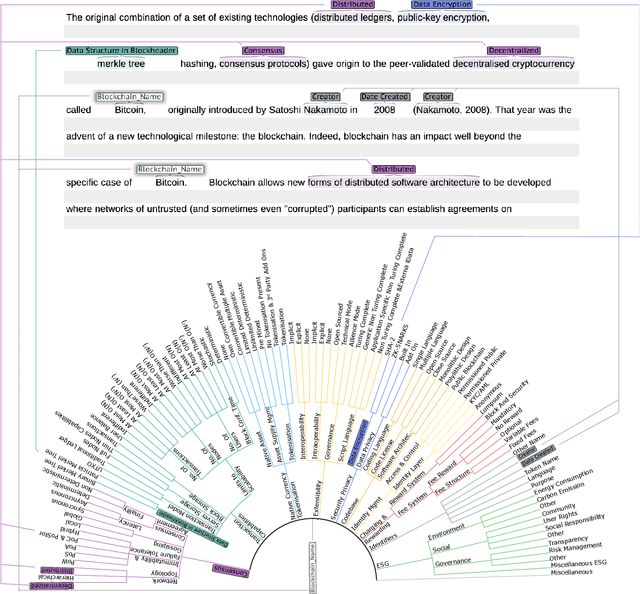
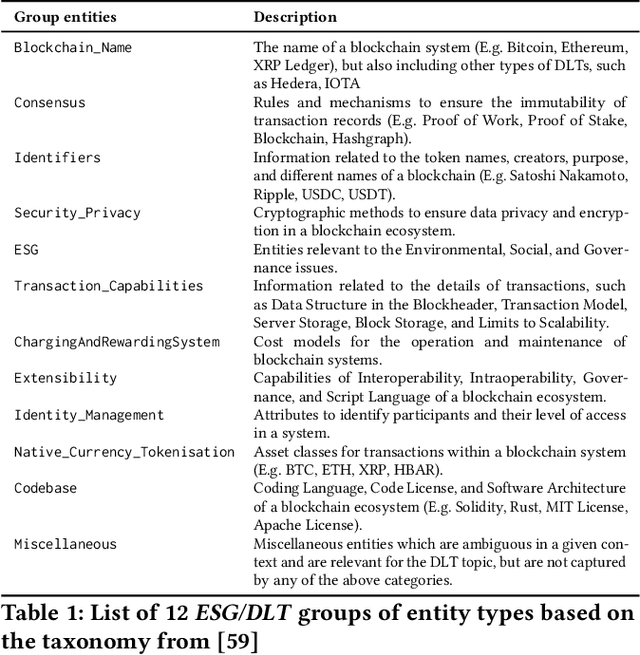

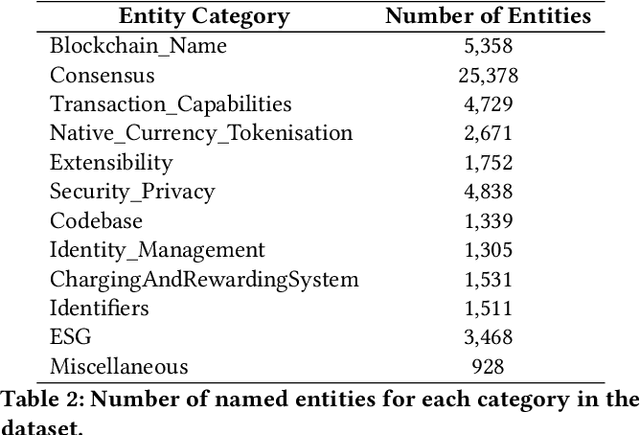
Distributed Ledger Technologies (DLTs) have rapidly evolved, necessitating comprehensive insights into their diverse components. However, a systematic literature review that emphasizes the Environmental, Sustainability, and Governance (ESG) components of DLT remains lacking. To bridge this gap, we selected 107 seed papers to build a citation network of 63,083 references and refined it to a corpus of 24,539 publications for analysis. Then, we labeled the named entities in 46 papers according to twelve top-level categories derived from an established technology taxonomy and enhanced the taxonomy by pinpointing DLT's ESG elements. Leveraging transformer-based language models, we fine-tuned a pre-trained language model for a Named Entity Recognition (NER) task using our labeled dataset. We used our fine-tuned language model to distill the corpus to 505 key papers, facilitating a literature review via named entities and temporal graph analysis on DLT evolution in the context of ESG. Our contributions are a methodology to conduct a machine learning-driven systematic literature review in the DLT field, placing a special emphasis on ESG aspects. Furthermore, we present a first-of-its-kind NER dataset, composed of 54,808 named entities, designed for DLT and ESG-related explorations.