 Add to Chrome
 Add to Firefox
 Add to Edge
Auditing Medical Vision-Language Models on Chest Radiographs: Estimating Reference Agreement Across Institutions
Aug 01, 2026
Vision-language models return structured chest-radiograph findings through interfaces exposing no confidence score, so a receiving institution cannot read off how far to trust an individual judgment. Whether agreement with an institution's reference standard transfers across sites, findings, prediction directions and question formats is largely unmeasured. We evaluated three generative vision-language models on three institutional chest-radiograph corpora and six findings under two elicitation protocols, comprising more than 345,000 finding-level predictions, and estimated finding-by-direction reference agreement at a receiving institution from a small budget of local labels. Estimation strategies were then stress-tested under repeated strict institution-held-out evaluation. Under evaluation excluding the receiving institution from development entirely, adaptive selection among the seven estimators that design admits did not improve on simple fixed alternatives: it achieved a mean Brier score of 0.1083, against 0.0853 for always using a Beta-Binomial empirical-Bayes estimator and 0.0855 for a target-only logistic model. Those two differ by 0.0003, less than this family's own sensitivity to a change of solver version, and each leads in about half the settings, so no default can be recommended. Their advantage over estimators pooling across institutions was concentrated at one site and not confirmatory once clustered by institution, and a plug-in empirical-Bayes posterior-predictive count interval at a nominal 95% level covered 87.0%, less at the hardest institution. Reference agreement therefore has to be re-evaluated per site and per interface; these results concern agreement with institutional labels, not clinical correctness.

SOTFormer: A Minimal Transformer for Unified Object Tracking and Trajectory Prediction
Nov 14, 2025Accurate single-object tracking and short-term motion forecasting remain challenging under occlusion, scale variation, and temporal drift, which disrupt the temporal coherence required for real-time perception. We introduce \textbf{SOTFormer}, a minimal constant-memory temporal transformer that unifies object detection, tracking, and short-horizon trajectory prediction within a single end-to-end framework. Unlike prior models with recurrent or stacked temporal encoders, SOTFormer achieves stable identity propagation through a ground-truth-primed memory and a burn-in anchor loss that explicitly stabilizes initialization. A single lightweight temporal-attention layer refines embeddings across frames, enabling real-time inference with fixed GPU memory. On the Mini-LaSOT (20%) benchmark, SOTFormer attains 76.3 AUC and 53.7 FPS (AMP, 4.3 GB VRAM), outperforming transformer baselines such as TrackFormer and MOTRv2 under fast motion, scale change, and occlusion.
Multiplex Heterogeneous Graph Convolutional Network
Aug 12, 2022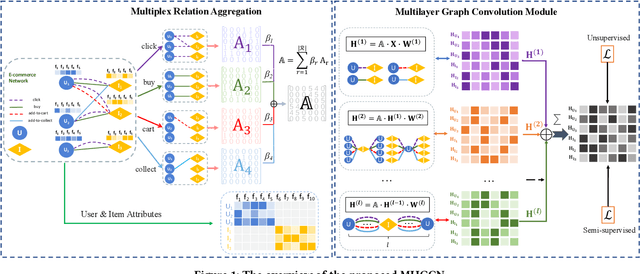
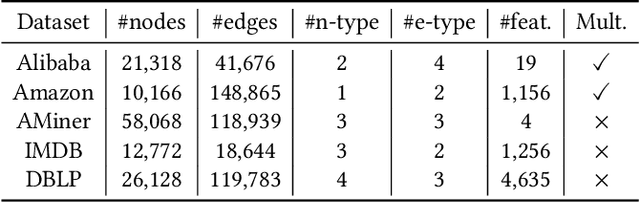
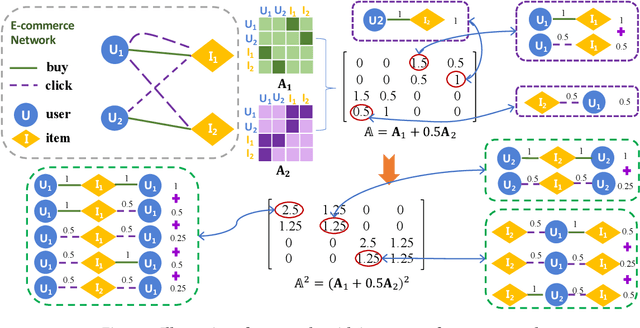
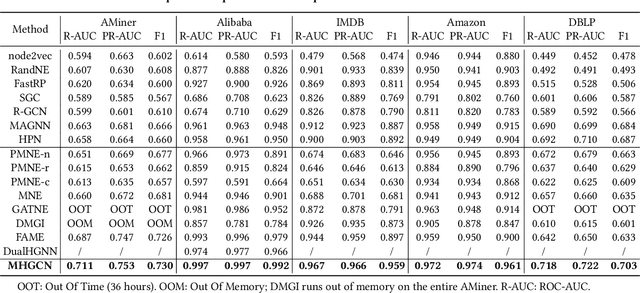
Heterogeneous graph convolutional networks have gained great popularity in tackling various network analytical tasks on heterogeneous network data, ranging from link prediction to node classification. However, most existing works ignore the relation heterogeneity with multiplex network between multi-typed nodes and different importance of relations in meta-paths for node embedding, which can hardly capture the heterogeneous structure signals across different relations. To tackle this challenge, this work proposes a Multiplex Heterogeneous Graph Convolutional Network (MHGCN) for heterogeneous network embedding. Our MHGCN can automatically learn the useful heterogeneous meta-path interactions of different lengths in multiplex heterogeneous networks through multi-layer convolution aggregation. Additionally, we effectively integrate both multi-relation structural signals and attribute semantics into the learned node embeddings with both unsupervised and semi-supervised learning paradigms. Extensive experiments on five real-world datasets with various network analytical tasks demonstrate the significant superiority of MHGCN against state-of-the-art embedding baselines in terms of all evaluation metrics.