 Add to Chrome
 Add to Firefox
 Add to Edge
VADER: Adaptive Debiasing for Hallucination Mitigation in Video Large Language Models
Aug 09, 2026
Large vision-language models (LVLMs) have demonstrated strong performance in open-ended video understanding, yet they remain prone to fluent responses unsupported by video evidence. Existing training-free methods typically apply a globally fixed visual intervention or construct a contrastive branch through input perturbation. The former cannot accommodate video-dependent fusion paths, while the latter can be compensated by cross-frame redundancy. We therefore propose Video-Adaptive Debiasing via Evidence Reweighting (VADER), a training-free framework with two complementary modules. Visual Focus Reallocation (VFR) automatically instantiates an intervention policy for each video-question input: it diagnoses layer-wise visual-to-text evidence flow, determines where to intervene, and derives how strongly to reallocate pre-softmax attention from system-token to video-token blocks. Selective Evidence Erasure (SEE) independently masks high-importance visual tokens in every frame, constructing a prior-biased branch that is difficult to compensate through neighboring frames. Contrastive decoding then down-weights predictions that remain confident after selective evidence erasure. Across multiple VideoLLMs, VADER yields substantial improvements on event-level grounding and temporal consistency; on LLaVA-Video-7B, it reaches 72.60% accuracy on EventHallusion.

Updatable Siamese Tracker with Two-stage One-shot Learning
Apr 30, 2021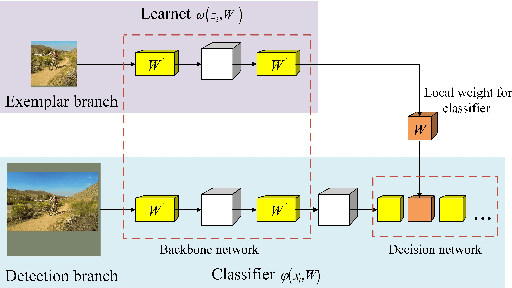

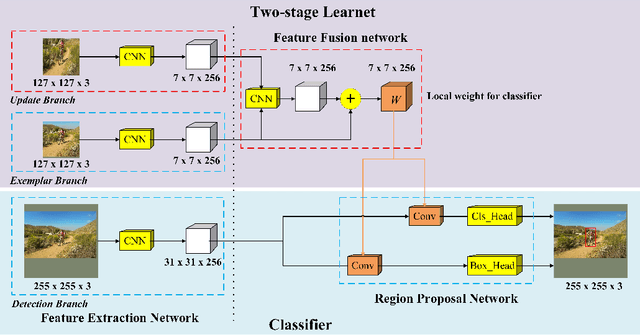

Offline Siamese networks have achieved very promising tracking performance, especially in accuracy and efficiency. However, they often fail to track an object in complex scenes due to the incapacity in online update. Traditional updaters are difficult to process the irregular variations and sampling noises of objects, so it is quite risky to adopt them to update Siamese networks. In this paper, we first present a two-stage one-shot learner, which can predict the local parameters of primary classifier with object samples from diverse stages. Then, an updatable Siamese network is proposed based on the learner (SiamTOL), which is able to complement online update by itself. Concretely, we introduce an extra inputting branch to sequentially capture the latest object features, and design a residual module to update the initial exemplar using these features. Besides, an effective multi-aspect training loss is designed for our network to avoid overfit. Extensive experimental results on several popular benchmarks including OTB100, VOT2018, VOT2019, LaSOT, UAV123 and GOT10k manifest that the proposed tracker achieves the leading performance and outperforms other state-of-the-art methods