 Add to Chrome
 Add to Firefox
 Add to Edge
Neural Electromagnetic Fields for High-Resolution Material Parameter Reconstruction
Mar 03, 2026
Creating functional Digital Twins, simulatable 3D replicas of the real world, is a central challenge in computer vision. Current methods like NeRF produce visually rich but functionally incomplete twins. The key barrier is the lack of underlying material properties (e.g., permittivity, conductivity). Acquiring this information for every point in a scene via non-contact, non-invasive sensing is a primary goal, but it demands solving a notoriously ill-posed physical inversion problem. Standard remote signals, like images and radio frequencies (RF), deeply entangle the unknown geometry, ambient field, and target materials. We introduce NEMF, a novel framework for dense, non-invasive physical inversion designed to build functional digital twins. Our key insight is a systematic disentanglement strategy. NEMF leverages high-fidelity geometry from images as a powerful anchor, which first enables the resolution of the ambient field. By constraining both geometry and field using only non-invasive data, the original ill-posed problem transforms into a well-posed, physics-supervised learning task. This transformation unlocks our core inversion module: a decoder. Guided by ambient RF signals and a differentiable layer incorporating physical reflection models, it learns to explicitly output a continuous, spatially-varying field of the scene's underlying material parameters. We validate our framework on high-fidelity synthetic datasets. Experiments show our non-invasive inversion reconstructs these material maps with high accuracy, and the resulting functional twin enables high-fidelity physical simulation. This advance moves beyond passive visual replicas, enabling the creation of truly functional and simulatable models of the physical world.

RadioDiff-Flux: Efficient Radio Map Construction via Generative Denoise Diffusion Model Trajectory Midpoint Reuse
Jan 06, 2026Accurate radio map (RM) construction is essential to enabling environment-aware and adaptive wireless communication. However, in future 6G scenarios characterized by high-speed network entities and fast-changing environments, it is very challenging to meet real-time requirements. Although generative diffusion models (DMs) can achieve state-of-the-art accuracy with second-level delay, their iterative nature leads to prohibitive inference latency in delay-sensitive scenarios. In this paper, by uncovering a key structural property of diffusion processes: the latent midpoints remain highly consistent across semantically similar scenes, we propose RadioDiff-Flux, a novel two-stage latent diffusion framework that decouples static environmental modeling from dynamic refinement, enabling the reuse of precomputed midpoints to bypass redundant denoising. In particular, the first stage generates a coarse latent representation using only static scene features, which can be cached and shared across similar scenarios. The second stage adapts this representation to dynamic conditions and transmitter locations using a pre-trained model, thereby avoiding repeated early-stage computation. The proposed RadioDiff-Flux significantly reduces inference time while preserving fidelity. Experiment results show that RadioDiff-Flux can achieve up to 50 acceleration with less than 0.15% accuracy loss, demonstrating its practical utility for fast, scalable RM generation in future 6G networks.
Erasing Noise in Signal Detection with Diffusion Model: From Theory to Application
Jan 13, 2025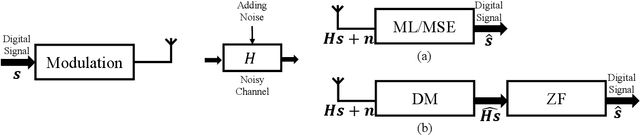
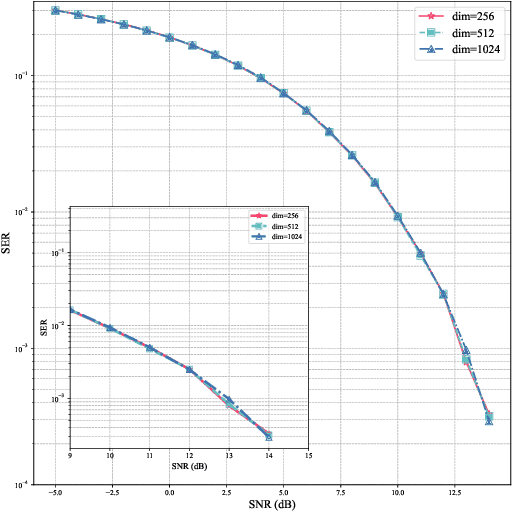
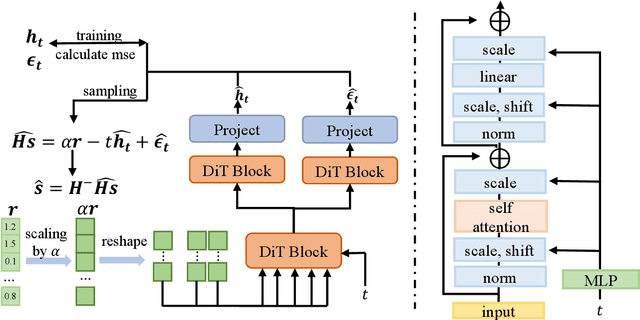
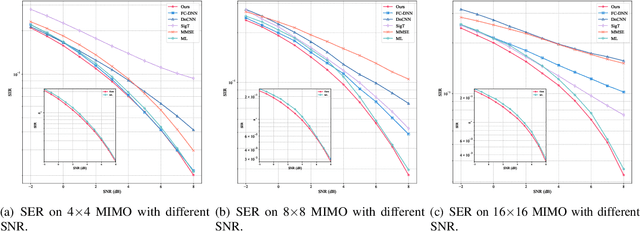
In this paper, a signal detection method based on the denoise diffusion model (DM) is proposed, which outperforms the maximum likelihood (ML) estimation method that has long been regarded as the optimal signal detection technique. Theoretically, a novel mathematical theory for intelligent signal detection based on stochastic differential equations (SDEs) is established in this paper, demonstrating the effectiveness of DM in reducing the additive white Gaussian noise in received signals. Moreover, a mathematical relationship between the signal-to-noise ratio (SNR) and the timestep in DM is established, revealing that for any given SNR, a corresponding optimal timestep can be identified. Furthermore, to address potential issues with out-of-distribution inputs in the DM, we employ a mathematical scaling technique that allows the trained DM to handle signal detection across a wide range of SNRs without any fine-tuning. Building on the above theoretical foundation, we propose a DM-based signal detection method, with the diffusion transformer (DiT) serving as the backbone neural network, whose computational complexity of this method is $\mathcal{O}(n^2)$. Simulation results demonstrate that, for BPSK and QAM modulation schemes, the DM-based method achieves a significantly lower symbol error rate (SER) compared to ML estimation, while maintaining a much lower computational complexity.