 Add to Chrome
 Add to Firefox
 Add to Edge
Explainability of Complex AI Models with Correlation Impact Ratio
Jan 10, 2026
Complex AI systems make better predictions but often lack transparency, limiting trustworthiness, interpretability, and safe deployment. Common post hoc AI explainers, such as LIME, SHAP, HSIC, and SAGE, are model agnostic but are too restricted in one significant regard: they tend to misrank correlated features and require costly perturbations, which do not scale to high dimensional data. We introduce ExCIR (Explainability through Correlation Impact Ratio), a theoretically grounded, simple, and reliable metric for explaining the contribution of input features to model outputs, which remains stable and consistent under noise and sampling variations. We demonstrate that ExCIR captures dependencies arising from correlated features through a lightweight single pass formulation. Experimental evaluations on diverse datasets, including EEG, synthetic vehicular data, Digits, and Cats-Dogs, validate the effectiveness and stability of ExCIR across domains, achieving more interpretable feature explanations than existing methods while remaining computationally efficient. To this end, we further extend ExCIR with an information theoretic foundation that unifies the correlation ratio with Canonical Correlation Analysis under mutual information bounds, enabling multi output and class conditioned explainability at scale.

Identification of fixations and saccades in eye-tracking data using adaptive threshold-based method
Dec 30, 2025Properties of ocular fixations and saccades are highly stochastic during many experimental tasks, and their statistics are often used as proxies for various aspects of cognition. Although distinguishing saccades from fixations is not trivial, experimentalists generally use common ad-hoc thresholds in detection algorithms. This neglects inter-task and inter-individual variability in oculomotor dynamics, and potentially biases the resulting statistics. In this article, we introduce and evaluate an adaptive method based on a Markovian approximation of eye-gaze dynamics, using saccades and fixations as states such that the optimal threshold minimizes state transitions. Applying this to three common threshold-based algorithms (velocity, angular velocity, and dispersion), we evaluate the overall accuracy against a multi-threshold benchmark as well as robustness to noise. We find that a velocity threshold achieves the highest baseline accuracy (90-93\%) across both free-viewing and visual search tasks. However, velocity-based methods degrade rapidly under noise when thresholds remain fixed, with accuracy falling below 20% at high noise levels. Adaptive threshold optimization via K-ratio minimization substantially improves performance under noisy conditions for all algorithms. Adaptive dispersion thresholds demonstrate superior noise robustness, maintaining accuracy above 81% even at extreme noise levels (σ = 50 px), though a precision-recall trade-off emerges that favors fixation detection at the expense of saccade identification. In addition to demonstrating our parsimonious adaptive thresholding method, these findings provide practical guidance for selecting and tuning classification algorithms based on data quality and analytical priorities.
How quantum and evolutionary algorithms can help each other: two examples
Aug 01, 2024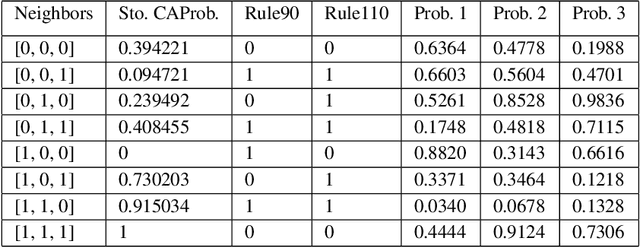
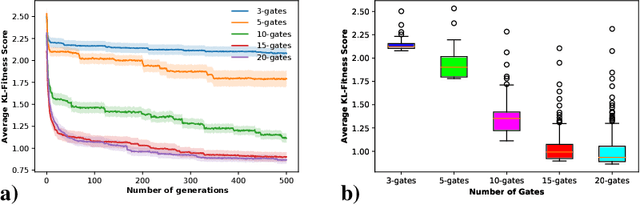
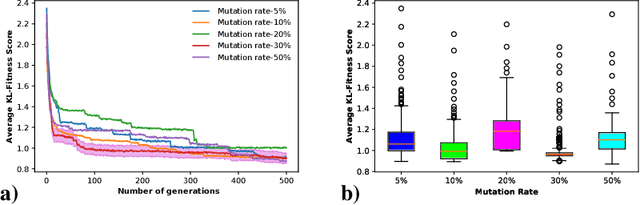
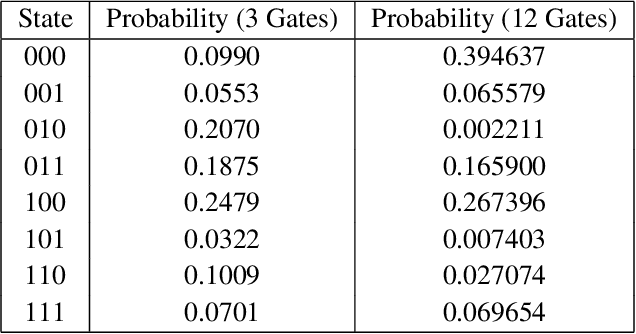
We investigate the potential of bio-inspired evolutionary algorithms for designing quantum circuits with specific goals, focusing on two particular tasks. The first one is motivated by the ideas of Artificial Life that are used to reproduce stochastic cellular automata with given rules. We test the robustness of quantum implementations of the cellular automata for different numbers of quantum gates The second task deals with the sampling of quantum circuits that generate highly entangled quantum states, which constitute an important resource for quantum computing. In particular, an evolutionary algorithm is employed to optimize circuits with respect to a fitness function defined with the Mayer-Wallach entanglement measure. We demonstrate that, by balancing the mutation rate between exploration and exploitation, we can find entangling quantum circuits for up to five qubits. We also discuss the trade-off between the number of gates in quantum circuits and the computational costs of finding the gate arrangements leading to a strongly entangled state. Our findings provide additional insight into the trade-off between the complexity of a circuit and its performance, which is an important factor in the design of quantum circuits.