 Add to Chrome
 Add to Firefox
 Add to Edge
PARWiS: Winner determination under shoestring budgets using active pairwise comparisons
Mar 01, 2026
Determining a winner among a set of items using active pairwise comparisons under a limited budget is a challenging problem in preference-based learning. The goal of this study is to implement and evaluate the PARWiS algorithm, which shows spectral ranking and disruptive pair selection to identify the best item under shoestring budgets. This work have extended the PARWiS with a contextual variant (Contextual PARWiS) and a reinforcement learning-based variant (RL PARWiS), comparing them against baselines, including Double Thompson Sampling and a random selection strategy. This evaluation spans synthetic and real-world datasets (Jester and MovieLens), using budgets of 40, 60, and 80 comparisons for 20 items. The performance is measured through recovery fraction, true rank of reported winner, reported rank of true winner, and cumulative regret, alongside the separation metric \(Δ_{1,2}\). Results show that PARWiS and RL PARWiS outperform baselines across all datasets, particularly in the Jester dataset with a higher \(Δ_{1,2}\), while performance gaps narrow in the more challenging MovieLens dataset with a smaller \(Δ_{1,2}\). Contextual PARWiS shows comparable performance to PARWiS, indicating that contextual features may require further tuning to provide significant benefits.

Identification of fixations and saccades in eye-tracking data using adaptive threshold-based method
Dec 30, 2025Properties of ocular fixations and saccades are highly stochastic during many experimental tasks, and their statistics are often used as proxies for various aspects of cognition. Although distinguishing saccades from fixations is not trivial, experimentalists generally use common ad-hoc thresholds in detection algorithms. This neglects inter-task and inter-individual variability in oculomotor dynamics, and potentially biases the resulting statistics. In this article, we introduce and evaluate an adaptive method based on a Markovian approximation of eye-gaze dynamics, using saccades and fixations as states such that the optimal threshold minimizes state transitions. Applying this to three common threshold-based algorithms (velocity, angular velocity, and dispersion), we evaluate the overall accuracy against a multi-threshold benchmark as well as robustness to noise. We find that a velocity threshold achieves the highest baseline accuracy (90-93\%) across both free-viewing and visual search tasks. However, velocity-based methods degrade rapidly under noise when thresholds remain fixed, with accuracy falling below 20% at high noise levels. Adaptive threshold optimization via K-ratio minimization substantially improves performance under noisy conditions for all algorithms. Adaptive dispersion thresholds demonstrate superior noise robustness, maintaining accuracy above 81% even at extreme noise levels (σ = 50 px), though a precision-recall trade-off emerges that favors fixation detection at the expense of saccade identification. In addition to demonstrating our parsimonious adaptive thresholding method, these findings provide practical guidance for selecting and tuning classification algorithms based on data quality and analytical priorities.
Modeling Eye Gaze Velocity Trajectories using GANs with Spectral Loss for Enhanced Fidelity
Dec 05, 2024Accurate modeling of eye gaze dynamics is essential for advancement in human-computer interaction, neurological diagnostics, and cognitive research. Traditional generative models like Markov models often fail to capture the complex temporal dependencies and distributional nuance inherent in eye gaze trajectories data. This study introduces a GAN framework employing LSTM and CNN generators and discriminators to generate high-fidelity synthetic eye gaze velocity trajectories. We conducted a comprehensive evaluation of four GAN architectures: CNN-CNN, LSTM-CNN, CNN-LSTM, and LSTM-LSTM trained under two conditions: using only adversarial loss and using a weighted combination of adversarial and spectral losses. Our findings reveal that the LSTM-CNN architecture trained with this new loss function exhibits the closest alignment to the real data distribution, effectively capturing both the distribution tails and the intricate temporal dependencies. The inclusion of spectral regularization significantly enhances the GANs ability to replicate the spectral characteristics of eye gaze movements, leading to a more stable learning process and improved data fidelity. Comparative analysis with an HMM optimized to four hidden states further highlights the advantages of the LSTM-CNN GAN. Statistical metrics show that the HMM-generated data significantly diverges from the real data in terms of mean, standard deviation, skewness, and kurtosis. In contrast, the LSTM-CNN model closely matches the real data across these statistics, affirming its capacity to model the complexity of eye gaze dynamics effectively. These results position the spectrally regularized LSTM-CNN GAN as a robust tool for generating synthetic eye gaze velocity data with high fidelity.
How quantum and evolutionary algorithms can help each other: two examples
Aug 01, 2024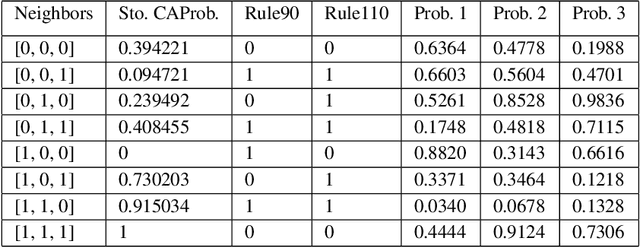
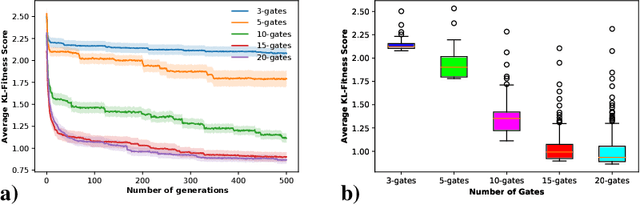
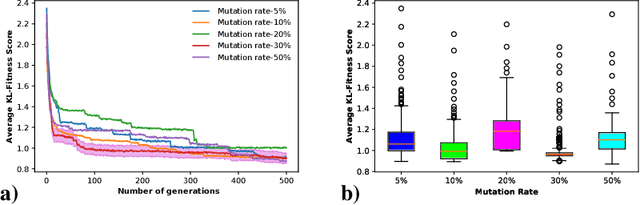
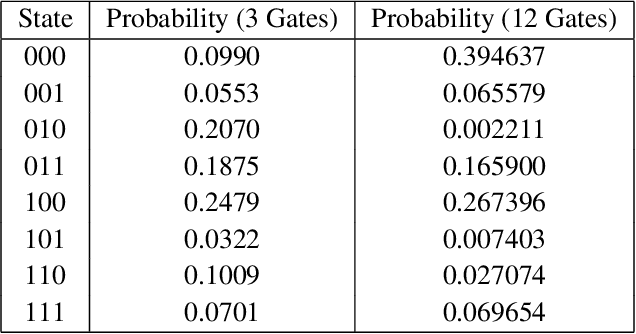
We investigate the potential of bio-inspired evolutionary algorithms for designing quantum circuits with specific goals, focusing on two particular tasks. The first one is motivated by the ideas of Artificial Life that are used to reproduce stochastic cellular automata with given rules. We test the robustness of quantum implementations of the cellular automata for different numbers of quantum gates The second task deals with the sampling of quantum circuits that generate highly entangled quantum states, which constitute an important resource for quantum computing. In particular, an evolutionary algorithm is employed to optimize circuits with respect to a fitness function defined with the Mayer-Wallach entanglement measure. We demonstrate that, by balancing the mutation rate between exploration and exploitation, we can find entangling quantum circuits for up to five qubits. We also discuss the trade-off between the number of gates in quantum circuits and the computational costs of finding the gate arrangements leading to a strongly entangled state. Our findings provide additional insight into the trade-off between the complexity of a circuit and its performance, which is an important factor in the design of quantum circuits.
Modeling stochastic eye tracking data: A comparison of quantum generative adversarial networks and Markov models
Aug 01, 2024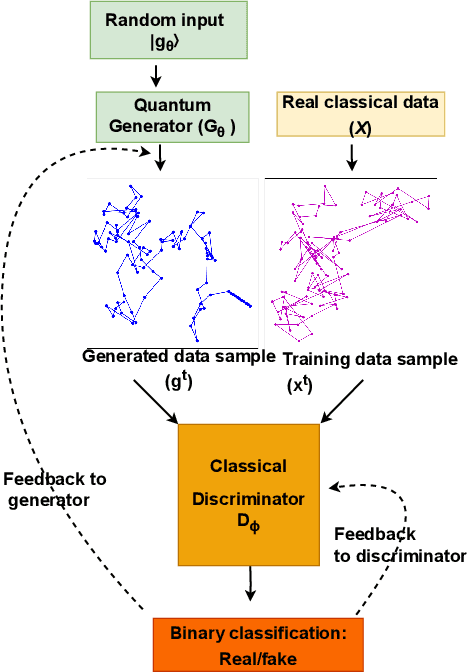
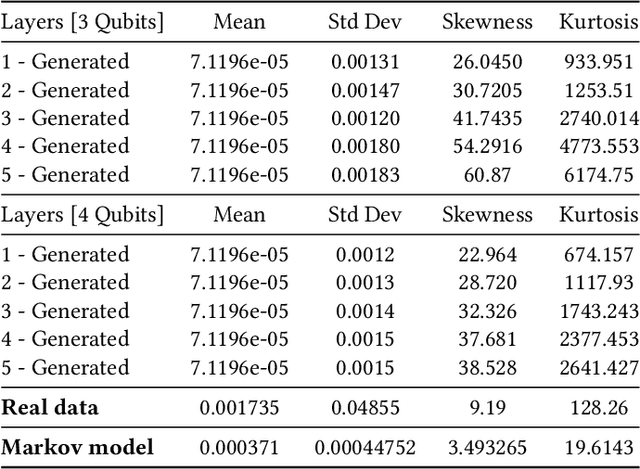
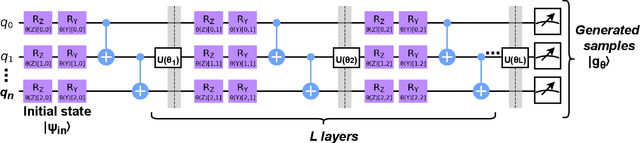
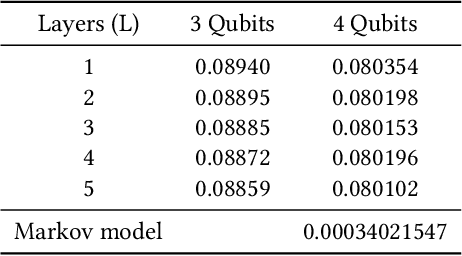
We explore the use of quantum generative adversarial networks QGANs for modeling eye movement velocity data. We assess whether the advanced computational capabilities of QGANs can enhance the modeling of complex stochastic distribution beyond the traditional mathematical models, particularly the Markov model. The findings indicate that while QGANs demonstrate potential in approximating complex distributions, the Markov model consistently outperforms in accurately replicating the real data distribution. This comparison underlines the challenges and avenues for refinement in time series data generation using quantum computing techniques. It emphasizes the need for further optimization of quantum models to better align with real-world data characteristics.