 Add to Chrome
 Add to Firefox
 Add to Edge
GraphLoom: Reliability-Calibrated Graph Evidence Routing for Multimodal KG-RAG
Aug 15, 2026
Multimodal retrieval-augmented generation (RAG) systems often rely on long unstructured contexts or aggressively expanded evidence graphs, which can introduce noisy evidence, weaken multi-hop reasoning, and increase unsupported generation. We present GraphLoom, a reliability-calibrated multimodal knowledge-graph RAG framework for compact and faithful evidence routing. Given a question and its associated multimodal input, GraphLoom constructs an instance-level multimodal knowledge graph from grounded scene descriptions, extracted relational triples, and external commonsense knowledge. Instead of injecting all retrieved evidence into the generator, GraphLoom performs reliability-aware subgraph retrieval with bounded expansion and selectively routes high-utility evidence through hierarchical graph memory slots and joint graph-sequence attention in a frozen language model. To improve robustness in complex reasoning settings, GraphLoom further combines interleaved retrieval with budgeted corrective retrieval, enabling adaptive multi-hop evidence refinement under noisy retrieval conditions. We evaluate GraphLoom on ScienceQA, MultiModalQA, and OK-VQA, including large distractor evidence pools that approximate noisy external knowledge retrieval. Experimental results show consistent gains in answer quality and evidence faithfulness over strong multimodal RAG, graph-retrieval, and open-source vision-language baselines, with improved retrieval quality on MultiModalQA and stable performance under noisy evidence pools. Additional analyses using MiniCheck-based verification, human evaluation, and latency profiling show that reliability-calibrated graph evidence routing provides an effective alternative to long-context multimodal evidence injection.

RELINE: Point-of-Interest Recommendations using Multiple Network Embeddings
Feb 02, 2019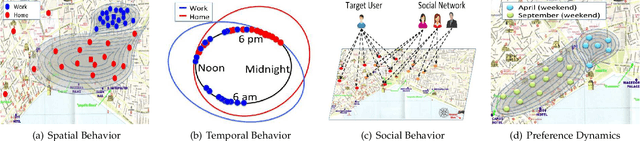
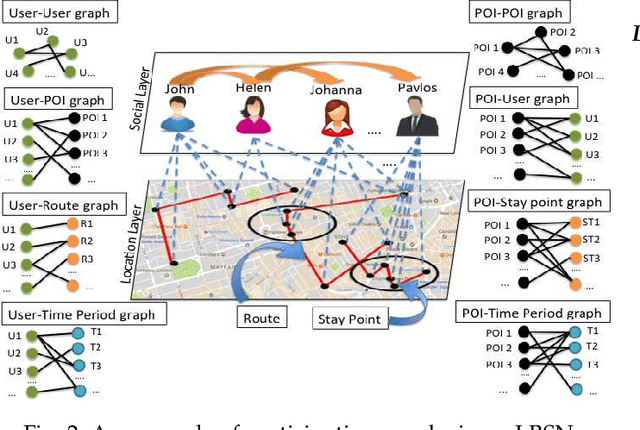
The rapid growth of users' involvement in Location-Based Social Networks (LBSNs) has led to the expeditious growth of the data on a global scale. The need of accessing and retrieving relevant information close to users' preferences is an open problem which continuously raises new challenges for recommendation systems. The exploitation of Points-of-Interest (POIs) recommendation by existing models is inadequate due to the sparsity and the cold start problems. To overcome these problems many models were proposed in the literature, but most of them ignore important factors such as: geographical proximity, social influence, or temporal and preference dynamics, which tackle their accuracy while personalize their recommendations. In this work, we investigate these problems and present a unified model that jointly learns users and POI dynamics. Our proposal is termed RELINE (REcommendations with muLtIple Network Embeddings). More specifically, RELINE captures: i) the social, ii) the geographical, iii) the temporal influence, and iv) the users' preference dynamics, by embedding eight relational graphs into one shared latent space. We have evaluated our approach against state-of-the-art methods with three large real-world datasets in terms of accuracy. Additionally, we have examined the effectiveness of our approach against the cold-start problem. Performance evaluation results demonstrate that significant performance improvement is achieved in comparison to existing state-of-the-art methods.