 Add to Chrome
 Add to Firefox
 Add to Edge
Multispectral airborne laser scanning dataset for tree species classification: MS-ALS-SPECIES
Apr 27, 2026
The shift from stand-level to individual-tree-level forest assessments supports improved biodiversity mapping, particularly in boreal ecosystems where tree species like aspen (Populus tremula L.) play a keystone role. While airborne laser scanning (ALS) is the standard for such inventories, a major limitation is the small number of publicly available ALS datasets containing high-quality, field-validated reference data. Furthermore, open multispectral ALS datasets with high-quality field reference data are completely lacking despite the potential of multispectral ALS data for tree species classification. This paper presents and details an open multispectral ALS dataset used in a recent international benchmarking study of machine learning and deep learning methods for tree species classification by Taher et al. (2026). The dataset comprises 6326 segment-level point clouds of individual trees representing nine species in Southern Finland. The point cloud data has been acquired using two multispectral laser scanning systems each operating at three laser wavelengths: a helicopter-borne system (HeliALS) with a point density exceeding 1000 points/m$^2$ and an Optech Titan system with approximately 35 points/m$^2$. We provide a detailed description of field data collection techniques developed in the study to facilitate the collection of high-quality ground truth data in an efficient and scalable manner. Additionally, our article presents new analyses on species classification using multispectral data building upon the initial findings of Taher et al. (2026). Furthermore, we study the relation between classification accuracy and tree height to highlight the versatility of the open dataset and to demonstrate the advantage of the point transformer model for small trees and minority species.

Multispectral airborne laser scanning for tree species classification: a benchmark of machine learning and deep learning algorithms
Apr 19, 2025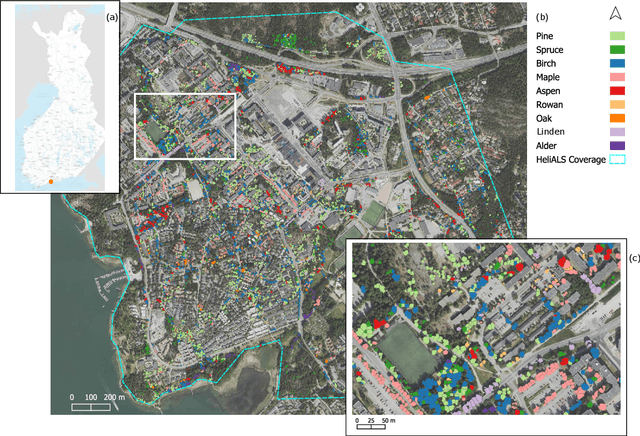
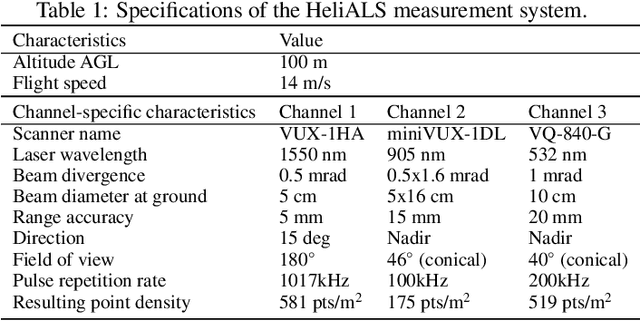
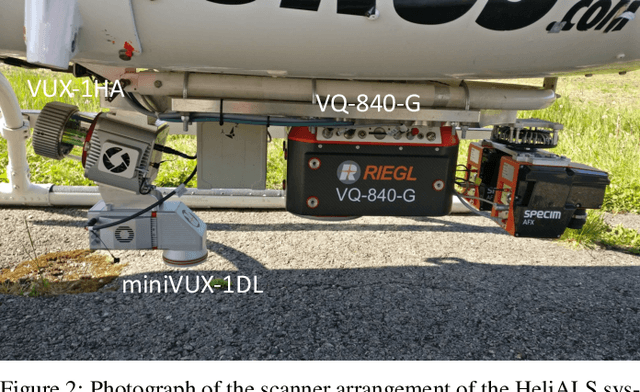
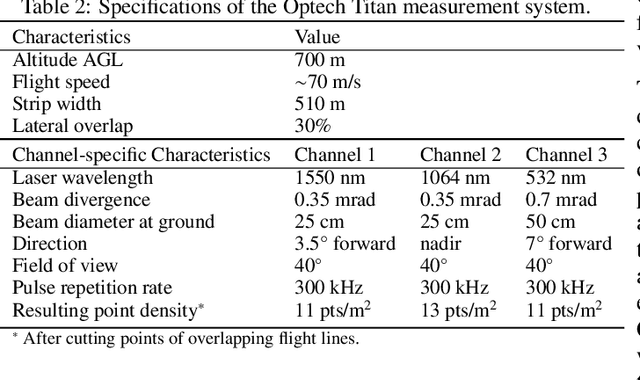
Climate-smart and biodiversity-preserving forestry demands precise information on forest resources, extending to the individual tree level. Multispectral airborne laser scanning (ALS) has shown promise in automated point cloud processing and tree segmentation, but challenges remain in identifying rare tree species and leveraging deep learning techniques. This study addresses these gaps by conducting a comprehensive benchmark of machine learning and deep learning methods for tree species classification. For the study, we collected high-density multispectral ALS data (>1000 pts/m$^2$) at three wavelengths using the FGI-developed HeliALS system, complemented by existing Optech Titan data (35 pts/m$^2$), to evaluate the species classification accuracy of various algorithms in a test site located in Southern Finland. Based on 5261 test segments, our findings demonstrate that point-based deep learning methods, particularly a point transformer model, outperformed traditional machine learning and image-based deep learning approaches on high-density multispectral point clouds. For the high-density ALS dataset, a point transformer model provided the best performance reaching an overall (macro-average) accuracy of 87.9% (74.5%) with a training set of 1065 segments and 92.0% (85.1%) with 5000 training segments. The best image-based deep learning method, DetailView, reached an overall (macro-average) accuracy of 84.3% (63.9%), whereas a random forest (RF) classifier achieved an overall (macro-average) accuracy of 83.2% (61.3%). Importantly, the overall classification accuracy of the point transformer model on the HeliALS data increased from 73.0% with no spectral information to 84.7% with single-channel reflectance, and to 87.9% with spectral information of all the three channels.